
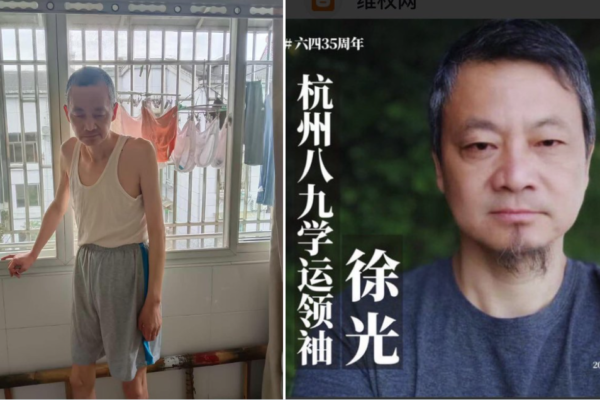
On May 19th, Xu Guang, a prominent leader of the 1989 pro-democracy movement and member of the Zhejiang Hangzhou Democratic Party, was released from prison after serving a four-year sentence. Xu had been on a hunger strike during his incarceration as a form of protest for four years and was carried out on a stretcher upon his release. His first public statement after being released emphasized the importance of not forgetting the events of June 4th.
Born on September 11, 1968, in Fuyang City, Zhejiang Province, Xu Guang graduated from the Department of Biology at Hangzhou University in 1990. During his university years, he actively participated in the student democratic movements of 1986 and 1989, becoming a leader of the Hangzhou University student movement and a core member of the Zhejiang Committee of the Chinese Democratic Party.
In June 1998, while working at the local Environmental Monitoring Station in his hometown of Fuyang City, Xu Guang founded the “Zhejiang Fuyang City Preparatory Committee of the Chinese Democratic Party”, the first county-level organization of the party. He authored articles such as “The Inexhaustible Chinese Democratic Party” and drafted the “Public Declaration of the Establishment of the Fuyang City Preparatory Committee of the Chinese Democratic Party”. Xu was arrested on September 15th and sentenced to five years in prison on November 9th on charges of “subverting state power”.
After his release, Xu continued to speak out against social injustices. In April 2014, he was detained by the Zhejiang authorities for engaging in online discussions related to the Chinese Democratic Party, charged with “subverting state power”, formally arrested on May 9th, and released on July 31st without ever being allowed to meet with his lawyer.
Prior to the 33rd anniversary of the June 4th crackdown in 2022, Xu Guang was detained again, arrested on July 2nd, and charged with “picking quarrels and provoking troubles” on November 7th. Authorities claimed that from 2018 to 2022, Xu had disseminated videos and articles on platforms like WeChat, Facebook, Telegram, and YouTube that they deemed harmful to the national image. Xu pleaded not guilty and continued his hunger strike in protest. On April 3, 2024, Xu was sentenced to four years in prison by the Hangzhou Xihu District Court for “picking quarrels and provoking troubles”, with the sentence set to end on May 19, 2026.
Chairman of the Chinese Democratic Party, Wang Juntao, told Epoch Times that Xu Guang had participated in the June 4th activities during his university days, leading him to fast every year on the anniversary of the event. Following the June 4th incident, Xu remained active in democratic and human rights movements, becoming a prominent figure in the Hangzhou area’s activism scene and co-founding the Chinese Democratic Party. He has been detained multiple times, sentenced twice, and has served a total of over 9 years behind bars.
Wang Juntao noted that Xu Guang’s influence was significant, evidenced by the large crowds that welcomed him upon each release, prompting authorities to take precautions. Upon his recent release, Xu was swiftly transported home before daybreak, leaving many of his supporters who had gathered empty-handed.
Regarding the overseas support for Xu Guang from the Chinese Democratic Party, Wang Juntao explained that it is a vital part of their work to advocate for their fellow members facing persecution and hardship in mainland China. He emphasized the importance of holding accountable the perpetrators of crimes committed against the Chinese Democratic Party members post-democratization of China.
Wang Juntao stressed the critical need for the international community, especially the United States and other free democratic societies, to recognize the true nature of the Chinese Communist Party (CCP) and continue to exert pressure on the regime regarding human rights and political reform. He warned that without sustained pressure, not only would the Chinese people suffer, but the entire international community could face the danger of war fueled by the CCP’s expansionist ambitions.
Drawing parallels from history, Wang Juntao invoked the disastrous consequences of appeasement policies towards Hitler before World War II and the firm stance taken against authoritarian regimes post-World War II, ultimately leading to the downfall of the Soviet Union. He emphasized the urgent need to safeguard human peace by holding oppressive regimes like the CCP accountable.
Wang Juntao concluded by highlighting that preserving the light amidst China’s darkest times was essential, as it could illuminate a brighter future for the Chinese nation and the world at large. Emphasizing the importance of global attention towards China’s democratic struggles, he urged for concerted efforts to ensure lasting peace and security for all.