
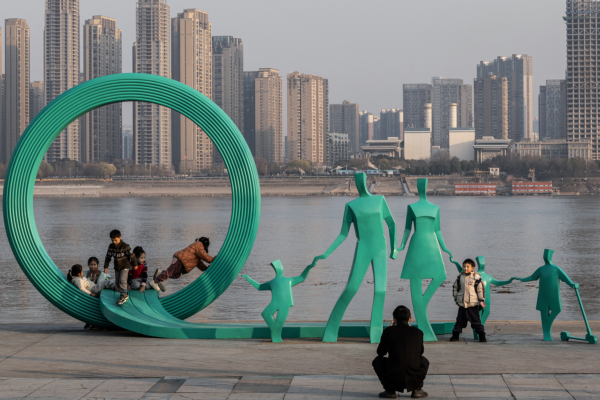
On January 19, the National Bureau of Statistics of the Communist Party of China announced that the number of births in China in 2025 was 7.92 million, lower than the 9.54 million in 2024, hitting the lowest level in decades. At the same time, China’s total population has been declining for the fourth consecutive year, with a decrease of 3.39 million people last year, marking the largest annual decline since China’s total population started to decrease in 2022.
Experts point out that the fundamental change in China’s traditional high fertility and child-rearing culture that has existed for thousands of years indicates not only a crisis in Chinese society but also a comprehensive crisis throughout the society.
Although some countries around the world are experiencing a downward trend in birth rates and fertility rates, the situation in China is drastically different.
Demographers estimate that by 2025, China’s total fertility rate will be around 0.9. The United Nations predicts that by 2025, China’s total fertility rate will reach 1.02. This is one of the lowest levels globally, with Europe projected at 1.41, the United States at 1.62, Asia at 2.24, and Africa at 3.95.
The total fertility rates in wealthier regions like the United States and Europe still remain below the replacement level of 2.1, but they are significantly higher than China’s estimated values.
Looking back in history, during the period of the Great Chinese Famine from 1959 to 1961, the birth population saw a sharp decline, with 16.35 million, 14.02 million, and 9.49 million births each year. The 7.92 million births in 2025 are nearly 1.6 million lower than the lowest point in 1961 when China’s population base was only 660 million.
This population decline is the first time since 1949, apart from the three years of the Great Famine, that China has experienced negative population growth.
According to statistics from the Communist Party’s Bureau of Statistics, China’s population has been declining for the fourth consecutive year, with a net decrease of 3.39 million people in 2025, resulting in a natural population growth rate of a negative 0.241%. China’s mortality rate will reach 8.04 per thousand people in 2025, the highest since 1968.
“This rate of decline is shocking, especially in the absence of major upheavals,” said Su Yue, Chief China Economist at The Economist Intelligence Unit (EIU), in an interview with CNBC.
Wang He, a China expert, told The Epoch Times that over 17 million newborns were born in 2016, but a decade later, there was only a fraction left, with 10 million fewer births. This decline, in peacetime, is remarkably rare in world history.
“This itself indicates that Chinese society is in crisis regarding its population, and the entire society is in a comprehensive crisis.”
The latest birth data has also been suspected of being embellished, with the actual number of births likely being even lower. The Communist authorities have a long history of falsifying population data.
In the 2020 China Census, the official population was announced as 1.41 billion, widely believed to be greatly inflated. Prior to this census, investigations into birth rates in numerous regions had already shown negative numbers.
In 2023, Hong Kong senior media figure and economics professor Lian Yizheng, in an interview with The Epoch Times, stated, “In the 1990s, the population numbers started being falsified. Around 2000, around 2005, when it was discovered that the growth rate was not sustainable, they began large-scale falsifications.”
Lian Yizheng also mentioned that foreign media still rely on official Communist Party data for reporting on China’s population, making it difficult to accurately grasp the situation. He once told American media reporters, “The data you’re quoting is inaccurate.” But they replied, “There’s no other option; this is the only data the country makes public.”
Wang He stated that all population data is in the hands of the Communist Party, and apart from population statistics, the Party also controls three other sets of data: one held by the Public Security Bureau on birth figures, another by the Health Department on annual births, and a third on data from enrollment in primary schools.
“These datasets are all in the hands of the Communist Party, and the extent to which they falsify the data is something only they know, with the outside world only able to speculate.”
Chinese families have a strong sense of family values, and raising children is not only about progeny but also a way to practice traditional values of love and filial piety. Therefore, in China, except during large-scale wars or famines, the population has always grown positively.
So far, despite various pro-natal policies issued by the Beijing authorities in recent years, such as introducing childbirth subsidies, simplifying marriage registration, extending maternity leave, and even imposing a 13% tax on contraceptives this year, they have been unable to reverse the trend of young people choosing not to marry and have children.
In 2024, the number of marriages in China plummeted by one-fifth, marking the largest historical decline on record, with over 6.1 million couples registering for marriage, lower than the 7.68 million couples in 2023. The number of marriages is often seen as a leading indicator of birth rates in China.
Young people still find the cost of raising children too high, especially during periods of high unemployment and economic slowdown.
According to a 2024 study by the National Population and Family Planning Commission, the average cost of raising a child in China until high school graduation is about 538,000 RMB, which is more than 6.3 times the per capita GDP, compared to 4.11 times in the United States and 4.26 times in Japan. In urban areas of China, this cost is even higher.
Experts from the RAND Corporation warned, “China’s declining fertility rate reflects unmet desires for childbearing, not a lack of willingness to have children. Encouraging fertility through policy has not achieved its goals because it focuses on norms and administrative reforms rather than addressing social or economic constraints that affect these desires.”
Li Hengqing, an economist in the United States, stated that family lineage and providing a support system for elders to rely on, safeguarding hope for the family, are intrinsic to the traditional values of the Chinese people. The current choice to refrain from having children signifies an extreme and painful decision, not a deliberate one.
Wang He pointed out that today’s young people in China do not want to marry or, if they do, they do not want children. This fundamental change in the traditional cultural norms of marriage, love, and child-rearing that have existed in China for thousands of years has been destroyed by the Communist Party in just a few decades. The current population crisis caused by this change may take generations to resolve.
“The atrocities committed by the Communist Party against the Chinese people are unprecedented in history.”
Wang He stated that while the Communist Party once sought negative population growth, the current situation of actual negative population growth in China has had a massive impact on the entire Chinese economy. Although they now want to reverse the situation, their efforts have completely failed.
Throughout history, no society has been able to sustain economic development under long-term population decline.
Economists warn that labor force shrinkage and population aging pose major economic risks. A decreasing number of newborns means a smaller future workforce that will struggle to support a rapidly growing retiree population, adding further pressure to already strained pension systems.
According to Reuters, the number of people in China aged 60 and over has reached 323 million, accounting for 23% of the total population. By 2035, the number of people aged 60 and above is expected to reach 400 million, roughly equivalent to the total populations of the United States and Italy combined.
A report released by the Chinese Academy of Sciences in 2019 estimated that China’s pension fund balance will be depleted by 2035.
Demographers warn that, despite some local governments expanding incentive measures, the continued economic and social barriers mean that this trend is unlikely to reverse.
It is more likely that China will fall into what demographers call the “low fertility rate trap,” where once a country’s fertility rate falls below 1.5 or 1.4—which is significantly higher than China’s current rate—it becomes challenging to increase it by 0.3 or more.
China’s historically low birth rate indicates a changing population structure that will affect global economy, supply chains, geopolitical landscape, and alter the dynamics of US-China competition.
In the late stages of the Cold War, one of the significant factors leading to the collapse of the Soviet Union was the low birth rate, resulting in negative population growth and economic stagnation, making it unable to compete with the vibrant population of the United States.
Li Hengqing noted that China’s population structure has undergone fundamental changes, partly due to the imbalance caused by the One-Child Policy and partly because of shifts in the country’s socio-economic structure.
Li Hengqing also said that the family planning policy has been, in essence, a genocide policy, which has eventually led to the current situation where economic growth is out of the question.
He emphasized that population issues cannot be solved by a single policy. Population is the cornerstone of a country’s development, and a sudden cliff-like collapse in population will pose significant problems for economic development, leading to a vicious cycle. China’s future societal and economic challenges will increase, making it more difficult to emerge from the downward trend.
The Rhodium Group, an American think tank, released a report at the end of last year, projecting that China’s real GDP growth in 2025 will range between 2.5% and 3.0%.
The avalanche of declining births in China has sparked extensive discussions on overseas social media.
One user on Platform X commented, “It’s truly admirable to swiftly reduce the population, just like housing prices.” “From 2.1 to 0.98 in less than ten years.” “Decline and fall, divine retribution!”
Some believe that the decline from 1.3 to 0.98 in China’s fertility rate within five years is not just a statistical contraction but also a drastic change in social structure, signaling an irreversible turning point for macro policies, economic growth models, and social governance.
“The demographic avalanche, coupled with credit contraction, has ended the era of cheap labor dividends and declared bankruptcy of the asset-driven model.”
“As the number of newborns continues to decline, this is the Chinese people’s resistance.”
“These are terrifying numbers, dealing another blow to the Chinese economy, which heavily relies on population dividends.”
Some believe that “economic contraction + population decrease” is a terminal illness in economics, both essentially reflecting a decline in people’s expectations for the future, leading to widespread lack of confidence. Rebuilding the confidence of millions, tens of millions, or even billions of people has never been successful historically, and in the end, the only result is to upset the table and change the ruling regime.
Similar incidents occurred during the pandemic, such as in Shanghai in 2022, where a young couple whose nucleic acid test results were negative were forcibly transferred to isolation by a group of authorities, threatening that refusing isolation would affect three generations. The man responded, “We are the last generation.” This statement resonated widely.
Wang He stated that in a sense, this is the people’s vote, expressing their anger through resistance to childbirth.