
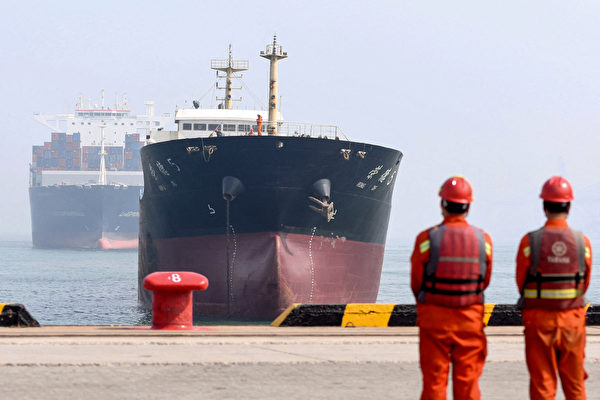
A lighting factory owner in Foshan exporting products to the United States expressed concerns over potential tax increases under the newly elected U.S. president, believing that worrying about it would be to no avail. Instead, he has decided to increase investments in a factory in Thailand.
James Cheng, 46, has his factory in Foshan currently producing over two thousand illuminated bathroom mirrors for a hotel in Las Vegas.
In 2018, when President Trump imposed tariffs on Chinese imports, many of the lighting fixtures produced by Mr. Cheng’s factory were hit with a 25% tariff. With Trump’s recent reelection, promising even higher tariffs of 60% or more on all Chinese-made products in his second term to protect American industries and jobs, Cheng told National Public Radio (NPR), “For ordinary business owners like us, worrying about the president’s tariffs is futile.”
Following the initial additional tariffs, Cheng shifted some of his lighting production to Bangkok, Thailand in 2019 to circumvent the tariffs. He mentioned that many of his Chinese counterparts have done the same.
“The 60% tariff will force us to increase investments in factories in Southeast Asia, particularly in Thailand,” Cheng said. “Whether I export through China where tariffs are added to consumer prices, or through Thailand where higher costs lead to price increases, ultimately the costs will be borne by American customers,” he added.
Tariffs could become a substantial source of government revenue for the Trump administration. According to a recent analysis by the Brookings Institution’s Tax Policy Center, Trump’s tariffs may bring in about $3.7 trillion in total tariff revenue for the U.S., but the actual growth in federal revenue over the next decade is estimated to be close to $2.8 trillion due to tariffs potentially reducing other tax revenues.
However, Trump’s Trade War 2.0 is bound to have an impact on Chinese exports. After over three years of stringent COVID controls and with a weakened real estate market and consumer confidence, export remains one of China’s few remaining economic engines.
On Thursday (November 7), when asked about Trump’s potential comprehensive tariff increases on Chinese goods, Chinese Foreign Ministry spokesperson Mao Ning responded, “We do not answer hypothetical questions.”
Even when queried about whether Chinese leader Xi Jinping had congratulated Trump on his election victory, Mao Ning did not give a direct answer. This information was first reported by U.S. media, with Xinhua News Agency subsequently publishing the Chinese notification.
The Wall Street Journal reported that most economists expect Trump to eventually settle on tariff rates within a milder range of 20% to 22%.
Wu Xinbo, Executive Dean of the Institute of International Studies at Fudan University in Shanghai, expressed a similar view in an interview with Interface News on November 5. “Whether the tariffs on Chinese goods will reach 60% depends on the specific types of goods imported from China to the U.S., and the actual revenue the U.S. may collect might not be that high,” he said.
However, even with milder tariffs, the impact on China’s economy would still be harsh. According to estimates by Goldman Sachs, the 2018 trade war led to a 0.65 percentage point drop in China’s gross domestic product. If Trump were to impose a 60% tariff, it could result in a 2-percentage-point reduction in China’s economic growth, not factoring in the effects of diverting goods to third countries to avoid tariffs.
Chinese scholars find Trump’s actions towards Beijing challenging due to his unpredictability.
Shen Dingli, a professor at the Institute of International Studies at Fudan University, told NPR, “We don’t know what he (referring to Trump) is thinking. He wants to negotiate and uses his unpredictability to intimidate and deter Beijing.”
Shen Dingli believes that the officials appointed by Trump will be critical.
Wang Zichen of the Center for China and Globalization (CCG) in Beijing, said, “I believe the opportunity lies in President Trump being pragmatic. Many people would use the term dealmaker to describe him.”
“The risk is that he is quite unpredictable. This could actually be very challenging,” he added.
Bonnie Glaser, Director of the India-Pacific Program at the German Marshall Fund’s American think tank, told Newsweek that she expects President-Elect Trump to fulfill his campaign promises.