
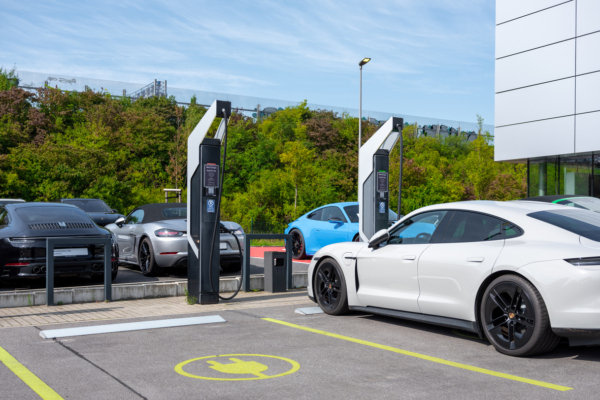
In order to accelerate the transition to green energy, the German government recently launched a new electric vehicle purchase subsidy program, with plans to invest 3 billion euros by 2029 to provide subsidies for 800,000 new vehicles over the next 3 to 4 years. The online application platform opened on May 19 (Tuesday) and immediately triggered a “frenzy of applications” among the German public.
According to statistics, within just 15 minutes of the system being online, over 1,800 applications flooded in; and within the first 24 hours of the process, the number of applications rapidly approached nearly 17,000. As of 3:30 pm on May 20, the Federal Ministry for the Environment confirmed that they had received a total of 19,448 applications. Carsten Schneider, the Federal Minister for the Environment and member of the Social Democratic Party (SPD) who spearheaded the policy, promptly stated, “The development of electric vehicle technology will continue to accelerate, prices will become more affordable, and there will be more charging stations available. The key point is that driving an electric vehicle can protect you from exploitation due to global crises and high oil prices.”
However, behind this seemingly win-win eco-friendly celebration, a fierce debate about “tax revenue distribution” and “policy loopholes” has quietly erupted in the German political and economic circles.
This new policy stipulates that all pure electric vehicles (BEV), specific plug-in hybrid electric vehicles (PHEV), and range-extended electric vehicles registered from January 1 of this year are eligible to retroactively apply for a maximum government subsidy of 6,000 euros. However, this “maximum subsidy” is not accessible to everyone.
Firstly, the plan specifically excludes company fleet vehicles, limiting the subsidy to private vehicle purchases only. Secondly, the subsidy amount is closely tied to consumers’ household annual income and number of children.
Individuals or families with a gross annual income not exceeding 80,000 euros (extended to 90,000 euros for those with children) are eligible for the full 6,000 euros when purchasing a pure electric vehicle. If opting for a hybrid or range-extended vehicle, the subsidy immediately decreases by 1,500 euros; and without children, an additional 1,000 euros is deducted from the subsidy.
Some German media outlets have done calculations, using the example of a typical German working-class family with an annual income of 45,000 euros. After deducting taxes and fees, their monthly disposable income is less than 3,000 euros, barely enough for even a used diesel car. Looking at the electric vehicle market, Volkswagen’s latest and touted as most affordable “ID Polo,” even in its base model, is expected to have a starting price of at least 25,000 euros.
Although acknowledging that subsidies can effectively help reduce dependence on oil, Michael Müller-Görnert, a transportation expert at the German environmentally friendly transport club (VCD), pointed out a crucial flaw in the policy, saying, “Even with the subsidy, many families still can’t afford new cars. The government should include used electric vehicles in the subsidy range; otherwise, mass adoption is simply not feasible.”
Aside from uneven consumer distribution, this policy is also facing scrutiny for the “benefiting outsiders” issue. Currently, the cheapest 10 electric vehicles on the German market range in price from 16,900 to 30,000 euros, with as many as 8 of them being assembled abroad, including in Asia.
This means that the 3 billion euros in subsidies issued by the German government with good intentions may ultimately flow into the pockets of Asian car manufacturers, particularly those heavily expanding into Europe, such as China. Economists call this phenomenon a “resource misallocation,” or in simpler terms, “German taxpayers funding the expansion of Asian manufacturers.”
To protect domestic industries, the German metal industry union has been vocal in emphasizing that subsidies can stimulate the market, safeguard employment opportunities for domestic car manufacturers and supply chains. The German government is currently urgently reviewing whether to introduce “EU priority rules” (aimed at providing targeted benefits to European car manufacturers). However, among the new electric vehicles registered in Germany, while 80% claim to be European brands, many components and supply chains are deeply tied to Asia, making the effectiveness of the defense line uncertain.
According to reports from German media, in the eyes of mainstream German economists, this whopping 3 billion euro plan appears more like a “lavish waste” of taxpayer money. Oliver Falck, an expert at the Munich-based ifo Institute for Economic Research, directly stated, “Overall, this subsidy is far from being spent wisely.”
The criticism from renowned German automotive expert Ferdinand Dudenhöffer is even more severe. He points out that with global oil price spikes due to Middle East geopolitical issues (such as the Iran crisis) and voluntary price reductions by car manufacturers, there was already a natural increase in demand for electric vehicles in the market. Dudenhöffer added, “The market itself is fully capable of self-adjusting. It’s a pity about this money; now the government is throwing taxpayers’ money here, which will inevitably need to be saved from other public finance areas in the future.”
The high click rate on the subsidy platform reflects not the success of the policy itself but rather the public’s anxiety about high inflation and oil prices. In Germany’s massive social welfare expenditure of up to 1.4 trillion euros this year, the 3 billion euros may be just a drop in the bucket. However, balancing “environmental costs,” “social equity,” and “domestic industrial competitiveness” clearly cannot be easily resolved by simply handing out a few thousand euros in checks.