
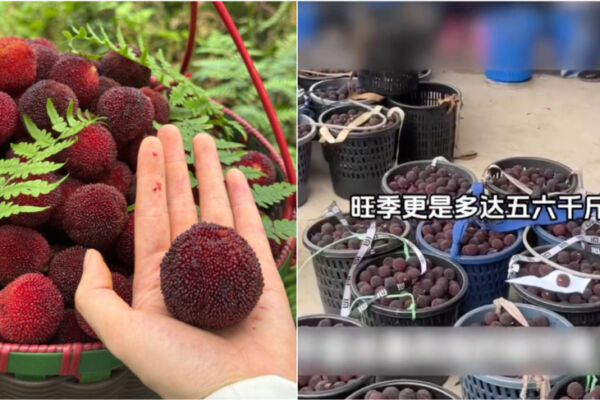
Recent Food Safety Scandal in China Shocks Society
In a shocking revelation, it was discovered that in Zhangzhou, Fujian, a major production area for waxberries, the fruit was being soaked in sweeteners and preservatives, causing widespread food safety concerns. As a result, the market collapsed, waxberries were left unsold, and farmers were left in tears. Authorities announced the detention of five individuals, only recovering 540 kilograms of the tainted waxberries, leading to widespread skepticism and ridicule among netizens.
On the evening of May 20, the Food Safety Committee of Zhangzhou, Fujian, reported the “soaked waxberries” incident, identifying five purchasing points involved. They seized 225 kilograms of contaminated waxberries and a batch of illegal additives, initiating investigations. A total of 540 kilograms of the problematic waxberries were recovered, along with 20.1 kilograms of illegal additives seized. There were 12 administrative cases opened, 2 criminal cases filed, and 5 individuals detained. The tainted waxberries and seized illegal additives were subsequently destroyed.
The report also claimed that from May 16 to May 20, a total of 639 batches of waxberries were tested locally, all meeting safety standards.
According to mainland media reports on May 15, Longhai District’s Fugong Town and Baishui Town in Zhangzhou, Fujian, are two major waxberry producing areas, with Fugong Town often referred to as the “Number One Town for Fujian Waxberries.” However, investigations by reporters visiting over ten waxberry purchasing points revealed that soaking waxberries in liquid was already an industry norm.
At a waxberry wholesale point, workers would directly submerge baskets of waxberries into a prepared mixture of liquid, let them soak briefly, drain them, and then package them without any hygiene protection or dosage control throughout the process. Two substances were added to this liquid – one labeled as “sweetness equivalent to 8000 times that of sucrose” and the other being sodium dehydroacetate used for preservation. The sweetener lacked ingredient information, production dates, or quality certifications, making it a typical “triple-zero product.”
A vendor commented, “Adding this makes the sour waxberries sweet, improving their appearance and popularity.” While workers nearby stated, “We absolutely don’t eat the waxberries soaked in chemicals, fearing potential harm.”
In Fugong Town, another major waxberry producing area, the abuse of additives was even more severe. Vendors poured sweeteners into the water used to soak the waxberries, with arbitrary and unregulated usage throughout.
Many wholesalers mentioned that waxberries were delicate and could spoil within a couple of days at room temperature. Additionally, waxberries ripening early tended to be sour and less marketable. Hence, almost all purchasing points resorted to using this liquid for soaking the waxberries, noting that if one did not follow suit, they would struggle to sell their produce.
Investigations revealed that over ten waxberry purchasing points in the area were illegally using additives. Daily shipments of soaked waxberries from these points could reach over a thousand kilograms, potentially exceeding five thousand kilograms during peak seasons. These chemically treated waxberries were then distributed through cold chains to wholesale markets in Zhejiang, Shanghai, Guangdong, and other regions.
Netizens expressed skepticism over the official claim of recovering only 540 kilograms of problematic waxberries, raising several questions:
“Did the relevant authorities only learn about fruit soaking on the first day? Exposing what’s caught, and ignoring the rest?”
“Reporters discovered thousands of kilograms being soaked daily but only recovered 540 kilograms. No supervision beforehand, a messy aftermath. Vegetables with pesticides, fruits with sweeteners, fish with anesthetics – one issue after another, laughable, shameful, and humiliating. What’s most infuriating is that these individuals are deliberately deceiving their own people, while exporting only compliant products.”
“Recovering 540 kilograms, while investigative journalists find thousands of kilograms being soaked daily implies that many tainted waxberries are still circulating.”
“Zhangzhou has 14,000 acres of waxberries?”
“Just 540kg with issues?”
“Where was the daily supervision? How to rebuild trust? Food safety is more critical than anything!”
“Specifically for Hong Kong and Macau, are they really compliant?”
Some netizens pointed out that law enforcement officials were already aware of the practice of soaking waxberries in chemicals. In this incident, from farmers to vendors and regulatory agencies, no one was innocent. If stringent actions are not taken under this management system, once the spotlight fades, things are likely to return to how they were.
Warning by experts highlighted that the “triple-zero” complex sweetener with unknown ingredients could potentially contain excessive amounts of sodium saccharin and aspartame, leading to neurological discomfort if consumed in excess over a prolonged period. Symptoms might include dizziness, headaches, fatigue, and memory degradation. Moreover, it could burden the liver and kidneys, causing chronic organ damage in severe cases.
As a repercussion of the scandal, many regions delisted Fujian waxberries, leading to plummeting prices and unsold stocks. Online videos circulated depicting mature waxberries being unsellable. Numerous farmers lamented substantial losses, with ripe waxberries on trees going to waste as they had no buyers, forcing them to watch the fruit decay or feed them to pigs.
On overseas social media platforms, discussions emerged:
“When everything is soaked in chemicals, everything turns toxic, who dares to eat? If you yourself won’t eat it, how can you sell it to others?”
“Vegetables, fruits soaked in chemicals, seafood injected, if sellers don’t dare to consume it, it’s unethical to sell it.”
“In plain terms, this indicates a complete breakdown of societal moral standards, a dysfunctional legal system, and systemic failure in government regulatory functions.”
It’s not just fruit; even tea is now under question. Recently, a mainland Chinese netizen climbing a mountain passed by a tea plantation and found numerous plastic bottles under tea trees labeled “Tea bud enhancing agent.” This netizen shared a video on social media questioning, “Would you still dare to drink this tea?”
[Video link]