
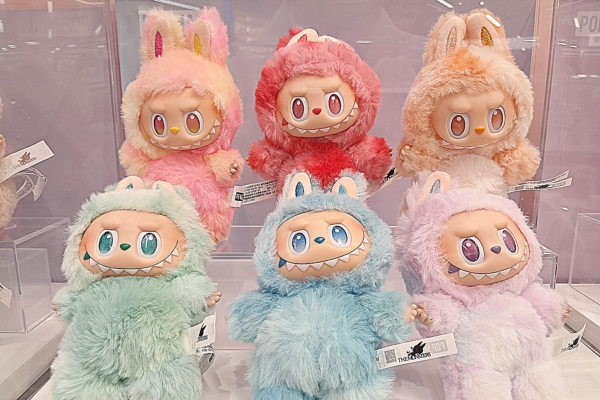
Recently, the globally popular toy series Labubu, under Pop Mart, has been under scrutiny in the United States due to concerns about the potential use of Xinjiang cotton in their dolls. These dolls have gained popularity in many regions, and the Chinese Communist Party has been promoting the brand to enhance its overseas influence.
On May 20th, advocacy group “State Armor” and the Victims of Communism Memorial Foundation sent a letter to US Homeland Security Secretary Markwayne Mullin and Secretary of State Marco Rubio urging the US Customs and Border Protection (CBP) to detain and inspect Pop Mart’s goods related to manufacturing centers in Guangdong, Hebei, and Zhejiang, China.
These organizations also called for the Forced Labor Enforcement Task Force to include Pop Mart in the Uyghur Forced Labor Prevention Act (UFLPA) entity list. Companies listed on this entity list are prohibited from trading with the US or US-related companies.
Isotope testing conducted on 20 Labubu dolls purchased in the US revealed that cotton in 16 dolls could be traced back to farms in Xinjiang, China, as stated in the letter.
The nonprofit organization “Uyghur Movement” had previously submitted information about Pop Mart to the US Customs and Border Protection’s Forced Labor Allegation Portal in August 2025.
The US Department of Labor has reported that since 2016, the Chinese government has been committing crimes against humanity, including genocide and state-sponsored forced labor, against Uyghurs and other predominantly Muslim ethnic groups in Xinjiang.
As a response, the US implemented the Uyghur Forced Labor Prevention Act (UFLPA), targeting products partially or entirely manufactured in Xinjiang, suspecting them to involve forced labor and banning their import unless importers can provide “clear and convincing” evidence.
The joint letter from “State Armor” and the Victims of Communism Memorial Foundation highlighted the connection between Pop Mart and Xinjiang, referencing the 2021 “Xinjiang Cotton Storm” where Adidas vowed to stop using Xinjiang cotton due to concerns about forced labor issues, while Pop Mart accused Adidas of “slandering Xinjiang” in Chinese court documents.
Chairman of the US House Committee on China Issues, John Moolenaar, declared the alleged use of forced labor cotton in Labubu products as “absolutely unacceptable” and urged strict enforcement of the UFLPA law unless evidence shows these products are not involved in forced labor.
One of the drafters of the UFLPA law, Congressman Chris Smith, in collaboration with scholar Adrian Zenz, urged US Customs to detain and inspect Pop Mart’s imported goods immediately and consider adding them to a trade blacklist.
Li Qiang, founder and executive director of China Labor Watch, told Epoch Times that the Labubu incident will test both corporate responsibility and US Customs enforcement capabilities.
If there is clear evidence that these products use Xinjiang cotton, it will not only damage the company’s image but also challenge US Customs’ ability to enforce the UFLPA law effectively.
In a previous report on January 17, China Labor Watch unveiled labor violations at Shunjia Toys Co. Ltd. in Xinfeng County, Jiangxi Province – a core manufacturer of Labubu toys with over 4,500 employees. The investigation revealed serious labor abuses including excessive overtime, the use of dispatched workers, opaque contracts, and suspected evasion of social insurance payments.
The report also exposed the employment of minors aged 16 in the factory, who not only worked alongside adults but also lacked the special protections required by Chinese labor laws.
China Labor Watch called on Pop Mart to address labor violations in its supply chain, compensate affected workers, and ensure future production aligns with Chinese labor laws and international labor standards. As of now, US Customs has not publicly announced specific enforcement actions against Labubu.
Pop Mart, the company behind the Labubu brand based in Beijing, has seen remarkable growth in revenue driven by the Labubu product line within the Monsters series. The company reported a revenue increase from 130.4 billion RMB (approximately 19 billion USD) in 2024 to 371.2 billion RMB (approximately 54.6 billion USD) in 2025, marking a 184.7% surge.
According to Pop Mart’s annual performance report submitted to the Hong Kong Stock Exchange, the Monsters series generated 141.6 billion RMB (approximately 20.8 billion USD) in revenue in 2025, constituting 38% of Pop Mart’s total revenue, with a 365.7% revenue growth from the previous year.
Additionally, Pop Mart forecasts significant revenue growth in the Americas, from 8.022 billion RMB (approximately 1.1791 billion USD) in 2024 to 68.1 billion RMB (approximately 10 billion USD) in 2025, a staggering 748.4% increase. The company also projects an expansion in the number of stores in the Americas from 22 to 64, with online revenue seeing a boost of 1094.9%.
Although Pop Mart’s financial report for 2025 indicated revenue and profit growth, its stock plummeted over 20% during trading, closing at 168.3 HKD/share, resulting in a market value loss exceeding 50 billion HKD on that particular day. As of May 21, its stock price stood at 151.8 HKD/share.
Chinese state media has been praising Pop Mart’s rise from both political and commercial perspectives. The People’s Daily linked the company’s development to the Chinese Communist Party’s promoted policies of the “new development pattern” and “high-quality development” in their interview with Pop Mart CEO Wang Ning.
In the interview, Wang Ning stated that Pop Mart has contributed to the growth of China’s toy design industry, shifting from “selling products” to “selling culture.” He highlighted the ongoing expansion in overseas markets, projecting that North America’s sales in 2025 will surpass those in Southeast Asia, emphasizing China’s vast domestic market and robust manufacturing base as advantages for Pop Mart.
Sarah Mujeeb’s article on Modern Diplomacy pointed out that Pop Mart’s Labubu toys exemplify how the company leverages popular culture, retail strategies, and efficient manufacturing to shape global consumer demand, exporting Chinese traditional culture and trendy toys worldwide.