
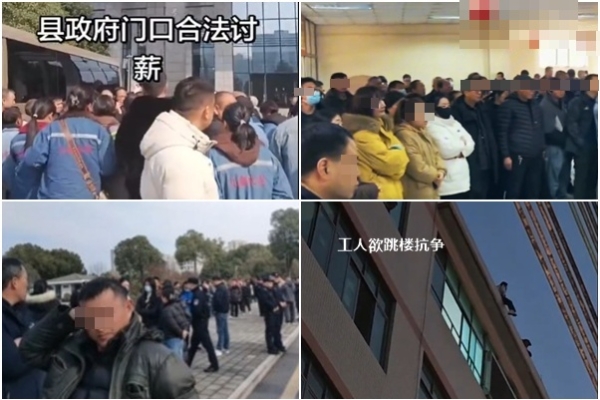
Following the establishment of the “Leading Group for Solving Delays in Farmers’ Wages” by the State Council of the People’s Republic of China in 2017, a nationwide effort to address wage arrears known as the “Anti-Arrears” campaign has been actively promoted. However, rather than resolving the issues of construction projects halting, outstanding project funds, and unpaid wages for farmers, these problems have continued to escalate.
Recently, a former staff member of the “Anti-Arrears” campaign in the Guangxi Zhuang Autonomous Region revealed on an overseas platform that the authorities had allocated approximately 40 million yuan to build a so-called “Arrears Early Warning Platform.” However, the system has long been stagnant in formality, with some areas even relying on PowerPoint presentations and demonstration interfaces to meet higher-level inspections.
The former official wrote on the platform that in recent years, the Chinese Communist Party (CCP) has been expanding its “digitalized anti-arrears” system. Grassroots labor supervision agencies are not only dealing with cases but also handling various arrears leads transferred down from higher-level platforms, leading to many individuals having to spend their days filling out forms in front of computers.
This former official, who served on the first-level “Anti-Arrears” task force in Guangxi Autonomous Region, stated that the Guangxi Zhuang Autonomous Region government had earmarked 40 million yuan for the construction of the “Arrears Early Warning Platform.” However, only a few provinces in the country have actually established the system, with most resorting to using a fake system interface, and even using PowerPoint to meet assessment requirements.
Scholar Li Xiangtong (pseudonym) from Guangxi criticized the “Arrears Early Warning Platform” as typical bureaucratic behavior, stating, “The CCP’s practice of squandering taxpayers’ money is rampant everywhere. These officials are constantly thinking about how to please their superiors, pushing arrears complaints down to the grassroots level, and even quashing them in their infancy. This is typical ‘stability maintenance’ investment, but the results prove futile.”
In recent years, the CCP has been establishing various complaint platforms. Li Xiangtong analyzed, “Among the social contradictions under CCP rule, issues such as wage arrears, unpaid project funds, and unpaid private capital are the most prominent. A friend of mine had his hotel requisitioned during the epidemic, owing millions that remain unpaid to this day. Many individuals end up having to go to the National Petition Bureau in Beijing or directly file complaints with national platforms, only for the cases to be sent back to local authorities. If you sue the Nanning government, can Nanning solve the issue?”
According to the Guangxi Zhuang Autonomous Region Department of Human Resources and Social Security’s announcement on August 24, 2024, the regional government invested 40 million yuan in constructing a provincial-level monitoring and early warning system for paying farmers’ wages, which is now commonly referred to as the “Guixinbao” platform. Officials claim that this move aims to strengthen efforts to tackle wage arrears through digital means.
The former official further disclosed that many wage arrears cases in various regions have become entangled with numerous disputes over project funds and labor payments. Some subcontractors and labor intermediaries, unable to receive project funds, would disguise them as “farmers’ wage claims” to enter the labor supervision process.
A retired civil servant from Shaoguan, Guangdong, Mr. Pan, stated that grassroots officials nowadays are basically idling away their time, saying, “Complaints are ignored these days. You submit your grievances to a platform, and it takes forever for them to respond. Many farmers initially do not sign labor contracts, making labor relations challenging to determine. Some subcontractors, in order to claim unpaid funds, package project funds as wages without verification. The current officials are either loafing around or waiting to get caught. In 2024, when I wasn’t retired yet, there were thousands of such complaints annually.”
Mr. Pan mentioned that the CCP’s human resources system has recently prioritized the so-called “Arrears Early Warning Platform,” attempting to predict enterprise arrears risks in advance through data on a company’s water and electricity usage, social security, and workforce numbers. However, when faced with arrears in state-owned enterprises, they dare not intervene. The bidding projects of state-owned enterprises now have spiraled out of control.
Mr. Yin, a legal professional in Hubei who monitors wage arrears issues in China, highlighted that the CCP has increasingly enforced a “digital” and “platform-based” model in grassroots governance, essentially delegating complaints regarding civil petitions and rights protection to the platforms for handling. He remarked, “Building these complaint platforms in various regions while officials avoid dealing with them eventually leads to social unrest, manifesting in random violence, attacks, and arson.”
Mr. Yin further emphasized that following the establishment of the “Leading Group for Solving Delays in Farmers’ Wages” by the State Council of the CCP in 2017, a large-scale promotion of the “Anti-Arrears” campaign began across the country. However, in recent years, the situation in the Chinese real estate, construction industry, and local finances has continuously deteriorated, worsening issues with construction halts, outstanding project funds, and farmers’ wage arrears. “After spinning our wheels for 9 years and seeing an increase in platforms, the number of individuals owed wages has not decreased. We are witnessing intensified conflicts between officials and citizens. Just look around at what’s happening.”