
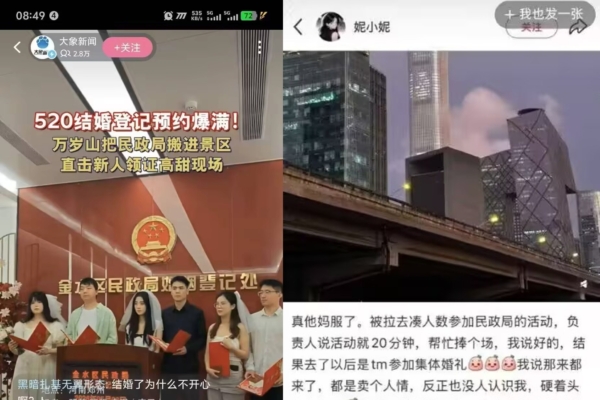
Recent leaked information from mainland Chinese journalists reveals that some civil affairs bureaus are hiring young people to pretend to be couples and queue up for marriage registration events, in light of the declining number of marriages. According to civil affairs bureau staff, some regions are facing pressure to meet their “mission” as the number of marriages continues to drop, leading to such measures.
These leaked posts related to the 520 marriage registration activities were circulating among mainland Chinese journalists recently. Pictures and messages shared within the journalist group revealed that a marriage registration event was held at the Wansui Mountain Scenic Area in Zhengzhou. The images showed captions like “520 marriage registration fully booked,” “Wansui Mountain brings the civil affairs bureau into the scenic area,” and “exclusive coverage of sweet moments of newlyweds receiving certificates” with the background indicating the “Civil Affairs Bureau Marriage Registration Office in Jinshui District.” Multiple couples were seen posing for the camera, while others were waiting in line.
One netizen commented, “Why aren’t couples happy about getting married?”
Another wrote, “Why do they all look so worried? Where’s the sweetness? Why don’t they smile? Are they naturally joyless?”
A screenshot shared by a journalist in Nanjing showed an internal staff member of the civil affairs bureau posting a notice in the community grid staff group titled “Pure Welfare Project” requesting 30 men and 60 women to “pretend to be couples in line” for the event on May 20th, emphasizing it’s for show and not real marriage registration. The notice mentioned a TV interview where participants are expected to speak positively and thank the civil affairs bureau, adding a promise of red envelopes for cooperation. It specifically stated, “Today, there will be a TV station and leaders present,” and participants had to meet certain age requirements. The poster also instructed, “No dyed hair, no long hair, no ponytails.”
A resident of Zhengzhou, Sun Qianru, told reporters, “Who’s getting married now? How can young people afford to get married? The young people in our community are all relying on their parents, living off their retirement funds, not needing to buy houses. Even the civil affairs bureau staff are worried; there are more public servants than people getting married.”
However, similar situations are not prevalent in all regions. According to a report from Guangzhou Daily in early May, as of 2 p.m. on May 8th, the online reservation system for marriage registration at Guangdong civil affairs offices showed no available slots for May 20th in all 15 registration venues across 11 districts in Guangzhou.
A civil affairs bureau employee in Shenyang mentioned to reporters that in recent years, there has been a decreasing trend in marriage registrations: “We even advise some people not to register in advance to try to have more numbers on May 20th or 21st to make the figures look better. There aren’t many people coming in for registrations during regular days. Is it considered fake? We have no choice; the higher-ups press us with tasks, but we can’t force people to get married.”
Another image circulated showed a participant from Inner Mongolia stating, “I’m truly fed up. I was dragged in to boost the numbers at the civil affairs bureau event, with the organizer saying it would only take 20 minutes, just to help create a scene.” The poster added, “I thought since I’m already here, and don’t know anyone, I might as well go along with it. But then a bunch of media cameras started rolling without informing me beforehand, taking close-ups and spreading them everywhere. My family and friends thought I had gotten married; it’s utterly ridiculous.”
She later contacted the organizer to remove the photos, expressing, “But the media personnel everywhere were telling me it couldn’t be deleted; otherwise, they would be accused of hosting a fake event… How did I end up in such an unfortunate turn of events?”
In recent years, China has seen a continual decline in marriage registrations as the birth rate has been decreasing for several years. Many civil affairs systems across different regions have introduced measures such as marriage and childbirth subsidies, scenic area marriage registrations, and collective wedding ceremonies. According to the Chinese Ministry of Civil Affairs’ statistics for the first quarter of 2026 released on May 9th, there were 1.697 million pairs of marriages registered nationwide, and 622,000 pairs of divorces. Multiple media outlets have calculated that the number of marriage registrations decreased by 113,000 pairs compared to the same period in 2025, with a decline of 6.24%.