
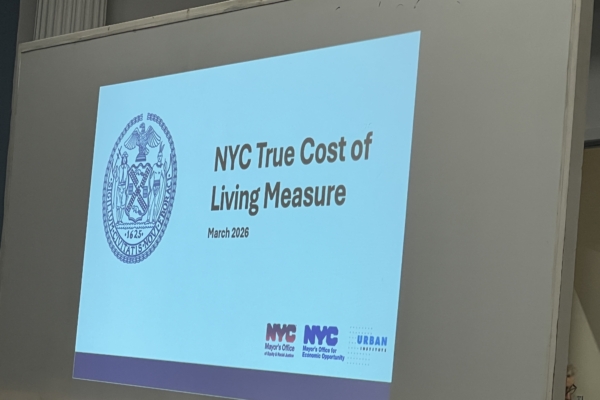
On Thursday, May 21st, the Rent Guidelines Board (RGB) in New York City held a public hearing to determine the extent of rent adjustments for rent-stabilized housing this year. During the proceedings, the RGB reviewed a report from the Mayor’s Office of Racial Equity and Justice (MOERJ) regarding the cost of living for New Yorkers. The report revealed a staggering statistic, stating that 62% of people in New York City, which amounts to over 5 million people, cannot afford the “True Cost of Living” (TCOL) in the city.
Firstly, Shahab Chowdhury, a senior advisor at the MOERJ office, explained what the “True Cost of Living” entails. This standard is not based on the concept of a “poverty line” established in the 1960s focusing on food and housing costs but rather encompasses everything a family would need to live a dignified life in the year 2026.
“This is what the ‘True Cost of Living’ aims to address,” Chowdhury said. “This number is three times the poverty line standard set by the New York City government, with the poverty rate in New York City standing at 20.5 percentage points. The true cost of living sheds light on the full spectrum of economic security.”
Debash Nagash, the Deputy Director of the MOERJ office, provided three examples to illustrate the real circumstances of New Yorkers. One example was Marysol, a home health aide living in the Bronx, who is a single mother of two children. She commutes through the Bronx on the M15 bus every morning to work, and her family resides in a rent-stabilized two-bedroom apartment at Mott Haven. Since her mother signed the lease in 2008, the actual cost of living for their family each year has been $142,000. Her salary combined with all eligible benefits totals around $63,000. After deducting all expenses and resources, she falls short of nearly $80,000 each year.
“Her stable rent is approximately $2,000 lower per month compared to the market rate for a similar two-bedroom in her community,” Nagash stated. “It is this price difference that allows her family to continue living here.”
The report outlined the basis for their research, sources of data, and distinctions among various administrative districts. It indicated that the cost of living varies based on the type of household. For instance, the median cost for single adults (without children) is $70,344; for a typical family with children (two adults and two children), the median cost is $166,000; and for elderly individuals, the median total cost is $123,000. These thresholds roughly delineate the different expenses individuals face, which vary depending on their needs.
The report highlighted that New Yorkers’ wages only meet 44% of the cost. Although the minimum wage in New York State has risen to $17 per hour, a single adult would need the equivalent of two full-time jobs’ income to meet the threshold solely on minimum wage. Thus, while wages are crucial leverage, they are insufficient to bridge the gap.
“We know that the Rand Board Rendur rent is an extremely important indicator for measuring housing affordability, but the ‘True Cost of Living’ can provide a more comprehensive framework to help us understand family costs and rent burdens,” Chowdhury summarized. “We attempt to comprehend a family’s actual expenditures on housing, healthcare, childcare, food, and all other essentials, as well as the variances in these expenses based on family composition and age structure in different administrative districts. Therefore, the true cost of living helps answer the question of ‘can this family truly afford all the essentials.'”
The RGB hearings will be held on the following dates and locations: June 4th, at the Jamaica Performing Arts Center, 153-01 Jamaica Avenue, Queens; June 8th, at Hostos Community College, 450 Grand Concourse, Bronx; June 11th, at the New York City College of Technology Theater, 275 J Street, Downtown Brooklyn; and June 16th, at the 95th Street Space in Manhattan.
Lastly, the vote will take place on June 25th at 7:00 PM at the intersection of 5th Avenue and 4th Street, at El Museo del Barrio in Manhattan.