
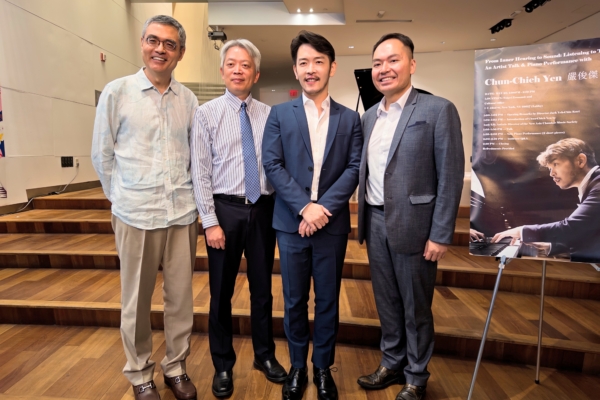
In order to continue the exchange of Taiwan’s music and arts with the international cultural community, the New York-Taipei Cultural Center held a lecture and demonstration performance by pianist Yan Junjie at the Taipei Economic and Cultural Office in New York on the afternoon of May 20th. The event attracted New York’s arts and cultural figures, music enthusiasts, and overseas Taiwanese community members. Through up-close conversations and performances, the event not only showcased the international prowess of Taiwanese musicians but also presented the artistic thinking and life experiences of Taiwanese pianists on the international stage.
Yan Junjie has been active in the music scenes of Europe, the Americas, and Asia for many years, having collaborated with renowned orchestras such as the Russian National Orchestra, the Rheinland-Pfalz Philharmonic, the Taiwan National Symphony Orchestra, and performed alongside esteemed conductors like Mikhail Pletnev, Zubin Mehta, Lu Shao-Chia, Jun Märkl, and Günther Herbig. He has completed challenging programs such as performing the complete set of Chopin’s 27 Etudes and Debussy’s Etudes, premiered Tchaikovsky’s Piano Concerto No. 2 in Taiwan, and recorded the world premiere of Chen Chi-Kang’s “Erhuang” Piano Concerto.
In addition to his performance career, Yan Junjie is actively involved in cross-disciplinary creations and music education. He founded the “International Master Piano Arts Festival and Competition” to cultivate the talents of the new generation of musicians. Currently serving as a professor at National Taiwan Normal University, his students have achieved remarkable success in various international competitions in recent years.
As a formidable figure in international piano competitions, Yan Junjie has won third place at the Prokofiev Competition, first place at the Hamamatsu International Piano Academy Competition, and third place at the Tchaikovsky Youth Piano Competition. He also received the “Best Classical Performance Award” at the 19th Golden Melody Awards. Having made a name for himself in international competitions at the age of 13, he has continued to be active on the international stage over the years while also balancing teaching, curating, and cultural promotion work.
During the lecture, Yan Junjie shared his experiences on maintaining artistic quality amidst a busy schedule of performances, teaching, and curating work. He recalled being invited to perform the complete set of Chopin’s 27 Etudes in 2010, coinciding with his military service when he had to practice in bits of free time. Describing his routine of waking up at 5:30 am daily to practice during breaks in the military, even squeezing in practice sessions between sentry duties, drills, and rest time.
He emphasized the importance of time management derived from this experience, stating, “Dividing time into small chunks and utilizing every available gap for practice, even 5 to 10 minutes, holds significant value.”
Yan Junjie also acknowledged the greater challenges faced by modern young musicians today. He pointed out that in an era dominated by AI, social media, and short videos, maintaining focus for extended periods has become increasingly difficult. He believes that besides technical training, it is essential for musicians to establish clear self-goals and artistic directions.
“If you have a clear idea of what you want to do and express, you will find ways to achieve it,” he said.
Reflecting on the relationship between music art and personality, Yan Junjie remarked that music ultimately reflects the performer’s state of being and temperament. He believes that the real challenge lies not only in completing a piece but in maintaining the space and composure to let the art “breathe” amidst busyness and stress.
In addition to the lecture sharing, Yan Junjie conducted a piano demonstration performance at the event, showcasing the artistic energy of a Taiwanese musician with an international perspective and cultural depth through nuanced and layered interpretations. The New York-Taipei Cultural Center expressed hopes that through such exchange activities, the dialogue between Taiwan and the United States in the arts and culture realm will deepen continuously, allowing more international audiences to witness the diverse facets of classical music from Taiwan.