
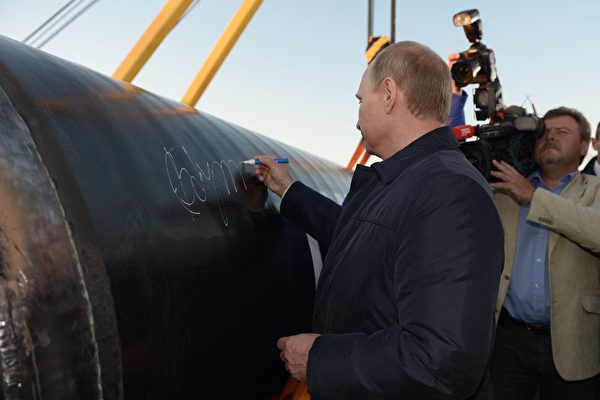
Russian President Vladimir Putin left Beijing on Wednesday (May 20) after holding a summit with Chinese Communist Party leader Xi Jinping. The highly anticipated negotiations for the China-Russia “Power of Siberia 2” natural gas pipeline did not see any breakthroughs.
Kremlin press secretary Dmitry Peskov stated after the summit that Russia and China have reached an understanding on the main parameters of the project, with only some details needing final confirmation. However, he admitted that the construction timeline for the pipeline is still uncertain.
Russian official news agency TASS also reported Putin’s remarks, saying that Russia is prepared to continue reliably supplying China with oil, natural gas, and coal. Despite years of similar statements from Moscow officials, substantive progress has been limited.
The planned pipeline, spanning 2,600 kilometers, is set to depart from the Yamal gas field in Russia, cross through Mongolia, and reach China, with an annual gas delivery capacity of 50 billion cubic meters, accounting for over 10% of China’s current demand.
Although Russia and China signed a legally binding memorandum in September 2025 to advance construction, pricing, financing terms, and delivery schedules remain unresolved.
During the meeting, Putin and Xi frequently emphasized their friendly relations, with Putin aiming to significantly increase Russia’s energy exports to China to further enhance what he described as an “unprecedented high level” of bilateral relations. However, concrete agreements on natural gas pipeline projects have eluded the two sides.
According to reports citing sources, the inability to reach an agreement is due to Beijing vigorously pushing for lower prices, making it difficult for the Kremlin, in urgent need of oil revenues to support the ongoing war in Ukraine, to agree.
The Financial Times reported comments by Alexander Gabuev, director of the Carnegie Moscow Center, stating, “Now is the best time – China (CCP) needs it more than ever before, while Russia is in a desperate situation seeking new sources of income.”
It is revealed that Beijing hopes the pricing of the new pipeline will be close to Russia’s domestic prices, around $120 to $130 per thousand cubic meters, while Russia seeks terms similar to those of the “Power of Siberia 1”. Analysts estimate a price difference of more than double between the two sides.
Some experts believe that Beijing’s strong push to lower prices on Moscow may also be due to the fact that China does not actually urgently need Russian natural gas.
An insider familiar with the matter told the Financial Times that it is not surprising that China and Russia have failed to reach an agreement on the gas price for the “Power of Siberia 2” pipeline, as Beijing is also concerned that domestic gas consumption has peaked and hesitates to make such a massive investment and long-term commitment.
Meanwhile, Russia is reluctant to sell at reduced prices due to substantial investments. Joseph Webster, a senior researcher at the Atlantic Council, previously analyzed China-Russia energy trade and suggested that with China’s natural gas consumption potentially declining, the income Russia receives through the new pipeline may not only be unprofitable but also insufficient to cover infrastructure investments.