
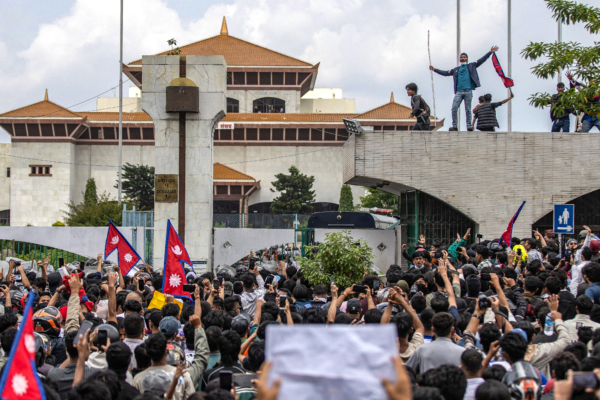
In early May, both the United States and the Chinese Communist Party simultaneously launched youth leadership program enrollments in Nepal, aiming to strengthen connections with the young demographic that played a significant role in overthrowing the pro-Chinese government last year.
While the United States focuses on cultivating civic engagement and democratic values among Nepalese youth, the Chinese Communist Party’s initiative aims at infiltration and influence.
Last year, discontent among Nepalese youth was sparked when the pro-Communist government imposed a social media ban, leading to mass protests and the resignation of then Prime Minister Sharma Oli in September.
Balendra Shah, a Nepalese rap singer turned politician, joined a political party that was only four years old and won a landslide victory in the early elections two months ago, securing the position of Prime Minister.
In 2011, the United States initiated the Youth Council Nepal (YUC) leadership training program targeting young people aged 20 to 30. The program, which lasts for a year, typically opens for applications in January or February. In September 2024, the Chinese Embassy also launched a similar program called the Chinese Embassy Youth Pioneer Program (CNYP), open for applications in the fall. This year, both the US and China nearly simultaneously opened applications, with the US Embassy in Nepal approving a total of 55 applications for the Youth Council program.
A spokesperson for the US State Department stated to Nikkei Asia that the purpose of the program is to provide practical job skills for Nepalese youth, helping bridge the gap between education and employment. Participants learn skills in business communication, digital marketing, and AI-assisted job readiness to enhance domestic and international employment prospects.
The US also has similar youth training programs in countries like Hungary, New Zealand, and Bulgaria. In Nepal, student politics has traditionally been a primary pathway to a political career, with most major political parties in Nepal originating from student anti-authoritarian protest movements. However, the politicization of student unions above academic issues has faced increasing criticism.
The US State Department spokesperson emphasized that the Youth Council program at the US Embassy is a strictly non-partisan platform independent of any political party, ideology, or external agenda. Allegations of foreign influence are deemed baseless.
Pitambar Bhandari, an assistant professor at Tribhuvan University, stated to Nikkei News that the US invests in Nepalese youth through training programs and alumni networks to establish long-term relationships, showcasing a classic example of soft power utilization.
Bhandari expressed that the US youth training program is considered the best entry point and professional development path, resembling a guided form of activism rather than traditional student politics, leaning towards voluntary and spontaneous engagement.
For young Nepalese individuals, the US is seen less as a direct political force than as a provider of excellent educational opportunities, hence highly appealing and of interest to educated Nepalese youth.
Samaya Khadka, a 25-year-old, mentioned to Nikkei Asia that joining the US Embassy Youth Council program initially aimed at expanding networks, enhancing personal skills, and connecting with individuals from various fields.
Khadka currently operates a startup company that provides services for job seekers. The US program primarily includes community engagement and enhancing skills in resume writing and report drafting, occasional discussions may touch upon geopolitical issues, with limited interaction with the US Embassy. The primary value lies in expanding networks and building relationships.
With the Shah government planning to crack down on student unions and delist party-affiliated student organizations from schools, both the US and China have intensified their engagement with Nepalese youth. While the US promotes democratic values and civic participation, China focuses on infiltration and influence through university and Chinese language exchange programs.
Since Nepal’s adoption of the current constitution in 2015, the Chinese Communist Party has been heavily involved in academic and ideological infiltration and influence in Nepal. However, with India’s deep social, cultural, and political connections, India still maintains its dominance in Nepal’s foreign relations.
Bhandari believes that initiatives taken by the US and China are geared towards long-term influence. While they may not directly reshape Nepal’s current political structure, both are investing in developing a cohort of young individuals, representing a long-term investment in influence.