
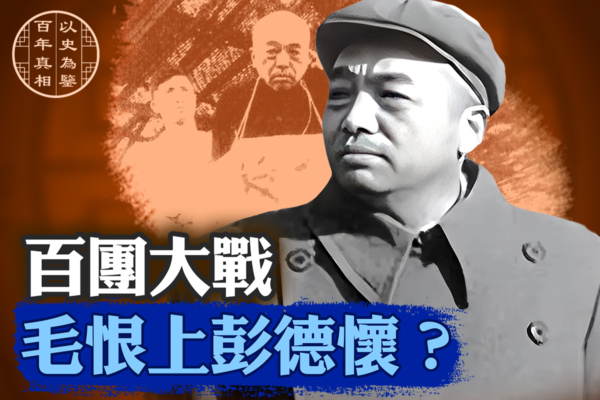
Hello to all viewers, welcome to “The Truth of a Century”.
In the history propaganda of the Chinese Communist Party (CCP), the Hundred Regiments Offensive is considered a classic battle that dealt a “heavy blow to the Japanese army” and is seen as a shining moment in the CCP’s anti-Japanese history.
However, many studies have pointed out that the scale and results of this battle were later significantly exaggerated by the authorities. Some experts in anti-Japanese history even refer to it as the “Hundred Regiments Small Battle.”
Moreover, Mao Zedong later criticized this battle repeatedly and even brought it up years later at the Lushan Conference to settle scores with Peng Dehuai.
So, what exactly was the Hundred Regiments Offensive? What did Mao Zedong truly hope to achieve at that time?
To understand the truth of this battle, we must go back to 1940.
In May 1940, the anti-Japanese war reached a critical point with intensified bombings by the Japanese army on Chongqing.
In just half a year, the amount of bombs dropped on Chongqing was equivalent to one-third of the total bombs dropped by Japan throughout the entire Pacific War. Thousands of civilians were killed by bombings, the city was reduced to ruins, a scene of unimaginable devastation.
At the same time, the Japanese army continued to advance along the Yangtze River, approaching Chongqing.
Not only through military attacks, Japan also took harsh actions in diplomacy and transportation, demanding France to close the Yunnan-Vietnam Highway and asking the UK to close the Yunnan-Burma Road, aiming to isolate the Nationalist Government.
For Chiang Kai-shek and the Nationalist Government, this was a matter of life and death. For most Chinese people, it was a profound national disaster.
However, Mao Zedong viewed the situation from a completely different perspective.
Mao believed that if Japan were to capture Chongqing, the Chiang Kai-shek regime could possibly collapse rapidly, completely reshaping China’s political landscape.
What Mao Zedong truly hoped for was not a quick victory in the anti-Japanese war, but for the Soviet Union to send troops and intervene in the Chinese situation.
To understand Mao Zedong’s true thoughts at that time, we must clarify a background, which is Stalin’s attitude.
Zhang Rong and Jon Halliday recounted in their biography “Mao: The Unknown Story” that on August 23, 1939, the Soviet Union signed a non-aggression treaty with Germany, dividing Poland. This event greatly shocked Mao Zedong.
At the end of September the same year, American journalist Edgar Parks Snow asked Mao Zedong: “Will the Soviet Union’s assistance to the CCP take the form of occupying half of Poland?” Mao replied affirmatively, “According to Leninism, such a possibility exists for China.”
This statement revealed Mao Zedong’s hand, as he hoped for a “Polish model” to unfold in China. If the Soviet Union and Japan partitioned China, then Mao Zedong would have the chance to become the ruler of “half of China.”
Coincidentally, following the signing of the Soviet-German Treaty, the Soviet Union began negotiations with Japan, with one of the core issues being the Chinese problem.
As negotiations progressed, the stronger the CCP’s power and territorial control, the more room Stalin and Japan had for bargaining.
As a result, Mao began to constantly report the battle results to the Communist International. On February 22, 1940, Mao reported to the Communist International that in the civil war, “victory always belongs to us” and “we annihilated 6,000 people in Hebei, 10,000 in Shanxi.” To show appreciation to Mao, Stalin approved providing $300,000 in aid to the CCP per month three days later.
During this period, on the surface, the CCP still proclaimed “unity between the Nationalists and the Communists, and joint resistance against Japan”; however, internally, Mao Zedong had already started planning a different strategy, shifting from “uniting with Chiang to resist Japan” to “uniting with Japan against Chiang.”
The key figure responsible for implementing this strategy in reality was Pan Hannian.
Pan Hannian was a core figure in the CCP’s intelligence system, responsible for external contacts. During the war, one of Pan Hannian’s important tasks was to establish intelligence and communication channels with the Japanese side.
In Shanghai, Pan Hannian maintained secret contact with the Japanese Vice Consul in Shanghai, and also a senior intelligence officer, Hideichi Iwai. Both sides exchanged intelligence, and the information provided by Pan Hannian was highly praised by the Japanese.
According to “Mao: The Unknown Story,” a former CCP intelligence officer later recalled: “A large number of comrades infiltrated our pseudo-organizational structures.” “We twice dismantled the organization of the Youth Corps of the Three Principles of the People in Shanghai,” he said, “and once during the siege of the Chongyi Liberation Army by Japanese people in Jiangxi, all under our party’s cooperation with the Japanese people.”
In the Central China region, Pan Hannian reached a tacit agreement with Japanese Central China Expeditionary Army Chief of Strategy, Colonel Tokiwa: the New Fourth Army ensured the safe and smooth operation of the southeastern railway, and the Japanese did not interfere with the development of the New Fourth Army in rural areas.
Peter Vladimirov, a Communist International liaison officer who had been active in Yan’an for a long time, wrote in the documentary book “Yan’an Diary”: “We found a trade deal between Yan’an and Japan. They not only engaged in trade with the Japanese, but also directly contacted the Japanese army headquarters, sending their most capable officials such as Pan Hannian and Yang Fan to negotiate with the Japanese army headquarters. They gained benefits from the Japanese. The Japanese gave them seven counties in northern Suzhou, on the condition they cooperate to eliminate the Nationalist Army.”
On July 24, 1941, the “Current News Bulletin” disclosed that the CCP and Japanese Army Commander Okamura Neji signed a secret agreement: the Eighth Route Army and Japanese Army collaborated to attack the Central Army; the Japanese gifted the Red Army ten small arms factories; the Red Army informed the Japanese of the Central Army’s operational plans.
While the CCP and Japan were secretly in contact, a completely different military operation suddenly erupted in North China.
At that time, Peng Dehuai, the Deputy Commander of the Eighth Route Army, only knew of Mao Zedong’s public statements about the Nationalist-Communist united resistance against Japan and did not understand Mao’s true intentions. On July 22, 1940, Peng Dehuai, on behalf of Zhu De, Peng Dehuai, and Zu Quan, signed and issued a top-secret operational order – to assault the Western Taihang Road and other railway lines.
This top-secret telegram, marked as “extremely urgent,” was sent to Yan’an and immediately copied to Mao Zedong, Wang Jiaxiang, Zhu De (who was in Yan’an at the time), Luo Fu, Wang Ming, Kang Sheng, Chen Yun, Deng Zihui, Ren Bishi, Tan Qilong, and the Operations Bureau. The order decided to start operations on August 10.
This report was handed to Mao Zedong twice, but Mao did not express any opinion; he neither opposed nor approved it. After Peng Dehuai sent a third telegram, Mao Zedong still did not respond. With no clear reply forthcoming, Peng Dehuai ultimately decided not to wait any longer.
On August 20, 1940, Peng Dehuai issued the order to initiate the attack, deploying 105 regiments, thus commencing the “Hundred Regiments Offensive.”
The Hundred Regiments Offensive lasted approximately a month, primarily focusing not on attacking Japanese military forces but on disrupting transportation routes and strategic economic facilities.
The main focus of the Eighth Route Army’s offensive was on key locations such as railways, roads, bridges, tunnels, and stations in the Japanese-controlled area of North China. This involved multiple railway lines including Zhengtai, Tongpu, Pinghan, Jinpu, Beining, and Deshi, as well as major roadways along these lines.
The entire operation can be roughly divided into three stages: the first stage mainly focused on disrupting transportation, with an emphasis on bridge demolitions, road destruction, and cutting off transportation routes; the second stage involved attacking and removing some Japanese garrisons; and the third stage was to counter the subsequent “mopping up” operations by the Japanese.
In terms of scale, this was the longest-lasting and most heavily involved military operation of the Eighth Route Army during the anti-Japanese war. However, in terms of actual results, its achievements were not as significant as later propaganda claimed – that it was a “heavy blow to the Japanese army.” On the contrary, as the Japanese conducted multiple large-scale “mopping up” operations, the CCP’s anti-Japanese base in North China noticeably contracted.
Regarding the results of the Hundred Regiments Offensive, the CCP boasted about killing 20,645 Japanese soldiers and 5,155 collaborationist troops. However, internal documents from the Japanese military medical department and the Japanese North China Front Army revealed that the Japanese had actually suffered 2,349 killed and 4,004 wounded, less than a quarter of the numbers propagated by the CCP.
Nevertheless, the Hundred Regiments Offensive did indeed cause disruption to the Japanese army. The Japanese “North China Front Army Operational Record” admitted, “This attack was completely unexpected for our army and led to significant losses.” The Jingxing coal mine supplying the Anshan Steel Plant in Northeast China was severely damaged, “unable to produce coal for at least half a year.” Japan had to recall a division attacking Chiang Kai-shek and temporarily halt plans to capture two railway lines leading to southern China.
Zhou Enlai, in a telegram from Chongqing to Mao Zedong, said, “The impact of the Hundred Regiments Offensive is significant, and even Chiang says it’s good. The newspapers here are reporting it in big headlines.”
However, Mao Zedong soon revealed his true attitude.
In a propaganda film titled “Steel Forged in One Hundred Battles: The 100 Years of the Chinese Communist Party,” the CCP acknowledged that after the Hundred Regiments Offensive, Mao, under public pressure, sent a telegram to Peng Dehuai saying, “The Hundred Regiments Offensive is truly exciting. Can we organize such battles one or two more times?” But soon after, he changed his stance and harshly criticized the Hundred Regiments Offensive.
By the later stages of the war, Mao even convened the North China Conference and labeled the Hundred Regiments Offensive as a serious mistake.
An article by Han Yu published on the People’s Daily website on April 11, 2016, mentioned that during the 1945 “North China Symposium,” facing severe criticism, Peng Dehuai was forced to reassess the Hundred Regiments Offensive, stating that “the Hundred Regiments Offensive of 1940… was also a political mistake,” having “prematurely exposed their strength and drawn the main Japanese forces from the front line,” among other things.
This assessment actually set the stage for a larger political reckoning that would follow.
Speaking of which, there is indeed one more question that needs to be addressed separately.
According to the research of the renowned anti-Japanese war expert, Mr. Xin Haonian, the so-called “Hundred Regiments Offensive” was, in fact, nothing more than a “Hundred Regiments Small Battle.” During a parade by the CCP on September 3, 2024, one of the “battle flag teams” made up of 80 flags, the statistics revealed undermined, thus reinforcing Mr. Xin Haonian’s argument.
A commentator named “Dan Fengchen” wrote in an article for the Epoch Times that, according to his analysis, out of the 80 “battle flags,” only 6 were related to the Hundred Regiments Offensive, with one called the “19th Regiment Like Bamboo Breaking.” The introduction of this flag stated:
“In the Hundred Regiments Offensive of 1940, the 19th Regiment of the Jin Cha Ji Military Region launched vigorous attacks on various Japanese positions, destroying 5 stone bridges, 2 tunnels, approximately 1.5 km of railway, and cutting thousands of kilograms of power lines, paralyzing Japanese traffic and communication. To prevent Japanese reinforcements to the Western Taihang Road, the 19th Regiment’s officers and soldiers traveled night and day, surrounding and isolating the Japanese in the Yuli County, Shanxi for several days. After days of intense fighting, the Japanese forces retreated entirely. In December 1940, the Jin Cha Ji Military Region awarded the 19th Regiment the honorary title ’19th Regiment Like Bamboo Breaking.'”
He analyzed that this introduction tells us that the exploits of the 19th Regiment were: “destroying 5 stone bridges, 2 tunnels, approximately 1.5 km of railway, and cutting thousands of kilograms of power lines, paralyzing Japanese traffic and communication.” There were no reported casualties among the Japanese; even after the efforts to “surround and isolate the Japanese in Yuli County, Shanxi,” the result was that the “Japanese forces retreated entirely” after days of intense fighting. There was still no indication of any Japanese casualties.
In this light, the value of this battle flag was pitifully low. If a regimental achievement like this could warrant the award of a “battle flag” in the Hundred Regiments Offensive, then the nature of this “Hundred Regiments Offensive” seems to raise significant questions.
By 1959, at the Lushan Conference, Mao Zedong once again brought up the issue of Peng Dehuai’s launching of the Hundred Regiments Offensive. Mao criticized Peng Dehuai for many reasons, but the most crucial point was that this battle, objectively, reduced the military pressure on Chiang Kai-shek’s regime from the Japanese, decreased the likelihood of the Japanese capturing Chongqing and thus swiftly causing the collapse of the Nationalist government, which in turn diminished the conditions for Soviet intervention in the Chinese situation.
In Mao’s view, the Hundred Regiments Offensive not only disrupted the CCP’s established strategic deployments but also, in practice, “helped Chiang Kai-shek.”
Li Rui, a former secretary of Mao Zedong, recorded in his 1989 book “The Lushan Conference Minutes” a segment where Mao, at the meeting, criticized Peng Dehuai. Mao said, “Some comrades thought the less land Japan occupied, the better. Later, they recognized that allowing Japan to occupy more land was more patriotic. Otherwise, it would become an act of loving Chiang Kai-shek. We have a country within a country, Chiang, Japan, and us, the three forces.”
This statement exposed Mao’s real motives at the time. Amid the mutual exhaustion between Chiang Kai-shek and Japan, the CCP took advantage to expand its territory, strengthen its power, and benefit from the situation.
It’s for these reasons that in 1972, during the normalization of Sino-Japanese relations, Japanese Prime Minister Kakuei Tanaka apologized to Mao Zedong, saying, “Ah, I’m sorry, we initiated an aggressive war that caused significant damage to China.”
Mao Zedong responded, “No need to apologize, you deserve credit! Why? Because if you hadn’t started the war with China, how could our Communist Party have become powerful? How could we have taken over? How could we have defeated Chiang Kai-shek? How can we thank you? We don’t want war reparations from you.”
In light of this history, it’s quite clear the role that the Hundred Regiments Offensive played.
Well, that’s all for today’s program, thank you for watching. If you enjoyed our show, don’t forget to like, subscribe, and share. See you in the next episode.
“The Truth of a Century” Production Team