
According to the data released by the National Bureau of Statistics of the Communist Party of China on May 18, the total retail sales of consumer goods, as a measure of consumption, only increased by 0.2% in April, marking the slowest growth since December 2022. Meanwhile, the General Administration of Customs of the Communist Party of China reported that the value of exports in April increased by 14.1% year-on-year, a significant increase of 11.6 percentage points compared to the previous month. Experts believe that with retail sales hitting a 40-month low, China’s economy is imbalanced and heavily reliant on unsustainable large-scale exports.
The official website of the National Bureau of Statistics of the Communist Party of China announced on May 18 that the total retail sales of consumer goods in April increased by only 0.2%, falling far below the expected 2% and setting a record low growth rate since December 2022. At the same time, industrial value-added growth in April was at 4.1%, lower than the market’s expectation of 5.9%, marking the weakest performance in almost three years. Additionally, real estate development investment nationwide saw a year-on-year decrease of 13.7% in the first four months of the year, while fixed asset investment during the same period was down by 1.6%, a significant drop compared to the 1.7% growth in the first quarter.
The overall economic data, including consumption, industrial output, and investment, have slowed down significantly. On NTD Television’s “Current Affairs Horizon,” former Shanghai entrepreneur Hu Liren analyzed and explained the situation from both the perspective of domestic demand and external factors.
Firstly, the poor domestic economic conditions have led to weak domestic demand, with the economic development model relying on real estate-driven growth malfunctioning.
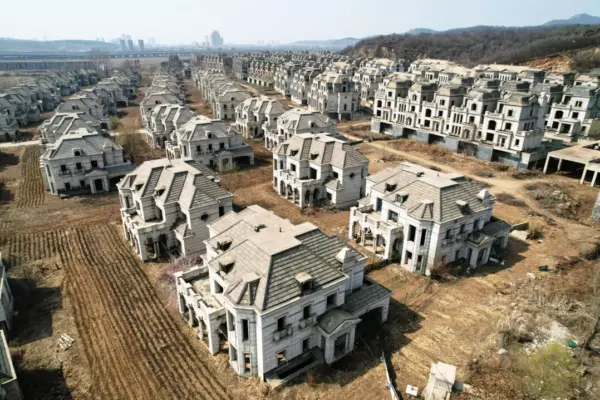
The bursting of the real estate bubble has been a major issue in recent years. In April 2026, real estate development investment declined by 14%, new construction area plummeted by 22%, and housing sales continued to decline, suppressing consumption related to furniture, home appliances, building materials, and other residential sectors. Moreover, over 60% of the assets of Chinese residents are tied up in real estate, leading to reduced wealth, uncertain income capabilities, and income expectations, making residents more cautious in making large consumption decisions.
Secondly, the private economy is stagnating. The shift towards a more state-controlled economy in China has pushed the private sector into a harsh winter, impacting the overall economy and employment levels, resulting in a decrease in overall household income.
Thirdly, local government finances are drying up. Previously, local governments relied heavily on land sales for revenue, but with the continuous slump in real estate and minimal infrastructure projects, local finances have dried up, prompting many regions to resort to squeezing private enterprises for funds.
Hu Liren pointed out that in this situation, it is challenging to boost the entire economy solely through domestic consumption in China.
While domestic demand in the Chinese economy continues to be insufficient, the export engine is running at a high speed. According to the General Administration of Customs of China, calculated in US dollars, exports in April increased by 14.1% year-on-year, a significant rise of 11.6 percentage points from March and well above the expected 7.9%. CNBC highlighted that foreign buyers are stockpiling goods due to concerns about the Iran war, contributing to the surge in Chinese exports.
Hu Liren analyzed that despite the apparent increase in exports, it is only a temporary surface phenomenon as many international businesses are stockpiling goods. Concerned about the prolonged duration of the war with Iran, these retailers and companies placed a large number of orders with Chinese enterprises in April, leading to extensive stockpiling. Therefore, the current high export data in China does not truly reflect supply-demand dynamics; once the war ends, there will likely be a rebound, making the sustainability of this growth difficult.
Hu Liren stated that the aggressive sales approach has led to a significant decline in corporate profits. With declining profits, employees are unable to see real increases in their income. Under these circumstances, the consumer base in China has lost its purchasing power.
Hu Liren believes that the growth in exports cannot alter the overall reality of economic weakness. In fact, China’s economy has entered a severe winter, compounded by the current political system, which makes it difficult to break through.
Oxford Economics of the UK stated in its report that “the lower-than-expected data reinforces our view that Chinese economic growth will slow, with limited prospects for future recovery, posing downside risks to our overall forecast for 4.7% GDP growth in 2026.”
In conclusion, the economic dynamics in China have entered a challenging phase with sluggish domestic consumption, over-reliance on exports, and structural issues in various sectors.