
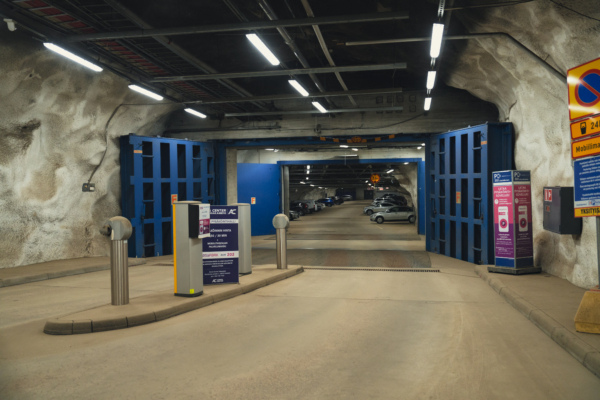
The vast underground air-raid shelter system in Helsinki, the capital of Finland, is attracting delegations from various countries to learn from. Against the backdrop of ongoing conflict in Ukraine and escalating tensions in Iran, Finland’s exports and construction business in this field have significantly increased.
According to a report from Reuters on Thursday (May 21st), Helsinki’s largest dual-purpose air-raid shelter is located in the Merihaka community, with a volume of 71,000 cubic meters, built 25 meters underground and capable of accommodating 6,000 people.
This enormous underground facility features sports facilities, gyms, and children’s playgrounds for daily use by citizens during peacetime. In the event of war or emergencies, it can be converted within 72 hours into an underground refuge equipped with double-layer beds, water tanks, and mobile toilets.
Laughter from children bouncing on trampolines and climbing soft climbing frames, sounds of plastic balls hitting hockey sticks in children’s floorball matches, and their cheers fill these air-raid shelters, contrasting sharply with their primary purpose of being shelters from war attacks.
Approximately 800 foreign delegations have visited Helsinki to tour the shelters, including Ukrainian President Volodymyr Zelenskiy, Polish President Karol Nawrocki, and European Commission President Ursula von der Leyen.
Helsinki has about 5,500 civil defense air-raid shelters, and Finland as a whole has about 50,500 shelters with a total capacity of 4.8 million people, roughly 85% of the national population.
Under Finnish regulations, buildings over 1,200 square meters must have air-raid shelters built below, with construction costs accounting for about 1.5% to 4% of the total construction costs.
With decades of accumulated expertise in dual-purpose air-raid shelter construction and maintenance, Finnish companies possess excellent professional skills, such as installing and maintaining radiation doors, ventilation systems, emergency power sources, communication, and sewage networks.
As demand rises, Finnish companies are actively expanding into overseas markets. The Resilience Center Finland was established in March of this year to promote related exports. The export volume of air-raid shelters has reached approximately tens of millions of euros, with the industry expecting significant growth potential.
Juha Simola, CEO of Temet Group, stated that the company is constructing a factory in the United Arab Emirates, with plans to build hundreds of air-raid shelters, particularly urgent in Abu Dhabi.
Ilkka Kivisaari, CEO of the joint venture company Verona Shelters Group, highlighted strong demand in the markets of Poland, Germany, and the Middle East, with production capacity expected to be insufficient in the next two years.
Tetiana Grunska, Deputy Director of the Military Administration of Barakliya City in Ukraine, expressed the desire to build similar sports complex air-raid shelter facilities locally after a recent visit with the Mayors’ Club Ukraine delegation. Barakliya currently faces over 15 air raid alerts daily, indicating a clear demand for air defense facilities near the Ukrainian front lines.
Deputy Director of the Polish Ministry of the Interior, Robert Klonowski, acknowledged that Poland’s last air-raid shelter was built in the mid-1990s, with no action taken in this field over the past 30 years. He disclosed that Poland is now beginning to rebuild, with allocated funds of 5.8 billion Zloty (approximately 1.59 billion US dollars) over the last year and this year for renovating collective underground defense facilities.