
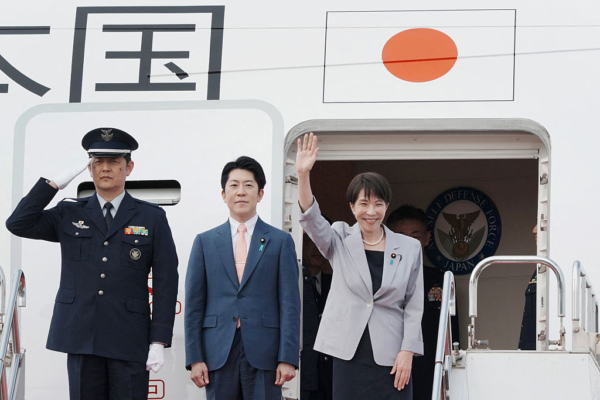
On Wednesday, Chinese Communist Party leader Xi Jinping and Russian President Vladimir Putin accused Japan of accelerating “remilitarization,” sparking a rebuttal from the Japanese government. Deputy Chief Cabinet Secretary Masanao Ozaki stated on Thursday that the accusations from China and Russia are “baseless.” Ozaki urged China and Russia to change their behavior that has raised “serious concerns” internationally.
Xi Jinping and Putin met in Beijing on Wednesday and in a joint statement, they accused Japan of speeding up “remilitarization,” viewing it as a “serious threat” to regional peace and stability. The statement also alleged that the Tokyo government is pushing to amend the “Three Non-Nuclear Principles,” which involve not possessing, producing, or introducing nuclear weapons.
According to reports from Japanese media Kyodo News, Deputy Chief Cabinet Secretary Masanao Ozaki refuted the accusations from China and Russia in a press conference on Thursday. He emphasized that since the end of World War II, Japan has consistently upheld values of freedom, democracy, and the rule of law, contributing to the prosperity of Asia and the world. Ozaki reiterated that Japan’s policy remains purely defensive-oriented.
During the press conference, Ozaki also stressed that Japan hopes China and Russia will change their behavior regarding military activities in places like Beijing, as well as Russia’s invasion of Ukraine. He stated that Beijing’s military actions have “triggered serious concerns in the international community.”
Tensions in Japan-China relations have been high since Prime Minister Takanosae Takaichi’s “Taiwan contingency” statement last November, which has led to economic retaliation from the Chinese Communist Party.
After Russia’s full-scale invasion of Ukraine in February 2022, Japan joined Western countries in imposing strict economic sanctions on Russia, further straining relations between Japan and Russia.
China’s increasingly aggressive posture continues to escalate regional security threats. In early December last year, Chinese fighter jets J-15 twice used radar to illuminate Japanese Self-Defense Force aircraft near the waters of Okinawa, prompting condemnation from the Tokyo government. In May of the same year, Chinese naval helicopters violated Japan’s airspace, leading the Japan Air Self-Defense Force to scramble two F-15 fighter jets in response.
These provocations have prompted Tokyo to expedite the process of increasing defense spending. In mid-December last year, the Japanese Diet approved a supplementary budget for the 2025 fiscal year, raising defense spending to 2% of the Gross Domestic Product (GDP), two years ahead of the original plan. This marks a significant milestone for Japan, which has long limited defense spending to 1% of GDP to maintain its post-war pacifist principles. However, the escalating threats in Japan’s vicinity in recent years have prompted a major shift in the country’s defense policy.
Sources revealed to Kyodo News on May 18 that Takaichi’s ruling Liberal Democratic Party had drafted a proposal urging the swift deployment of interception drones and high-energy weapons, drawing lessons from the war in Ukraine.
Takaichi previously stated, “Japan’s security environment has become extremely severe, so I believe it is imperative to strengthen defense capabilities.”