
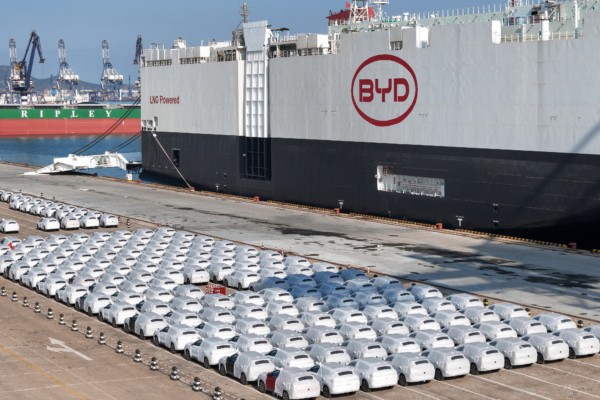
Since May, more than 10 car companies have raised prices or tightened purchase rights for nearly 20 new energy vehicle models. It is noteworthy that this round of price hikes is not driven by strong consumer demand, but by soaring supply chain costs and plummeting profits, just like the price wars in previous years, all are desperate moves by car companies to survive.
In May, the mainland new energy vehicle market has seen a wave of price adjustments, with many mainstream new energy vehicle models gradually increasing prices or tightening purchase rights.
According to a report by “The First Financial Daily” on Wednesday (20th), incomplete data shows that this round of price adjustments involves more than 10 major car companies and nearly 20 new energy vehicle models, with price increases ranging from 2000 to 10,000 yuan (RMB) for each model.
Major models include Changan Oushang Q07, Guangqi Aion Y Younger and Aion S Plus, three models under the Aion brand, three models under the NIO brand, six models under the BYD brand, some models in the Volkswagen ID series (ID.3, ID.4 X, ID.6 X), and the Toyota BZ4, among others.
Changan Oushang officially stated that due to the sharp rise in global automotive grade chip costs, starting from May 7th, the guidance prices of the three configurations of the Oushang Q07 Tianzhu Smart Laser Edition (215 Laser Prestige, 215 Laser Flagship, 215 Laser Flagship Plus) produced have been uniformly raised by 3000 yuan.
Recently, Guangqi Aion’s Aion Y Younger, Aion S Plus and other popular all-electric models have raised end prices by 3000 to 6000 yuan and simultaneously tightened end discounts. NIO’s 2026 models ES6, ES8, EC6 and other SUV main models have adjusted prices, with price increases ranging from 5000 to 10,000 yuan, and the original free battery swapping rights have also been reduced.
In addition, some brands have not raised the prices of their models, but their pre-order/purchase rights have changed. For example, the reservation benefit for Le Dao L80 has been reduced from “2000 yuan redeemable for 5000 yuan” to “1000 yuan redeemable for 3000 yuan”, Xiaopeng G6/G9 intelligent driving version has canceled or narrowed the time-limited discount (an implied price increase of 5000 yuan), and the financial interest subsidy for Ideal Cars has decreased (an increase of about 3000 to 5000 yuan in hidden costs).
According to reports from several mainland media outlets including “Securities Times” and “Fast Technology,” the sharp rise in supply chain costs is a key driver of the current round of price hikes.
The “Securities Times” reported on Wednesday (20th) that Zhang Xiang, a researcher at the Automotive Industry Innovation Research Center of North China University of Technology, analyzed that the prices of raw materials for power batteries continue to rebound, with the price of lithium carbonate significantly rising, coupled with simultaneous increases in the prices of cobalt, nickel, copper, and other metals, leading to a continuous increase in the overall manufacturing costs of vehicles. At the same time, the global AI industry occupies a large amount of semiconductor production capacity, resulting in a tense supply and rising prices of automotive grade chips, further exacerbating the cost burden on car companies.
A report by “Fast Technology” recently stated that since the beginning of this year, the price of the core raw material lithium carbonate for power batteries has risen from 75,000 yuan/ton to nearly 200,000 yuan/ton, an increase of over 125%. Since batteries account for 30% to 60% of the total vehicle cost, this has led to an increase of 3000 to 5000 yuan in the manufacturing cost of a car.
More importantly, the demand for AI large-model computing power has surged, with global wafer fabs prioritizing advanced process capacity for AI chips, leading to a supply-demand imbalance in automotive-grade storage chips.
According to UBS data, in the past three months, the overall price of automotive-grade DRAM has increased by 180%. TrendForce monitoring has shown that since the second half of 2025, the price of automotive-grade DDR4 memory has cumulatively increased by over 150%, while DDR5 memory has surged by 300%. The increase in storage chip prices alone has added 3000 to 7000 yuan to the cost of intelligent driving models.
An article on the WeChat public account “Car Market Stories” stated on Tuesday that two years ago, cars in the 200,000 yuan price range had memory sizes of only 8GB or 12GB, similar to mobile phones. But now, in order to run large models and high-level intelligent driving systems, the memory usage has exceeded 100GB, and some even reached 200GB! This is the reason why BYD’s “Tian Shen Zhi Yan B” assisted driving laser edition and Changan Oushang Q07 Tianzhu Smart Laser edition recently increased prices by 2100 yuan and 3000 yuan, respectively.
In addition to batteries and chips, the prices of other raw materials have also risen significantly. This year, aluminum prices have exceeded 25,000 yuan/ton, and copper prices have surpassed 100,000 yuan. Manufacturing a medium-sized electric vehicle requires 200 kilograms of aluminum and 80 kilograms of copper.
UBS’s research report on “The Impact of Metal and DRAM Price Increases on Electric Vehicles in the Chinese Automobile Industry” calculates that the manufacturing cost of a typical medium-sized smart electric vehicle will increase by 4000 to 7000 yuan in the short term. Just due to the rise in metal raw material prices, the cost of a single electric vehicle has increased by about 5600 yuan.
An article in “China Industry Report” analyzed that the fundamental reason for car companies raising prices is that the continuous price war has squeezed industry profits to the limit. In January 2023, Tesla first significantly reduced prices, BYD launched the “same price for electric and gasoline vehicles,” in 2024, more than 227 models announced price reductions, and by early 2025, over 30 brands once again collectively entered the market, making price wars the norm. The profit margins of car companies have been eroded layer by layer.
The situation where sacrificing prices in previous years brought market share has also changed. This year, the effect of price reductions on sales has weakened, and the intensity of price reductions has sharply decreased.
According to data from the China Passenger Car Association, in the first four months of 2026, the year-on-year decrease in national passenger car retail sales was 18.5%; in the first ten days of May, sales plummeted by 21%. The car market is in a trough, with consumers showing a strong preference to wait and see before purchasing a car.
Recently, Cui Dongshu, Secretary-General of the Passenger Car Branch, admitted that since the beginning of the year, there have been only 56 offerings nationwide for passenger car price reductions, a full 12 fewer than the same period last year! The extent of price reductions for new energy vehicles has dramatically shrunk: plug-in hybrid models have had 9 price reductions, a decrease of 4 models, and pure electric vehicles have had 16 price reductions, a full 14 fewer than the same period last year!
The article on the WeChat public account “Car Market Stories” mentioned above believes that the end of the exemption from purchase tax for new energy vehicles, now replaced by a halved tax rate, as well as a decrease in the subsidy intensity for trading in old models for new ones, have contributed to this trend. Last year’s wave of “last-minute policy buses” overdrew a large amount of demand, resulting in a “hell mode” start to this year.
The article in “The Securities Times” mentioned above stated that there are differing views within the industry regarding the sustainability of the current round of price hikes.
Cui Dongshu, Secretary-General of the National Passenger Car Market Information Joint Council, believes that the conditions for continued widespread price increases may not exist. He analyzed that high-end new energy vehicle companies have relatively strong cost pressure tolerance; while mid- to low-end car companies face dual pressures from intensified market competition and shrinking consumer demand. Once prices are raised significantly, they are at high risk of losing customers and the likelihood of price increases is very low. At the same time, as a large number of new car models have entered the market with low-price strategies, most car companies’ price increases are mainly at the level of public opinion, but practical implementation poses significant challenges.
However, some hold the opinion that with the high-tension situation in the prices of battery raw materials such as lithium carbonate expected to persist in the short term, coupled with the continued tight supply and demand situation for automotive-grade chips, the pressure on manufacturing costs could possibly exist in the long term, providing a basis for the sustained price hikes in this round.
Auto industry analyst Wu Kun stated that some car companies are in a dilemma, as they dare not raise prices significantly which would result in a loss of market share, but they also have to deal with the profit erosion caused by the rising prices of raw materials. They can only maintain a balance by shrinking discounts and reducing benefits. Car companies focusing on the entry-level market are in a more precarious situation. Fierce homogenized competition has deprived them of bargaining power, and the pressure on costs can only be absorbed internally, squeezing their survival space.