
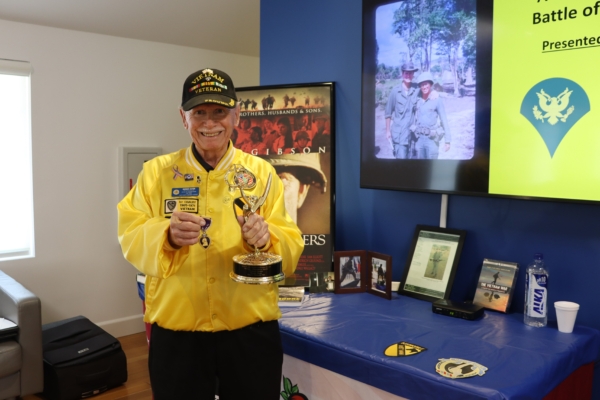
Recently, the city of Costa Mesa in Orange County, Southern California, held a special exhibition called “Echoes of Conflict: Remembering Vietnam” to commemorate the Battle of la Drang, a significant 5-day battle of the Vietnam War. 83-year-old Vietnam War veteran Ronnie Guyer, who witnessed the Battle of la Drang, was invited to share his experiences with residents. Many veterans have buried their experiences and emotions from the early years in their hearts due to the environment back home.
The book “We Were Soldiers Once…and Young” published in 1992 meticulously documents this key battle of the Vietnam War. One of the authors, Lt. Col. Harold G. Moore, who commanded the “X-Ray Landing Zone” at that time, co-authored the book with war correspondent Joseph Galloway. This book was adapted into the movie “We Were Soldiers” in 2022, starring Mel Gibson as Moore.
In the Heroes Hall gallery, Guyer began reminiscing: “One of the greatest opportunities in my life was enlisting in the military. Serving the country, whether in New York or Vietnam, has given me many valuable life experiences.”
When my mother passed away when I was 20, everything was uncertain. “I urgently wanted to escape, to see the world, to understand what is real and what is false.” With new policies allowing young people to volunteer for a two-year service, it suited me well—it used to be mandatory to serve for three years.
God always made things happen for me at the right time. I enlisted near a draft board by Two Guys department store, and then we stayed in New York City for a while, experiencing the glamour of the big city; from there, we assembled to board ships bound for Vietnam.
As a child, I always wanted to be a tall, 220-pound man, but I ended up short. However, in the intense firefight and various incidents on the battlefield, I was strong and powerful.
In the summer of 1965, with President Lyndon B. Johnson’s approval, 300,000 regular US troops entered Vietnam for combat. From November 14-18, a major battle broke out in the Central Highlands of Vietnam, known as the Battle of la Drang. The US military considered the area ideal for “air mobile” tactics, using helicopters to insert battalion-sized forces and provide air artillery support, followed by evacuation upon completing the mission.
From the 14th to the 16th, under the command of Lt. Col. Moore, the US forces at the X-Ray Landing Zone repelled the relentless attacks of the North Vietnamese army for three days and nights, declaring a kill ratio of 10 to 1. From the 17th to the 18th, at the Albany Landing Zone led by Lt. Col. Robert McDade, the US forces were surrounded by the North Vietnamese and engaged in close combat, unable to call for artillery support, resulting in over 50% casualties; both sides declared victory in the battle.
Guyer served as a clerk and radio operator in the 1st Battalion of the 7th Cavalry under Moore. The US forces bombed the X-Ray Landing Zone for safe helicopter landing, with the first helicopters taking off around 10:35 am on the 14th and arriving at the landing point about 13 minutes later.
Guyer continued to recount: “It was quiet when we arrived, with no enemy sightings. I kept receiving and transmitting various orders. About 20 minutes later, our forces captured two enemy soldiers. The hellish melee broke out around 2:45 pm. The combat parts of the movie were quite realistic, but the ending was altered.”
The US forces had absolute air power, continuously transporting ammunition and supplies with helicopters, evacuating casualties; B-52 bombers were used for the first time in battle; artillery units kept firing, creating a dense and formidable line of fire around the landing zone, shielding the soldiers fighting bravely in the bloodbath.
Guyer showed photos from that time to everyone. He explained that the wounded with X-marked bandages were critically injured and needed to be evacuated urgently; lightly wounded had no marks or bandages, and the bodies of the deceased were left uncovered for identification purposes.
Rick Rescorla became well-known for his photo carrying a rifle, which became the cover image of a book. He was a company commander in the 2nd Battalion of the 7th Cavalry. He evacuated all the lightly and severely wounded in his area and sent them by helicopter. Moore called him “the best company commander I have ever seen.” Years later, during the 9/11 attacks, as the security chief of Morgan Stanley, he led about 2,700 employees to evacuate from the 44th floor of the World Trade Center’s Tower 2 but tragically died trying to save more people when he went back to the tower.
Guyer mentioned how a young officer named Martha Pierre was severely injured, with a bullet hole through her throat, and was promptly operated on by Captain Carrera; machine gunner Clinton from Iowa was hit by gunshot wounds and shrapnel but stood firm on his post. They were the bravest and most dedicated soldiers he had ever seen.
A video captured Lt. Col. Moore’s speech: “These soldiers showed incredible bravery over three days and nights. They went wherever they were assigned without hesitation to complete the mission. They possessed tremendous cohesion and were impeccable soldiers. As the commander of this unit for 18 months, I truly cannot put into words their greatness.”
The Purple Heart is awarded by the President to US military personnel wounded or killed in action since April 5, 1917. Guyer received the Purple Heart and said, “Every time I speak at schools, I let the audience pass it around so kids can proudly say they have touched it or held it in their palms.”
Guyer continued his recollections: “The landing zone was covered in waist-high grass. As we moved down the slope towards the designated position, the person in front of me suddenly fell, and as I followed closely, a sharp bamboo stick pierced his leg and then mine. We were both unlucky, but his injury was much more severe than mine.”
After the battle, Lt. Col. Moore personally wrote condolence letters for all about 500 casualties and wounded soldiers, and Guyer was in charge of typing them. “I was busy for about 2 and a half weeks and had to bring all the typewriters over.” Guyer said, “My other task was registering. Every time wounded or deceased soldiers were brought back by helicopter, I had to check their identification tags around their necks, record their names and injuries, and report to the commander.”
The Battle of la Drang resulted in 237 US military personnel killed, 258 wounded, and 4 missing. Guyer returned home from the front lines in 1966 and has since been dedicated to “clarifying the truth.” He said, “This has been the top priority for me to invest my energy and fight for over the past 61 years.”
Television often portrays various bizarre and ridiculous dramas, even now; thankfully, they are being corrected and debunked. Guyer suggests that to uncover the truth, the best way is to engage in deep discussions and exchanges with those who were on the “battlefield” themselves. ◇