
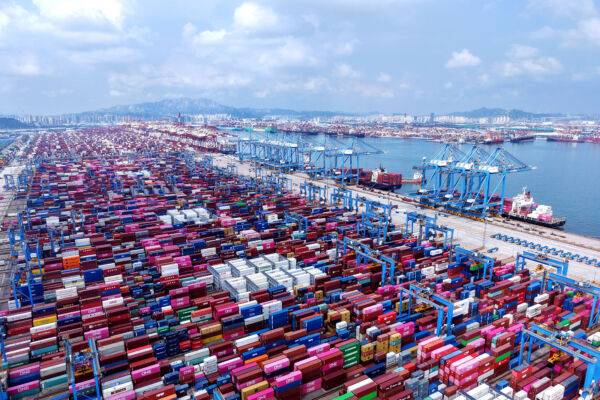
On 12th May, the EU delegation to China hosted the “Second EU-China Relations Forum” in Beijing. During the event, the escalating trade tensions between the two sides led to intense arguments and mutual accusations, showing that the deteriorating trend in EU-China relations is like a “sinking ship,” with a trade war becoming increasingly inevitable.
According to the official website of the EU delegation to China on 13th May, the forum brought together government officials, scholars, business leaders, experts, diplomats, media representatives, and the public to engage in a full day of open and constructive dialogue on the future of EU-China relations.
However, as reported by the South China Morning Post on 17th May, participants from Europe and China engaged in heated arguments over issues such as the deepening trade friction between the two sides.
The EU accused Beijing of ignoring Europe’s long-standing concerns and turning a blind eye to the increasingly imbalanced economic reality of their trade relationship. In response, China accused the EU of implementing “protectionist” policies and trying to decouple from Beijing.
During a panel discussion titled “EU-China Trade Relations: Partners or Sinking Ship?”, participants from both sides engaged in heated exchanges, almost reaching a point of confrontation.
Jens Eskelund, Chairman of the EU Chamber of Commerce in China, criticized China for disregarding facts and accusing the EU of implementing “protectionism” while flooding the EU with goods.
He vividly described the current EU-China trade situation as not just a sinking ship or a partnership but rather a giant 400-meter-long container ship carrying 24,000 containers to Europe and returning nearly empty.
Researcher Jian Junbo from Fudan University’s Center for EU-China Relations responded by calling the EU’s policy of decoupling from China “regrettable” and emphasized the need for both sides to “jointly oppose protectionism.”
Eskelund countered by highlighting that 42% of containers entering Europe come from China, with a 17% increase in Chinese container transport to the EU in 2025.
He further emphasized, “The lie of ‘European protectionism’ must be permanently shattered. In reality, Europe is extremely open… If you come from Mars and someone tells you, who is engaging in protectionism, China or Europe? The answer is clear, China is the protectionist nation.”
The dispute not only revolved around policy but also raised arguments about who should be held responsible for the comprehensive deterioration of relations between the two sides.
EU Ambassador to China Jorge Toledo pointed out that the EU faced attacks from “Chinese media and government from all sides” for its first major comprehensive industry policy, the Industrial Acceleration Act (IAA).
This statement was immediately rebutted by a Chinese participant, mocking him for “vividly demonstrating bullying.”
Alicia Garcia-Herrero, a Spanish economist, retorted vehemently, stating, “This is a meeting organized by EU institutions – you can’t talk to an EU ambassador about bullying.”
In his speech, Li Jian, Director of the European Department of the Chinese Ministry of Foreign Affairs, called for a thorough reduction of the risk level set for China and an end to targeted decoupling behavior.
He stated, “Some people always view relations with China through the lens of geopolitics and great power competition, seeing everything as weaponization or instrumentalization.”
Erik Kurzweil, the EU’s top diplomat for Asian affairs, emphasized, “The EU’s approach is not decoupling, but de-risking, with the aim of maintaining cooperation while reducing its own vulnerabilities, ensuring that China’s export-oriented industrial policy does not come at the expense of EU competitiveness.”
EU officials believe that although the EU had threatened Beijing that it would close its market if China did not open up its own, this threat was never carried out. China continued to close its market and flood the EU with almost all products while accusing Europe of implementing protectionism.
A senior diplomat involved in formulating policies towards China stated, “Every time we start discussing this trade reality, their gaze immediately becomes vacant – either they don’t care or they simply think they don’t need to take any action to change it.”
Some observers suggest that a trade war may be the only way to truly bring Beijing back to the negotiating table.
At the policy level, the European Commission is actively preparing stronger trade defense measures. Once the IAA draft is passed, it will require foreign investors dominant in strategic areas such as batteries and electric vehicles to hire more European workers, procure local manufacturing components, and transfer technology to European partners as a precondition for entering the EU market.
Simultaneously, updated cybersecurity legislation will tighten market access for Chinese companies in areas such as telecommunications, semiconductors, cloud computing, and connected cars.
According to reports from the Capitol Forum website, the EU will launch the next round of safeguard measures investigations in the chemical industry next month. This indicates that the quotas and tariffs imposed recently on the steel and ferroalloy industries may further expand.
In response, Beijing has issued multiple threats of retaliation. On 15th May, China banned companies, including airport scanner manufacturer Nuctech, from cooperating with the EU in the investigation of foreign subsidy regulations, demonstrating Beijing’s full commitment to countering Brussels’ tough policies.