
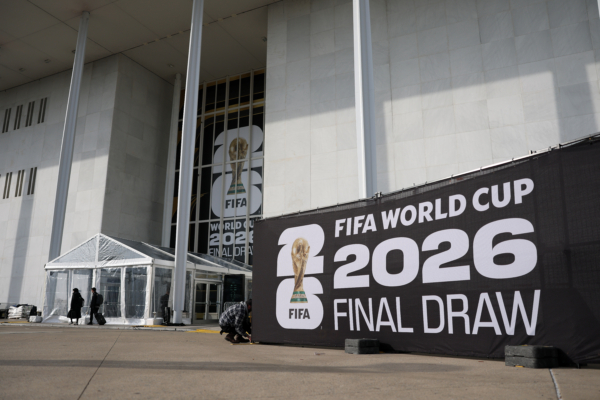
In the opening match of the 2026 FIFA World Cup in the United States, Canada, and Mexico, the Chinese Communist Central Television (CCTV) cannot afford the broadcasting rights. It is feared that hundreds of millions of football fans on the Chinese mainland may not be able to watch the games through official channels. The reasons behind this decision are varied and debated among mainland netizens. Many believe that the audience’s purchasing power is low and with people struggling to make ends meet, there are fewer viewers for the World Cup.
Less than 40 days remain until the start of the 2026 FIFA World Cup, and CCTV has yet to secure the broadcasting rights for the tournament. According to reports from mainland media, FIFA initially offered the broadcasting rights to CCTV for a price ranging from 250 to 300 million US dollars. However, CCTV’s budget may only be around 60 to 80 million US dollars. Even after negotiations reduced the price to 120 to 150 million US dollars, there is still a “huge gap” between FIFA’s expectations and CCTV’s budget.
Media in China stated that CCTV’s refusal to compromise is justified. With the Chinese team failing to qualify for the World Cup, even with the tournament expanding to 48 teams, the appeal of the World Cup domestically has significantly decreased.
Zhang Qing, the founder and CEO of Beijing Key Sports Consulting Co., said, “This is a process of negotiation. FIFA believes that with the expansion of the World Cup and more matches, the price should increase. However, in China, the era of big screens is gradually fading, and television media revenues have been declining.”
However, many Weibo users point out that CCTV’s decision not to purchase the broadcasting rights is due to the audience’s declining purchasing power.
A Weibo influencer, “Director in the Courtyard,” stated that it is evident that the World Cup no longer adds up financially, as people are prioritizing survival over entertainment. He highlighted the decline in box office revenues of movies during the holidays and how people are now focused on surviving before seeking happiness.
The post received nearly three thousand likes, with many users expressing similar sentiments, stating that younger people have less interest in football, while those in their forties are either facing job cuts or are concerned about potential unemployment, leading to a lack of interest in watching football matches.
Some netizens emphasized the impact of economic downturn and reduced consumer spending on entertainment, making it difficult for CCTV to attract advertisers and generate revenue to afford the broadcasting rights for the World Cup.
Former CCTV sports channel host Wang Tao commented on social media that during the 2022 Qatar World Cup, CCTV’s advertising revenue was less than 5 billion yuan. With the traditional media advertising market shrinking in recent years, achieving revenue surpassing this figure in the current tournament is challenging. The cost of acquiring broadcasting rights close to 2 billion yuan could severely limit profit margins and even pose a risk of losses.
Public opinion analysts have suggested that CCTV’s inability to purchase the World Cup broadcasting rights reflects China’s economic decline and financial constraints.
Sports industry manager Qiu Zhiwei, former vice president of LeTV Sports, stated to BBC Chinese that non-commercial entities like CCTV in China lack the flexibility in budget to afford FIFA’s demands, exceeding their financial capabilities.
According to official regulations in China, CCTV holds exclusive rights to negotiate and purchase television broadcasting rights for major international sports events within the country, which are then distributed to other platforms after acquisition.
Wang Tao, who worked at CCTV Sports for 11 years, mentioned that in the past, World Cup broadcasting rights were typically secured six months before the tournament began. This marks the first time with less than a month before the start of the tournament, there has been no agreement reached.
If FIFA and CCTV fail to reach an agreement, viewers in mainland China may not have access to live broadcasts of this year’s World Cup. FIFA has already reached media rights agreements for the 2026 World Cup with 175 countries and regions globally.
In Hong Kong, Now TV under PCCW secured the broadcasting rights for approximately 25 million US dollars, while in Macau, the broadcasting rights were acquired by TDM for an undisclosed amount.
In the United States, Fox Television paid 480 million US dollars to become the exclusive broadcaster. In the UK, BBC and ITV purchased the bundled rights for the next two World Cup editions for 350 million US dollars. The total spending on World Cup broadcasting rights in Europe amounted to nearly 1.5 billion US dollars. Platforms in Japan and South Korea secured single-edition rights for 200 million and 125 million US dollars, respectively.