
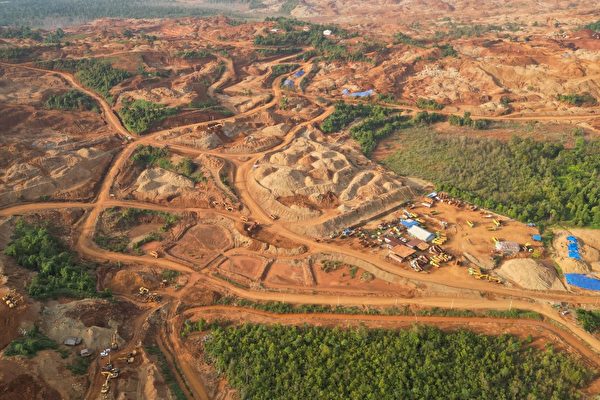
With the rapid development of the global new energy industry, the importance of key minerals such as nickel is becoming increasingly prominent. Indonesia and the Philippines recently signed a cooperation agreement in the nickel industry, aiming to create a regional “nickel corridor”. Analysts believe that against the backdrop of rising global “resource nationalism”, this move will not only reshape the supply chain and strengthen the control over strategic resources but also be seen as indirect opposition to China’s Belt and Road Initiative, potentially having a profound impact on Chinese enterprises’ overseas resource strategies.
According to a report from Antara News Agency on May 8th, Indonesia and the Philippines inked a landmark strategic cooperation agreement in the nickel industry to establish a “nickel corridor”, integrating the rich nickel resources of both countries to secure the supply chain for global electric vehicle batteries and stainless steel production.
Airlangga Hartarto, the Coordinating Minister for Economic Affairs of Indonesia, stated that this serves as the foundation for the “nickel corridor” of the two countries, a structured platform that connects Indonesia’s downstream smelting capabilities with the upstream mineral supply of the Philippines.
Airlangga emphasized that through cooperation, the Philippines will no longer be merely an exporter of raw ore but will be integrated into a higher-level regional value chain, while Indonesia will secure the raw material supply for the battery and stainless steel industries.
The significance of the agreement between the two countries aligns with the strategic deployment of strengthening the regional critical mineral supply chain emphasized at the 27th ASEAN Economic Coordination Summit. The 48th ASEAN Summit and related meetings were held in the Philippines from May 7th to 9th, with the Philippines serving as the rotating chair.
Data from the US Geological Survey in 2026 shows that by 2025, Indonesia and the Philippines collectively controlled around 73.6% of the global nickel production (Indonesia producing about 2.6 million tons, accounting for 66.7%; the Philippines producing around 270,000 tons, making up 6.9%). This collaboration between the two countries will open up the “nickel corridor” and build a powerful trade alliance.
Airlangga stressed that this regional axis of nickel reserves and production integration will have a global impact. Antara News Agency referred to the “nickel corridor” established by the two countries as part of the “energy sovereignty strategy”.
The collaboration between Indonesia and the Philippines is bound to have a significant impact in the field, especially affecting China, which holds a crucial position in this sector.
Nickel is a vital strategic mineral globally, especially for electric vehicle batteries and solar energy storage.
Over the years, Chinese companies have heavily invested in nickel mining in Indonesia, initially focusing on purchasing Indonesian raw ore primarily for domestic enterprises’ production of nickel-iron and stainless steel. In 2014, when Indonesia banned the export of nickel ore, Chinese enterprises began investing directly in building facilities in Indonesia, mainly developing pyrometallurgical projects and gradually integrating downstream stainless steel projects.
Currently, with the rapid growth of new energy vehicles and the substantial increase in nickel demand for ternary batteries, Chinese enterprises have launched hydrometallurgical projects to further solidify their dominant position.
A report from the C4ADS, a US-based global security non-profit organization, stated that Chinese companies control approximately 75% of the refined nickel production capacity in Indonesia, raising concerns due to existing supply chain and environmental risks.
The report mentioned that Indonesia’s 8 million tons of refined nickel production capacity is spread across 33 companies, but tracing ownership reveals overlapping shareholders. As of 2023, Chinese companies ultimately controlled about three-quarters of the smelting capacity.
In the past decade, Chinese investments in Indonesia have exceeded 14 billion US dollars. In terms of cooperation, Chinese enterprises have gradually expanded from nickel mining and nickel-iron smelting to battery materials and complete vehicle manufacturing throughout the entire industrial chain.
A study by mainland Zhong Lun Law Firm highlighted that the reason Chinese companies have rapidly expanded in Indonesia is due to the almost non-existent institutional barriers in Indonesia.
In reality, Chinese mining, processing, and investment in nickel in Indonesia have been an important aspect of advancing their new energy industry layout under the backdrop of promoting the Belt and Road Initiative globally.
A previous analysis by Taiwan’s DSET, a national-level think tank, referred to Chinese companies’ expansion into critical minerals in Indonesia as the “Indonesian model” of China. The report suggested that Chinese enterprises have not only gained low-cost minerals in Indonesia but also evaded US trade barriers, securing an almost monopolistic position.
The report cautioned that the risks posed by this structure to global critical mineral supply chains should not be underestimated.
The report assessed the case of Qing Shan Group. Since 2009, the company has entered relevant fields through joint ventures with Indonesian companies and rapidly expanded investments post-2014, gradually expanding its business from mining and processing to battery production and material recycling, completing a highly vertically integrated industrial layout.
It is noteworthy that these commercial activities were progressively implemented and expanded under the support of China’s Belt and Road Initiative policy. The Chinese side refers to its cooperation with Indonesia as jointly building a framework under the Belt and Road Initiative. This has raised external concerns about its “green extractivism” behavior and highlighted Indonesia’s long-term structural risk due to Chinese control in critical mineral sectors.
The report indicated that China’s success in Indonesia has led to the replication of this model in other overseas critical mineral investments, such as copper mining and processing in Peru and cobalt mining investments in the Democratic Republic of Congo. These cases share a common characteristic: China’s global layout in critical mineral supply chains.
Recently, the Indonesian government revised the pricing formula for nickel ore, including the value of by-product metals in the nickel ore price calculation. According to reports by Every Economic Net, prior to this adjustment, nickel ore pricing only considered the value of nickel metal elements; after the adjustment, iron, cobalt, chromium, and other metals are included in the pricing formula. In other words, Indonesia has begun valuing associated metals in nickel ores.
The new calculation method naturally raises nickel ore prices. Every Economic Net cited experts stating that following the price changes, the price of nickel ore (hydrometallurgical) has increased by at least 22 US dollars per ton.
On April 14th, the Indonesian Ministry of Energy and Mineral Resources announced that the calculation rules for the basic mineral price (HPM) would be revised, which was signed into effect by ministerial decree on April 10, 2026, effective from April 15.
Veteran media figure Mike Li told the Epoch Times that Indonesia’s move “has changed the nickel ore pricing method of the past century, moving from ‘single nickel element pricing’ to ‘comprehensive element pricing’, potentially leading to a price hike of over 100% in Indonesian nickel ore”.
Nickel ore from Indonesia and the Philippines has low nickel content, typically around 1.2% to 1.6%, with higher levels of other elements like iron, chromium, and cobalt, and moisture content around 20%. Due to its red iron content, it is also known as “laterite nickel ore”.
Mike Li emphasized, “With Indonesia holding around 40% of global nickel reserves, China has extensively invested capital in this area in recent years, with investments totaling up to 14 billion US dollars. China’s new energy policy has turned Indonesia into the global hub for nickel ore supply.” “Now, Indonesia wants to take full control and set pricing on its own terms.”
This policy adjustment will not only impact the stainless steel industry but also affect battery manufacturing, high-nickel batteries, and energy storage systems.
Mike Li pointed out that Indonesia’s policy adjustment, similar to the recent Chilean copper tax increases and the mining policy changes in the Democratic Republic of Congo, is a reaction to China’s expansionist Belt and Road Initiative, reflecting a global rise in “resource nationalism”.
Since the end of 2025, some resource-rich countries around the world have started implementing restrictions on mineral resource exports.
According to a report by the Global Times, at the end of 2025, the world’s largest cobalt-producing country, the Democratic Republic of Congo, tightened its cobalt export quotas; subsequently, Vietnam also banned the export of rare earth minerals.
In February 2026, Africa’s largest lithium resource supplier, Zimbabwe, suspended the export of lithium ores and lithium concentrates, and Ghana announced that it would cease exporting unprocessed ores by 2030.
In March 2026, Indonesia significantly reduced its nickel ore mining quota to about 210 million tons for 2026, down by over 40% from 2025; Guinea, the world’s largest bauxite producer, stated it will soon restrict bauxite ore exports.
Mike Li told the Epoch Times that “These mineral resources have a significant impact on China’s new energy economy.”