
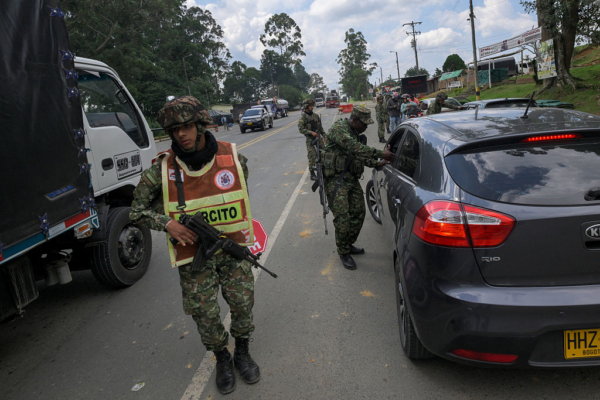
Colombia’s presidential election is set to take place at the end of May, with violence and crime issues expected to be among the top concerns for voters. Recent attacks on civilians and military bases in the southwest of the country have raised security concerns.
According to the Colombian Ministry of Defense, since last Friday (24th), anti-government groups have carried out 26 attacks using explosives and drones, including a fatal explosion on a highway between Cali and Popayán on the 25th. As of Monday (27th), the death toll from this explosion has risen to 21.
For decades, Colombian rebel groups have been vying for control over the southwest region with the government, attempting to establish it as a base for illegal activities like mining and drug trafficking, including the cultivation of coca leaves.
Authorities in Colombia have accused a group called FARC-EMC of orchestrating the deadly explosion near the Pan-American Highway tunnel last weekend. The leader of this group, Nestor Vera, also known as Iván Mordisco, was a former member of the Revolutionary Armed Forces of Colombia (FARC) who rejected the peace agreement reached with the Colombian government in 2016.
Political risk analyst Sergio Guzmán in Bogotá suggests that FARC-EMC might be trying to demonstrate their capability of causing serious damage as leverage in future negotiations with the next government.
Under President Petro’s leadership, the Colombian government has been promoting a strategy called “Comprehensive Peace” to engage in peace negotiations with domestic anti-government armed groups.
Petro’s government has proposed ceasefire agreements to various armed groups in Colombia for peace talks. However, analysts believe that this strategy has failed, with rebel groups regrouping and strengthening their control over Colombian communities during these ceasefires.
For instance, FARC-EMC is known for taxing residents in their controlled areas and forcibly recruiting young people into their organization.
Political science professor Javier Garay from Externado University in Colombia pointed out that the government’s peace policy is too naive, believing that a condescending approach towards these organizations would yield positive responses.
In late 2023, peace negotiations with FARC-EMC, led by Mordisco, began but the hardliners withdrew in April 2024, leading to continued clashes with the Colombian government forces.
In the past two years, armed groups led by Mordisco have retaliated with drone and car bomb attacks against Colombian military actions in Micay Canyon. This canyon is abundant in coca fields and is still under the control of FARC-EMC.
The Colombian Minister of Defense stated on Sunday (26th) that due to government actions, incidents of kidnappings and blockades against civilians by anti-government groups in Cauca province have decreased in the past year.
On Monday (27th) night, President Petro announced on national television that his government has been combating drug trafficking and curbing coca cultivation in Colombia, reducing the coca cultivation area to 258,000 hectares (638,000 acres) by the end of 2025.
However, the government’s “Comprehensive Peace” strategy has faced criticism from the opposition. Opposition candidates pledged to take a tougher stance against crime.
According to the Colombian constitution, the president cannot seek re-election. Ivan Cepeda, a candidate from Petro’s party, has vowed to continue peace negotiations with anti-government armed groups.
Cepeda condemned the recent attacks in southwest Colombia on social media and urged authorities to investigate if these incidents were attempts to interfere with the elections.
In response, President Petro called on the Colombian security forces on Monday night to investigate if the explosives used in the Saturday attacks came from Ecuador — the neighboring conservative government has recently been in a trade war with Colombia over border security issues.
Petro stated in his televised address, “They are trying to disrupt our elections to ensure the victory of the extreme right… They are very afraid.” However, he did not specifically indicate who might be trying to disrupt the upcoming election.
The Colombian presidential election is scheduled for May 31st. Voters will choose the next president from 14 candidates, including the leftist Cepeda and conservative candidates Abelardo de la Espriella and Paloma Valencia.