
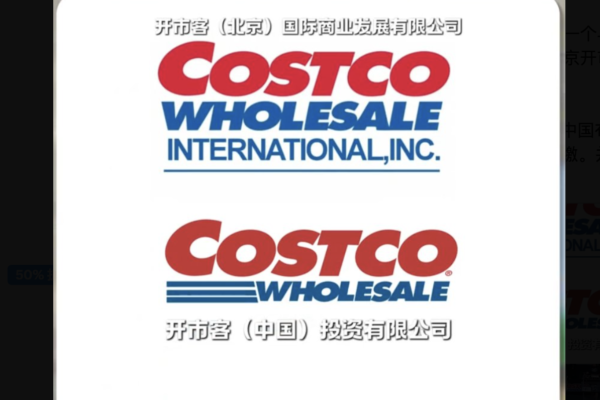
China has seen repeated incidents of foreign brands being counterfeited, and the recent “true or false Costco” controversy is escalating. Two retailers, one claiming no trademark infringement, and the other stating it is the legitimate operating entity of Costco in mainland China, both deny any association with each other. One of them, possibly involving state resources due to Chinese operation, has sparked heated discussion online, speculating that it might be a “white glove” for high-ranking officials in the Chinese Communist Party.
The original “Costco China” was established on December 22, 2017, headquartered in Pudong, Shanghai, as a wholly-owned foreign enterprise registered in Nevada, USA, known as COSTCO WHOLESALE INTERNATIONAL, INC.
The other is “Costco Beijing,” operating as “Costco Beijing International Business Development Co., Ltd.” The WeChat public account recently claimed that COSTCO WHOLESALE INTERNATIONAL, INC. (Costco International Wholesale Company) would invest a total of $1.5 billion to establish Costco (Beijing) International Business Development Co., Ltd. in Beijing.
As the Chinese headquarters of Costco, the initial focus of “Costco Beijing” will be in six core cities including Beijing, Chengdu, Wuhan, Guangzhou, Tianjin, and Hefei.
“Costco Beijing” was registered on April 16, 2026, as a foreign-owned enterprise with a registered capital of $100 million, located at Room A27, 3rd floor, Building 2, No. 15 Guanghua Road, Chaoyang District, Beijing, with Huang Shousu as the legal representative. Its shareholder, COSTCO WHOLESALE INTERNATIONAL, INC., is registered in New York, USA.
The public WeChat account of “Costco Beijing” also released notarized documents, business licenses, and registration certificates from the Beijing Municipal Supervision Bureau.
In response to “Costco Beijing” announcing the establishment of its Chinese headquarters, “Costco China” immediately declared a “counterfeiting” accusation, claiming that the other party had infringed on its trademark, brand identity, and company name, and has initiated legal action to protect its rights.
“Costco Beijing” countered, saying that the supermarket’s name it plans to open will not use “Costco” or “Costco,” but instead “COSTCO WHOLESALE INTERNATIONAL, INC.” It also accused “Costco China” of allegedly infringing on its reputation. On April 24, “Costco Beijing” filed a lawsuit against “Costco China” with the Shanghai court for reputation infringement, seeking a claim of 100,000 yuan. The case is currently under review.
“Costco Beijing” claimed that its parent company in New York has legally obtained a 10-year authorization for the “Costco” trademark from PRICE COSTCO INTERNATIONAL, INC., and will not open stores in the same city as “Costco China.”
Mr. Zeng, Vice President of the company, provided media with trademark authorization and several supporting documents, revealing that the authorization is valid from 2024 to 2034, with an annual licensing fee of $10 million. He emphasized that both Costco entities in China are legitimate.
However, “Costco China” denies “Costco Beijing” claims of authorization from the U.S. headquarters’ subsidiary.
According to mainland media reports, the trademark authorization obtained by “Costco Beijing” is limited to advertising and promotion and does not include retail or wholesale services for ordinary products.
The core of the dispute between “Costco Beijing” and “Costco China” lies in whether the trademark authorization is legal and valid.
On April 24, Zhao Liangshan, a senior partner at Shaanxi Henderson Law Firm, told mainland media that it is impossible to determine whether “Costco Beijing” has obtained a complete and legally valid authorization for the Costco trademark for commercial use on the ground. Even if it is presumed that the trademark authorization held by “Costco Beijing” is flawless, it has no right to directly open supermarkets under the name of Costco in various cities on the Chinese mainland.
It is worth noting that the direct controlling shareholder of “Costco Beijing” and its ultimate parent company have taken the same name as associated companies of “Costco China,” namely COSTCO WHOLESALE INTERNATIONAL, INC., and Costco Wholesale Corporation, with the difference being the registration location. In the U.S., different states allow the use of the same company name.
Per information from the official website of New York State, the direct controlling shareholder of “Costco Beijing” – Costco Wholesale International, Inc., was registered on March 26, 2026. In other words, this is a newly registered company.
Mr. Zeng, Vice President of “Costco Beijing,” told mainland media that when “Costco Beijing” opened, “Costco China” sent a congratulatory letter, accompanied by screenshots of Weibo. However, a related person from “Costco China” stated that the company never sent any congratulatory letter content and has not yet opened an official Weibo account.
The individuals behind the New York parent company of “Costco Beijing” are gradually piquing people’s curiosity.
An April 25 report from mainland media “Whale News” reveals that information on the official website of the New York Secretary of State indicates that COSTCO WHOLESALE INTERNATIONAL, INC. was registered on March 26, 2026, with its legal contact person being SHENGCHUAN PI — a Chinese surnamed Pi, as seen from the spelling — and the registered address displayed on Google Maps is a regular residential area.
According to the report, the name of Pi, the contact person of the New York State Costco company, has appeared multiple times in various controversies related to Costco. Many associated companies of Pi include terms such as “Costco.”
Financial search platform “Tianyancha” shows that Pi is currently involved in 14 companies, among which HSBC Zhaotage Group (Shenzhen) Co., Ltd., is one of Pi’s core companies.
However, Mr. Pi replied to mainland media that he stopped working in late March and officially resigned on April 17 for personal reasons, without any ties to the U.S. New York company or Costco Beijing.
The ‘true or false Costco’ incident in China has sparked discussions on overseas social media, with netizens commenting on the issue of counterfeiting and intellectual property rights protection challenges faced by international brands and celebrities in China.
Michael Jordan filed a lawsuit against Chinese company Qiaodan Sports Co., Ltd, using the name “Jordan” without consent. After multiple trials and appeals, in 2020, the Shanghai court ruled against Qiaodan Sports Co.
Similarly, New Balance was sued for trademark infringement in China by Zhou Lelun, who owned rights to the mark “Bairen” and “Xinbailun.” New Balance was ordered to compensate Zhou Lelun and make a public apology.
A long-standing 25-year dispute occurred between Japanese retailer MUJI and a textile company in Beijing over the “Muji” trademark. Despite legal battles, MUJI ultimately lost the case to the counterfeit brand.
These cases highlight the challenges faced by international companies in safeguarding their intellectual property rights in the Chinese market, often leading to legal disputes and financial losses.