
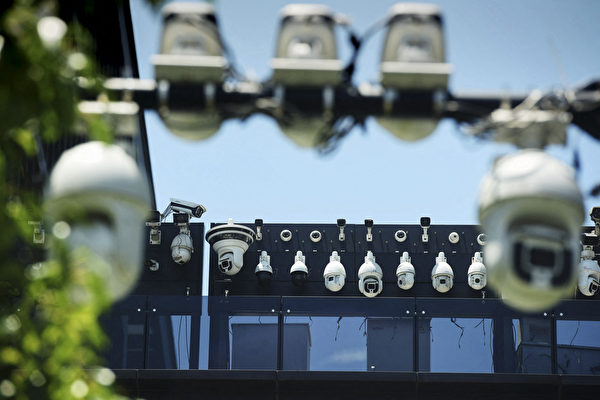
【Epoch Times May 20, 2026】Foreign media has revealed that the Chinese Communist authorities are utilizing AI facial recognition and big data integration technology to build a “Dynamic Control Platform for Overseas Personnel,” tracking foreign students, foreign spouses, foreign journalists, and other groups within China in almost real-time.
According to analysis by the cybersecurity research group NetAskari, this platform may currently be a “demo-system,” not fully connected to real-time data environments, with some complex functions still under development.
However, researchers have found that as of April 2026, new features such as “relationship graph query” have been added, indicating that the CCP may be attempting to integrate data from various sectors like transportation, healthcare, hotels, and leisure facilities to create an omnipresent digital surveillance network.
Sophia Yan, a senior foreign correspondent for The Telegraph who had been stationed in China for 10 years, discovered her own personal profile within this leaked database.
Yan stated that her file included old photos from 2021, her country of origin, organization names, English and Chinese names, gender, date of birth, citizenship status, passport number, and Chinese phone number among other information.
She shared that unlike many other records in the database, her record had a column labeled as “trackable” on the right side.
“Clicking into it, you can see all the data snippets showing where I was photographed, discovered, and entered into the database at certain locations in China.”
She described that details in some personal records were “very granular,” such as someone being captured 78 times at a specific intersection; other data could come from cameras at supermarket entrances, different subway stations, and more.
“This is very, very specific… and a bit spine-chilling,” Yan pointed out that China has deployed a large number of security cameras in cities and villages over the years, utilizing facial recognition scans for entry into places like gyms or boarding flights, generating a large amount of raw data that could be used for comprehensive individual tracking.
Yan warned that the CCP might further deploy this technology to track foreigners overseas.
The platform was first discovered by NetAskari, an independent research organization focused on Chinese cybersecurity, which later shared and jointly analyzed the findings with The Telegraph.
Developed by the Public Security Bureau of Zhangjiakou, Hebei Province, this platform’s monitoring capabilities far exceed traditional understanding. According to NetAskari, the system integrates diverse life data, including details of foreigners taking trains – such as train numbers, carriage numbers, and specific seat numbers.
Monitoring points also include hotel check-ins, hospital visits records, even “gasoline consumption” listed as separate data.
As Zhangjiakou was one of the locations for the 2022 Winter Olympics, NetAskari mentioned that the system appears to also integrate a skiing ticket system driven by facial recognition at ski resorts, for tracking foreigners visiting the area on holidays.
One of the core features of the platform is the “relationship graph tool”. The system can establish relationship models for the monitored targets, analyzing who are the target’s classmates, colleagues, whether they live in the same community or building, and even show if different people have been captured in the same frame by cameras.
Moreover, the system assigns “risk levels” to individuals. In leaked platform screens, one target was marked with a “63% risk level.” NetAskari pointed out that it’s currently unclear what information generates this indicator, in which contexts it is used, and it could be a temporary value in the demo system. However, this indicates that the system is designed to include the function of marking individuals with risk assessments.
The database shows that the CCP’s security agencies pay particular attention to specific groups. The system has dedicated statistical charts tracking citizens from the “Five Eyes Alliance” countries – the United States, United Kingdom, Canada, Australia, and New Zealand.
NetAskari’s analysis suggests that this shows the CCP security agencies seem to hold a default hostility towards citizens from the “Five Eyes” countries.
According to The Telegraph, the platform also offers other in-depth search functions, including filtering based on “fugitives,” foreign journalists, travelers, and individuals from Hong Kong, Macau, or Taiwan.
Researcher Marc Hofer from NetAskari stated that the CCP tracking journalists it deems as “national enemies” or at least “worth keeping an eye on” is not surprising, as such practices have existed since the CCP came to power.
He said, “They have never liked journalists from the beginning. Journalists are seen as another player in this large game of controlling narratives, controlling people’s thoughts, controlling historical reality – because that’s how the CCP operates; that’s their mindset.”
This system can be seen as a manifestation of the CCP’s broader surveillance projects like the “Sharp Eyes Project” and the “Sky Net.” Currently, there are more than 700 million surveillance cameras installed throughout China, averaging one camera for every two people.
Concerns from external sources highlight that as AI capabilities improve, the CCP is transforming people’s movements, social relationships, and daily activities into analyzable, filterable, and traceable data, forming an almost real-time and highly automated digital surveillance system. This not only threatens press freedom but also poses serious threats to the privacy and freedom of movement of foreign nationals in China.
The Telegraph pointed out that after investing in digital surveillance capabilities for the past 20 years, the Communist China is rapidly transitioning into a “dystopian authoritarian state.”