
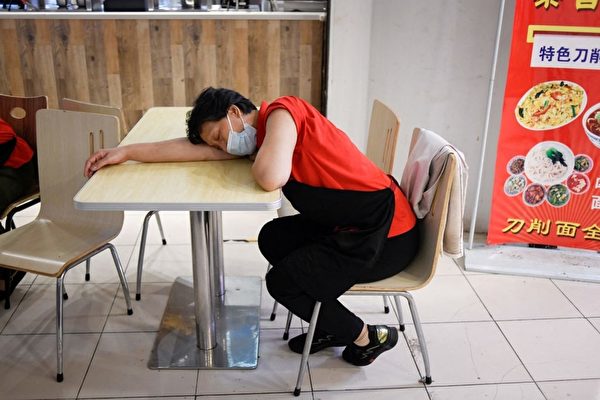
The Chinese official emphasizes the “theory of economic brightness,” but cannot hide the dire situation of the Chinese economy across various industries. Particularly, industries related to consumer livelihood are facing large-scale bankruptcies and closures, with even surviving businesses contracting.
According to data released by the Chinese National Bureau of Statistics on May 18, the “total retail sales of consumer goods,” as a measure of consumption, only grew by 0.2% in April, far below analysts’ expectations of 2%, marking the slowest growth rate since December 2022.
Meanwhile, according to the latest data from the People’s Bank of China, in April this year, Chinese residents’ loans decreased significantly by 786.9 billion yuan, hitting a record low. Both short-term and medium to long-term loans from residents shrank, indicating an overall contraction in consumer loans and housing loan demands.
Consumption is one of the so-called “three drivers” boosting China’s economic growth, but signs indicate that the Chinese consumption market has plunged into an unprecedented decline.
Incomplete statistics from Winshang.com show that in 2025, over 180 typical domestic brands closed stores throughout the year, with over 15,000 stores shut down. Among them, the closure of dining brands accounted for over 50%, and brands experiencing intensive closures and complete withdrawals made up nearly 80%.
Within a year, over 3 million dining outlets closed, with the average survival period reducing from 2.1 years in 2015 to 15 months in 2025.
In 2025, the number of merchants marked as closed in the Meituan system reached 3.39 million, a 9.4% increase compared to the previous period.
Simultaneously, the average dining consumption per capita has been declining. In the third quarter of 2025, the national average dining consumption per capita was 33 yuan, reflecting a 23.6% decrease from the previous two years. Among 45 key cities, only Beijing’s average consumption per capita exceeded 100 yuan, with 80% of cities falling below 50 yuan. The dine-in prices have returned to the levels of 2015, a significant regression.
The closures included not only a large number of new businesses with less than a two-year operating period but also many long-established dining businesses that have been operating for decades.
As for emerging brands, coffee stores under Tea Badao and the popular milk brand PinkShake both failed to survive for more than two years. The fierce competition in the coffee market has forced Luckin Coffee to introduce new alcoholic beverages in their stores to maintain profits.
In the international cuisine sector, “Taiji Bao” in the hamburger industry and several other brands in Shanghai and elsewhere announced their exits, showing the difficulties faced by the sector.
The retail sector has also seen over 60 chain brands closing stores in 2025, with a focus on supermarkets, beauty care, luxury products, and fashion multi-brand stores, where mass-market and mid-range brands account for over 63%.
80s and 90s consumers’ symbolic stores like Mannings and Sasa suddenly exited the Chinese market, while household names like Watsons scaled back operations in key urban areas, reaching a seven-year low in store numbers. Traditional Japanese skincare brand Menard and Korean cosmetics brand Sulwhasoo withdrew products from Chinese shelves.
Moreover, in healthcare and wellness industries, high-end maternity center “Richbaby” and invisible braces specialist “Fosman Dental” all faced sudden closures nationwide.
The situation was not better in the automotive industry, with a massive shrinkage observed in the domestic car market. The Chinese Passenger Car Market Information Joint Council reported a steep 37% drop in April 2026 compared to the previous year, affecting the sales of both conventional and new energy vehicles.
Defaults and closures continued to plague various sectors, including the entertainment and leisure industry, where several enterprises entered bankruptcy or restructuring proceedings. The crisis extended to several countries, impacting national 4A scenic spots, high-end hotel clusters, and other market-leading projects.
In the midst of these challenges, the real estate market played a central role in dampening social consumption, experiencing a continuous decline for years. In April 2026, new housing prices in 70 major and mid-sized cities in China fell by 3.5% year on year, marking the largest drop since May 2025 for the 34th consecutive month.
The once-booming Chinese real estate industry has faced hardships in recent years, with demand shrinking significantly, leading to financial difficulties, layoffs, and even bankruptcies for major real estate enterprises.
Public data showed that in the first half of 2025 alone, over 1,500 cases of bankruptcy reorganization and liquidation were recorded among real estate enterprises nationwide, a 25% increase compared to 2024.
The distress extended to institutions catering to all age groups, such as well-known dance training centers like Barbara’s Little Angels Dance and Bell Robotics Programming Centers, which had to abruptly close multiple branches across several cities.
In summary, various sectors in China face unprecedented challenges, leading to closures, bankruptcies, and overall financial strains, indicating a widespread economic downturn affecting both large enterprises and small businesses across industries.