
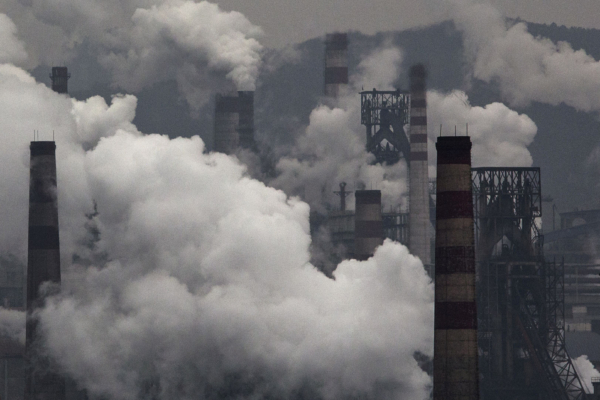
In Wuhan, Hubei Province, New Zhou District, a natural village with only 585 residents has seen at least 34 villagers diagnosed with cancer or leukemia over the past decade, many of whom are young adults under the age of 50. This has sparked strong suspicions among the villagers regarding the long-term pollution caused by a local chemical factory.
According to a report by mainland Chinese media “Daily News,” since 2015, 34 people in the Huangtupo natural village in Zhangxin Village, Liji Street, New Zhou District, Wuhan, have been diagnosed with cancer or leukemia, with 19 deaths reported. If earlier cases are included, the number of affected individuals reaches 62, with the majority being young adults under 50. Villagers suspect that these health issues are related to the continuous pollution from the “Changsheng Alkali Factory” in New Zhou District, Wuhan.
Multiple villagers have reported that the factory, which has been in existence for decades, used to emit dust during production, and its wastewater was described as “soy sauce-colored,” flowing through farmland into ponds through drainage ditches. Some villagers mentioned that crops near the drainage ditches showed abnormal growth, with instances of “failure to sprout red sweet potatoes, and withering of weeds.”
58-year-old villager Xu Wenjie stated that his 43-year-old wife was diagnosed with leukemia in 2012 and passed away after four years of treatment; in 2017, his 26-year-old daughter-in-law was also diagnosed with leukemia. “It was only later when I tallied the numbers that I realized there have been 62 cases of cancer or leukemia in the village over the years.”
“The factory was established in 1986 and was originally a state-run iron factory. After inquiring, I found out that in 1995, the factory was contracted by Xiong Yaoxi, a former township official in Liuxi Township, and bought out in 2000, renamed as the Changsheng Alkali Factory in New Zhou District, Wuhan,” said Xu Wenjie.
Information from AiQicha shows that the operations of the Changsheng Alkali Factory include the production of alkali. Sodium silicate (commonly known as alkaline), after heating to remove crystal water, is dissolved to make sodium silicate solution (commonly known as water glass), mainly used in the construction industry as adhesives and accelerators.
The topography of the Changsheng Alkali Factory is higher, with the drainage ditch winding down the slope, passing through villagers’ vegetable fields, and flowing into the village pond. The bottom of the drainage ditch has a layer of black-brown hard sediment.
Outside the factory’s walls are the former vegetable fields of the villagers of Huangtupo Village, with several scattered graves. Xu Wenjie stated that many have died from cancer and leukemia. “There are more than a dozen vegetable plots here, with at least one person in each household suffering from cancer or leukemia, and some households have more than one affected individual.”
Li Xianggui, a 60-year-old owner of a vegetable plot adjacent to the factory, has been diagnosed with esophageal cancer. Li Xianggui recalled, “During the factory’s operation, the dust was as dense as haze, obscuring visibility. Thick layers of dust accumulated on the leaves of the vegetables. I later stopped planting vegetables out of fear, the sweet potatoes wouldn’t sprout, and now I grow corn. Interestingly, the closer the seeds are to the drainage ditch, the shorter the plants grow, with height differences of up to half.”
On April 7, 2022, Xu Wenjie called the Wuhan Mayor’s Hotline to report the situation. On April 8, villagers once again reported to the local environmental protection department. However, despite waiting for days, no one showed up at the site. During this time, the Changsheng Alkali Factory excavated the drainage ditch under the guise of “rectification” and blocked the original discharge outlet.
Public records indicate that the Changsheng Alkali Factory mainly produces sodium silicate (water glass) products. In 2022, an investigation by the Wuhan Municipal Ecological Environment Bureau revealed that the factory lacked environmental assessments and discharge permits, and was located within the ecological control line. Third-party testing reports showed that the factory’s wastewater had significantly exceeded standard levels in total alkalinity, color, and other parameters, with total alkalinity reaching 29,214 mg/L, far exceeding normal levels in saline-alkali lakes.
Villagers further accuse the environmental protection authorities of engaging in “pre-announced inspections” during enforcement actions. Videos taken by villagers show the factory manager admitting that environmental personnel had informed them in advance to block the discharge outlet.
Villagers claim that the factory has repeatedly discharged pollutants clandestinely. Currently, villagers continue to demand the official release of complete test data and an investigation into whether the high incidence of cancer and leukemia in the local area is related to pollution. In response to external scrutiny, some records and investigation materials from the New Zhou District Ecological Environment Sub-Bureau have been refused for disclosure citing “non-disclosure.”
The above incidents have garnered widespread attention from mainland Chinese netizens, subsequently trending on social media platforms.
Many online users have commented, calling the situation “reckless loss of lives” and demanding the immediate dismissal of local environmental protection officials. “Where can these poor people voice their grievances?” “They have destroyed more than 60 families!”