
Recently disclosed correspondence indicates that the Lebanese government has submitted a strongly worded complaint to the United Nations, accusing Iran of abusing diplomatic immunity and clandestinely sending members of the Islamic Revolutionary Guard Corps (IRGC) into Lebanon under the guise of diplomatic activities.
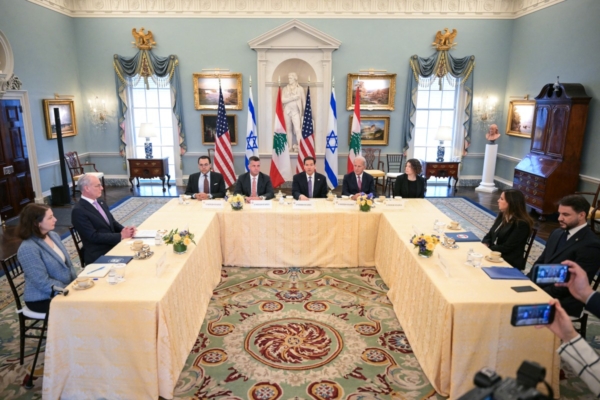
This diplomatic move comes at a critical juncture as Lebanon and Israel engage in normalization talks in Washington, with US officials disclosing that the negotiation atmosphere is “very positive, even exceeding expectations.” It is believed that these talks could potentially dismantle the terrorist activities of Hezbollah, a group supported by the Iranian regime, in Lebanon.
According to a report by Fox News on Friday, Lebanon’s Ambassador to the United Nations, Ahmad Arafa, criticized Iran in a letter at the end of last month for surreptitiously infiltrating IRGC terrorists into Lebanon under the cover of diplomatic activities.
Both the US and the European Union have designated the IRGC as a terrorist organization.
Arafa stated that Iran has committed “blatant disregard for the decisions of the Lebanese government.” He further added, “Iran’s actions constitute direct and flagrant interference in Lebanon’s internal affairs, dragging this country into a war it did not choose to be a part of.”
The correspondence submitted by Lebanon to the United Nations argues that Iran has violated the 1961 Vienna Convention on Diplomatic Relations and interfered in Lebanese national affairs.
The letter also strongly condemns Iran’s Ambassador to Beirut, Mohammad Reza Sheibani, for “blatant interference” in Lebanon.
Middle East expert Walid Phares told Fox News that many see Lebanon’s communication to the United Nations as the beginning of a shift in attitude towards Iran by the Lebanese government.
Phares added that besides security threats, the core of the dispute involves Lebanon’s decision to no longer grant automatic visa waivers to Iranian citizens, a move that has sparked strong discontent in Tehran.
“Additionally, Tehran is angry at the Lebanese government for not providing assistance in handling several IRGC members killed by Israel in Lebanon,” Phares said.
Meanwhile, under the facilitation of the US, Lebanon and Israel are engaged in negotiations in Washington aimed at de-escalating conflicts and disarming Hezbollah.
State Department spokesperson Tommy Pigott confirmed that both parties have agreed to extend the ceasefire agreement that began on April 16 by 45 days to further advance the peace process.
Furthermore, military delegations from both sides are set to initiate security dialogues at the Pentagon on May 29 to promote lasting peace, mutual recognition of sovereignty, and the establishment of secure borders between the two countries.
Recently, threats from Iran and its proxies have continued to garner international attention. The US Department of Justice announced on Friday the arrest and extradition of Iraqi national Mohammad Baqer Saad Dawood Al-Saadi, accused of being a senior member of the Iran-backed Kata’ib Hezbollah.
Kata’ib Hezbollah is a Shiite quasi-militia group in Iraq known for launching drone and missile attacks on US bases in the Middle East and Israel.
Southern District of New York federal prosecutor Jay Clayton stated in a release that Al-Saadi is suspected of planning or supporting nearly 20 attacks in the US and Europe, including “attempts to kill on US soil.”
The indictment revealed that the organization’s targets include US officials, Israeli interests, and Jewish civilians.