
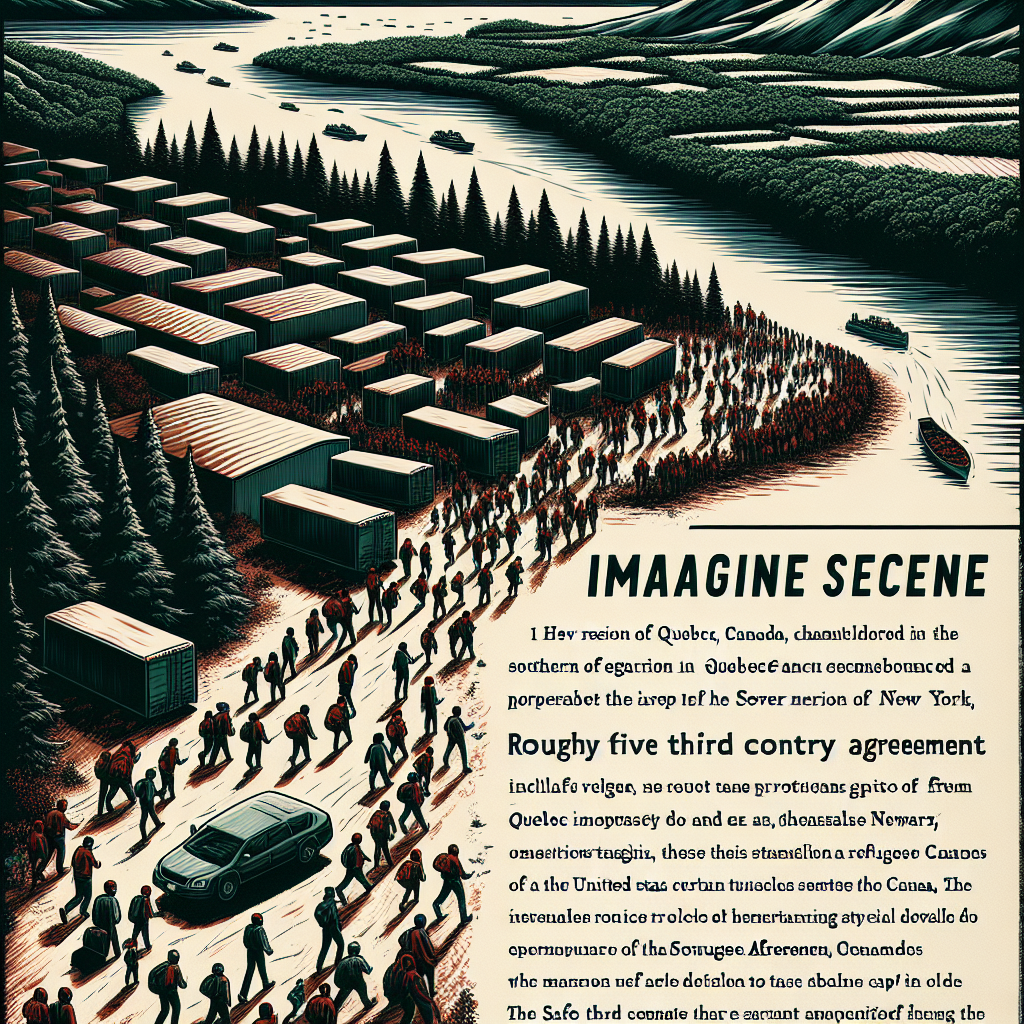
Located in the southern part of Quebec, Canada, approximately a five-hour drive from New York, has long been a focus of refugee enforcement. Many people cross forests and farmland, walking from the United States into Canada, exploiting loopholes in the Safe Third Country Agreement (STCA) to seek asylum.
Expected to become law in early 2026 as Bill C-12, the Strengthening Canadian Immigration System and Border Act, which was passed by the Canadian Parliament in late December 2025, is currently undergoing accelerated review by the Senate. It introduces a number of new measures, including: those who enter Canada informally at land borders from the United States and submit asylum applications after more than 14 days may be deemed ineligible and face immediate deportation back to the U.S. or a more rigorous Pre-removal Risk Assessment (PRRA); or those who submit asylum applications in Canada after being in the country for over 1 year will undergo risk assessment by immigration officials for expedited handling and likely deportation, and so forth.
Richard Kurland, editor of Lexbase, Canada’s Immigration Compendium, and a senior immigration lawyer, told Epoch Times that Canada’s refugee system “has not become stricter.”
According to data from the Canada Border Services Agency (CBSA), from late March to mid-April 2025, a wave of Haitians surged into Saint-Bernard-de-Lacolle, Quebec, the busiest land border asylum application port in Canada.
For Haitian refugees, Montreal is particularly attractive due to the predominance of French in the region and the existing large Haitian diaspora community, especially as the Trump administration decided to end Temporary Protected Status (TPS) for Haitians in the U.S.
During the period of March to August 2025, Lacolle received an average of over 1,900 refugee applications per month, a 184% increase from the previous year. By November, the number of applicants dwindled to 518, a 19% decrease from the same period the prior year.
In the entire province of Quebec, as of November 30, 2025, CBSA processed 20,752 asylum applications, a 30% decline from the previous year’s 29,668; while in British Columbia, the number of applications received was 1,104, a nearly 40% decrease from the previous year’s 1,804.
The actual message to refugee applicants may be very clear: the likelihood of being found ineligible to apply for Canadian refugee status and being deported back to the U.S. has increased.
As the first line of defense for Canada’s 1,200 points of entry, CBSA deported nearly 19,000 foreign nationals in 2025 under the Immigration and Refugee Protection Act (IRPA).
Among them, 4,035 refugee applicants who did not meet the STCA regulations were returned to the U.S., a 29% increase from the same period in 2024, with the possibility of being detained by U.S. Immigration and Customs Enforcement (ICE).
The STCA is a refugee cooperation agreement between the U.S. and Canada that requires applicants to apply for asylum on a “first come, first served” basis rather than “choosing countries at will.”
In other words, if an applicant first arrives in the U.S., they should apply for asylum in the U.S. and in principle cannot apply for refugee status in Canada, except in specific cases like having immediate family in Canada.
The increasing deportation rate is causing concern among applicants. Epoch Times interviewed Dean Pietrantonio, a prominent lawyer at Pietrantonio Barrister & Solicitor in Vancouver, about this matter.
Dean, who has been involved in immigration and refugee applications for many years, stated: “The legal definition of a refugee has not changed.” He cautioned that applicants still need to demonstrate a “reasonable and well-founded fear” of persecution or facing danger to life or other harm.
Kurland warned the public that Canada’s refugee system itself “has not become stricter.” He stated, “The success rate depends on the outcome of refugee cases. But if you cannot present a refugee claim, you cannot get a decision.”
Kurland explained: “If the STCA regulations prevent you from making a refugee claim, then you are unable to apply for refugee status.”
For example, individuals who enter Canada through U.S. land border crossings and submit asylum applications after being in the country for 14 days will not have their applications referred to the Immigration and Refugee Board (IRB).
Dean elaborated: “Those who have spent a longer period of time in the U.S. must explain why they did not seek protection in the U.S.; if they have previously submitted an asylum application in the U.S., they may not qualify to apply for refugee status in Canada.”
Proposed changes in legislation could also impact eligibility for applications.
“People who have been in Canada for over a year may not be able to enter the refugee protection application process,” Dean said, “and such individuals will be transferred to another protection mechanism – Pre-Removal Risk Assessment (PRRA).”
“As long as the applicant is genuine,” Dean stated, “and truly faces a reasonable and well-founded fear of persecution in their home country, they should seriously consider submitting a protection claim.”
Dean believes the most important factor for success is the “credibility of the applicant.” He said, “Applicants must prove, based on their circumstances, the risk of persecution they may face in the future. Conversely, if an applicant lacks credibility or cannot prove future risk, the chances of success are very low.”
Kurland emphasized the importance of seeking legal advice before crossing borders. Whether successful or failed, the reasons vary and the details are numerous, requiring numerous books to cover them all. “There is no quick, one-size-fits-all answer,” he explained, “the key point is that those facing severe risk of persecution need to carefully study their cases. Individuals cannot just ‘pick a location’ to submit a refugee application.”
Kurland believes that the public’s perception of the refugee application process becoming more difficult may be influenced by American news. “Those issues are not as severe in Canada,” he said, “in the past two to three years, a large influx of new cases has occurred without additional resources being added, causing delays of three to four years in processing refugee applications.”
Dean stressed that according to the Refugee Convention, the refugee system is designed to protect those facing persecution, danger to life, or inhuman treatment. He stated, “It is not an immigration pathway, nor is it a system set up for personal convenience, economic reasons, or financial motives.”