
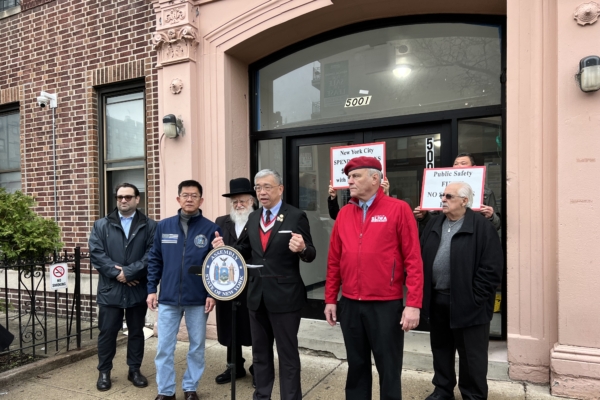
New York State Assemblyman Zheng Yongjia held a press conference on April 6, urging the mayor and relevant agencies such as the Department of Homeless Services to halt the plan to convert two apartment buildings in Boro Park – 5001 10th Avenue and 1016 50th Street – into shelters for the homeless. He directly pointed out that this move is a “serious abuse of power and public funds.”
According to Yongjia, the plan not only forces long-term residents and grassroots workers who have served the community for decades to move out but also allows landlords to profit from city contracts. He emphasized that current tenants, some of whom still reside in the buildings, are at risk of eviction at any time. This approach does not help solve the homeless crisis but instead creates more homeless individuals, turning priorities upside down.
The attendees of the press conference also included State Senator Chen Xueli from the neighboring district, mayoral candidate Curtis Sliwa, Senator Felder’s Chief of Staff Judah Wohlgelernter, among others. They criticized the plan for benefiting private developers and non-profit organizations at the expense of residents, diverting much-needed resources from the community to homeless shelters.
Sliwa bluntly stated, “This is a scam orchestrated across all five boroughs. The government uses shelters as a cover for evicting tenants, allowing developers, landlords, and shelter operators to profit, making hundreds of dollars a night, while the local community bears the risks of security and property devaluation.”
Senator Chen Xueli also expressed anger, questioning how they could evict original residents and then require them to reapply to live in their own homes as homeless individuals, likening it to the absurdities of the Bolshevik (Soviet Communist Party) era.
Representatives of residents, long-term tenants, and local businesses also voiced their opinions at the scene. Conrad Ramkissoon, who has lived in the area for 22 years, pointed out that as a disabled individual, he faces eviction. Giovanni, the owner of a nearby pizza shop, criticized the impact the case could have on business and community safety, emphasizing that it is not a housing policy but a money-making operation detrimental to the entire community.
Another community resident, Esther Friedman, told a reporter that the building used to be inhabited by staff from the nearby Maimonides Hospital, who had deep connections with the community. However, they were forced to relocate, only to be replaced by homeless individuals with no ties to the community, which is unacceptable. Friedman witnessed fights, increased police presence every night, noise, and items being thrown out of windows around the shelter, leading to a noticeable deterioration in the community atmosphere and security.
Representative of the community organization “New Yorker First,” Ron Cantorino, pointed out that such forcibly implemented shelter plans are not uncommon citywide, bypassing the oversight mechanisms of the city council, fostering a private exchange between the city government and developers. He stated that this is akin to the “bait-and-switch” maneuver occurring at 2134 Coyle Street in Sheepshead Bay.