
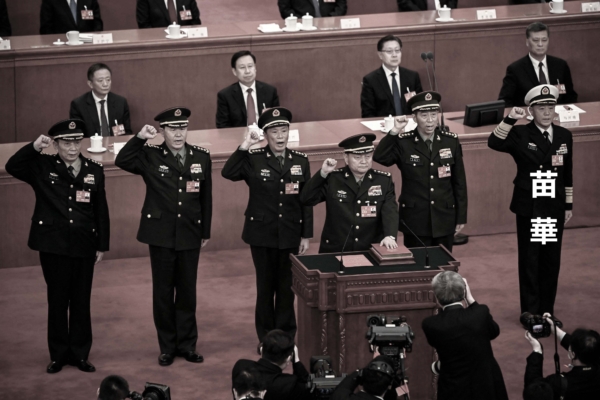
In a recent development that has caused a stir both domestically and internationally, Xi Jinping’s “most trusted confidant” Miao Hua has come under investigation.
Strangely, this announcement was not authorized for release by Xinhua News Agency, nor by the military discipline inspection commissions or the Central Commission for Discipline Inspection. Instead, it was initially released by a spokesperson of the Chinese Ministry of National Defense.
On November 28th, Chinese Ministry of National Defense spokesperson Wu Qian, prior to taking questions from reporters, issued four consecutive statements, with the second statement reading, “Central Military Commission member and Director of the Political Work Department of the Military Commission, Senior General Miao Hua, is suspected of serious violations of discipline. After deliberation by the central committee, a decision has been made to suspend Miao Hua for inspection.”
Miao Hua holds positions in both the Central Military Commission of the CCP and the National Central Military Commission, with a rank higher than deputy national level but lower than ministerial level.
The Ministry of National Defense is just one department under the State Council. The rank of the Minister of National Defense is lower than that of a member of the Central Military Commission. The announcement of Miao Hua’s investigation by the Ministry of National Defense is akin to a lower-level unit announcing the investigation of a higher-level leader, which raises questions about its legitimacy and coherence.
This unusual situation of an announcement from the Ministry of National Defense raises significant questions and implications.
Last year, on August 31, Li Shangfu, who held positions as a member of the Central Military Commission, a state councilor, and Minister of National Defense for only five months, was investigated for serious violations of discipline. On October 24 of the same year, Li Shangfu was removed from his positions by the National People’s Congress.
On December 29 of the same year, Navy Commander Dong Jun was promoted to Minister of National Defense.
How was Dong Jun able to ascend to the position of Minister of National Defense? Key figures in his promotion likely included Miao Hua. Miao Hua previously served as the political commissar of the Navy, with Dong Jun as his subordinate at the time. After Miao Hua was appointed Director of the Political Work Department of the Military Commission in 2017, Dong Jun was successively promoted to Deputy Commander and then Commander of the Navy, with both promotions being recommended by Miao Hua to CMC Chairman Xi Jinping. Dong Jun’s appointment as Minister of National Defense was also a result of Miao Hua’s recommendation.
Since the establishment of the People’s Republic of China, there have been a total of 14 Ministers of National Defense. Prior to Dong Jun, none of the 13 previous ministers came from the Navy. Dong Jun became the first Minister of National Defense from the Navy. Many observers believe that Dong Jun is a close aide of Miao Hua. Without Miao Hua’s role as Director of the Political Work Department of the Military Commission, Dong Jun would not have been able to rise to the position of Minister of National Defense.
Following Miao Hua’s arrest, officials associated with him would likely distance themselves to protect themselves. As the Minister of National Defense, Dong Jun is a high-ranking official responsible for China’s military interactions on the international stage.
The day before the Ministry of National Defense’s routine press conference, on November 27, the Financial Times reported that Chinese Defense Minister Dong Jun was under investigation for corruption. When foreign journalists asked Chinese Foreign Ministry spokesperson Mao Ning about the veracity of the report on Dong Jun’s investigation, Mao Ning replied with “groundless accusation,” without further elaboration.
During the Ministry of National Defense’s press conference on November 28, a similar question was posed by a foreign journalist. Spokesperson Wu Qian of the Ministry of National Defense stated that the reports were “pure fabrication, the fabricators have malicious intentions, and China strongly objects to such slanderous actions.”
Throughout the press conference, Wu Qian repeatedly emphasized “Chinese Defense Minister Dong Jun,” “Defense Minister Dong Jun,” “Minister Dong,” in response to foreign media’s queries about the identity of the Chinese Defense Minister. Wu Qian’s vigorous denial of the Financial Times report regarding Dong Jun’s investigation, along with his repeated mentions of “Minister Dong Jun,” indicates that prior to the press conference, Dong Jun, Wu Qian’s superior, likely directed him to convey the message that Dong Jun was not under investigation.
Wu Qian’s statements during the press conference concerning Dong Jun were likely a demonstration of Dong Jun distancing himself from his former leader, Miao Hua, following Miao Hua’s arrest.
Based on the current situation, Dong Jun is unlikely to be implicated in Miao Hua’s case at the moment. This is because the two previous Defense Ministers, Li Shangfu and Wei Feng, were investigated for serious violations of discipline and law. If Dong Jun were to be investigated now, it would be highly damaging for the CCP internationally.
As mentioned at the beginning of the article, Miao Hua is considered Xi Jinping’s “most trusted confidant.” This is evidenced by their decade-long friendship during Xi’s tenure in Fujian. Miao Hua played a crucial role in Xi’s naval restructuring after being transferred from the army to the navy as a political commissar in 2014. Following his appointment as Director of the Political Work Department of the CMC in 2017, Miao Hua became instrumental in recommending and appointing senior military officials under Xi’s command.
On December 4th, an article was published on Da Ji Yuan titled “How to Interpret the Three Anomalies of Xi’s Close Aide Miao Hua’s Arrest?” which delved into the power dynamics surrounding Xi’s sudden illness sidelining his military authority and the crucial role of Deputy Chairman of the CMC, Zhang Yuxia, in shaping the political landscape.
The arrest of Xi’s trusted aide Miao Hua is unlikely to have been orchestrated by Xi Jinping himself but by Zhang Yuxia. The dissemination of Miao Hua’s investigation by the Ministry of National Defense spokesperson indicates a decision made at a higher level, possibly by Deputy Chairman Zhang Yuxia.
Since the 20th National Congress of the CCP, a wave of high-ranking military officials have fallen from grace, with the CCP refraining from immediate public announcements. Notably, there was a significant delay in publicizing the investigations of officials like Li Yuchao and Li Shangfu.
The initial report of Miao Hua’s arrest came from overseas commentator Cai Shengkun on November 11th. According to Cai Shengkun, Miao Hua was apprehended on November 9th. Minister of National Defense spokesperson Wu Qian officially announced Miao Hua’s investigation during the routine press conference on November 28th, almost 19 days after the arrest.
The swiftness of the public announcement of Miao Hua’s arrest exceeds the timeline of previous investigations involving senior military officials over the past year.
This prompt disclosure is likely a deliberate move orchestrated by Zhang Yuxia. As a key figure aiding Xi in consolidating military power, Miao Hua’s arrest, publicized by Wu Qian through the Ministry of National Defense, serves as a significant blow to Xi’s military influence and also to Xi’s close aides appointed through Miao Hua.
Since Xi took office in 2012, an extensive anti-corruption campaign has been ongoing, resulting in the investigation of over 600 high-ranking officials and hundreds of military generals. From the central government to regional institutions, state-owned enterprises to public figures, Xi has antagonized numerous high-ranking officials.
In his 12 years of leadership, Xi Jinping’s administrations have been marked by a series of controversial internal and external policies, yielding limited constructive results. Instead, China faces unresolved economic challenges, exacerbated by the COVID-19 pandemic since 2020, leading to economic stagnation, foreign capital outflows, mounting debts, rising unemployment, social unrest, and growing dissatisfaction among the populace.
The events surrounding Miao Hua’s arrest underscore the precarious state of China’s political landscape and could potentially mark a significant turning point.
The announcement of Miao Hua’s investigation by the Ministry of National Defense is not a random occurrence but rather a complex and far-reaching development that could have substantial implications on China’s political future.
Many analysts predict a potential “unprecedented upheaval” in China in 2025. The public disclosure of Miao Hua’s investigation may signify the beginning of this anticipated transformation.
The above analysis explores the intricate power struggles and implications within the Chinese political sphere, especially following the arrest of Miao Hua. The evolving dynamics between key figures such as Xi Jinping, Miao Hua, and Zhang Yuxia underscore the complexity and uncertainty surrounding China’s political landscape.
This situation not only reflects internal power struggles but also showcases the fragility of political relationships within the Chinese Communist Party. The arrest of Miao Hua and its ripple effects among high-ranking military officials point to a tumultuous period ahead, potentially reshaping the trajectory of Chinese governance.