
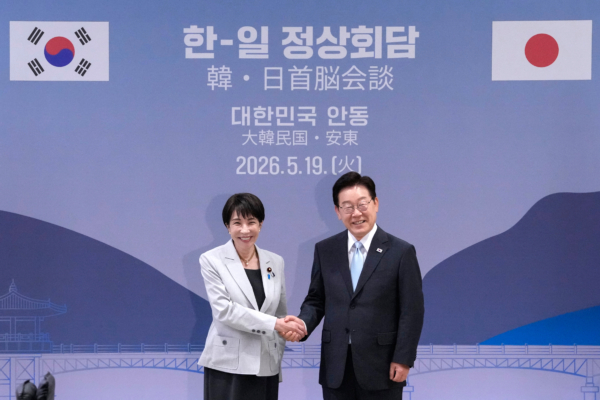
On May 19, 2026, in the city of Andong, South Korea, President Lee Jae-myung and Japanese Prime Minister Sanae Takai held a summit meeting. This marked the fourth meeting between the leaders of Japan and South Korea within six months, with a focus on the stability of energy supply amidst the conflict in the Middle East and enhancing economic and security cooperation in the context of tensions in the Indo-Pacific region.
Andong is a city in southeastern South Korea, known for its traditional folk village with hundreds of years of history, designated as a UNESCO World Heritage site. In January of this year, the two leaders met in Takai’s hometown in the ancient Japanese capital of Nara, symbolizing the deepening of the two countries’ “shuttle diplomacy” and “hometown diplomacy.”
This also marked the first time in history that leaders of Japan and South Korea visited each other’s hometowns during their time in office.
Shortly before noon on Tuesday, Takai arrived at Daegu International Airport and proceeded to Andong. President Lee welcomed Takai at the entrance of the hotel, wearing a light sky blue tie that coordinated with Takai’s outfit.
According to reports from the scene, President Lee expressed gratitude to Takai, saying, “Thank you for making the effort to come all the way to this small city.”
Prior to his departure, Takai also stated to the media, “Given the current challenging international situation, including the Middle East and Indo-Pacific affairs, I look forward to engaging in in-depth discussions with President Lee and achieving fruitful results for the further development of Japan-Korea relations.”
Since the outbreak of the Iran conflict in late February, the vital global energy transit route of the Strait of Hormuz remains restricted, posing a common challenge to Japan and South Korea, both highly dependent on oil imports from the Middle East.
The two sides are expected to reach agreements to strengthen cooperation in ensuring stable energy supply and establish a more resilient supply chain for critical minerals.
Amid North Korea’s missile and nuclear weapons development, as well as escalating military activities by the Chinese military, both countries are enhancing bilateral defense cooperation and deepening their trilateral alliance with the United States. Additionally, the talks may also touch on the recent “Xi-Jinping meeting” in Beijing.
Despite unresolved disputes such as forced labor and comfort women from the colonial period, the two governments are currently inclined to prioritize collaborative agendas and avoid open contention. Experts analyze that Japan and South Korea are seeking to address economic and security challenges by strengthening cooperation amidst external uncertainties.
Choi Eun-mi, a researcher at the Eosan Policy Institute, pointed out, “The two countries are currently placing more emphasis on cooperation rather than contentious issues. They may now consider that fluctuating bilateral relations or eventually moving towards a negative relationship would not be beneficial to anyone.”
Following the meeting, the two leaders will hold a joint press conference to announce the outcomes and attend a dinner with cultural performances.
Prime Minister Takai is expected to conclude his two-day visit to South Korea and return to Japan on Wednesday morning.