
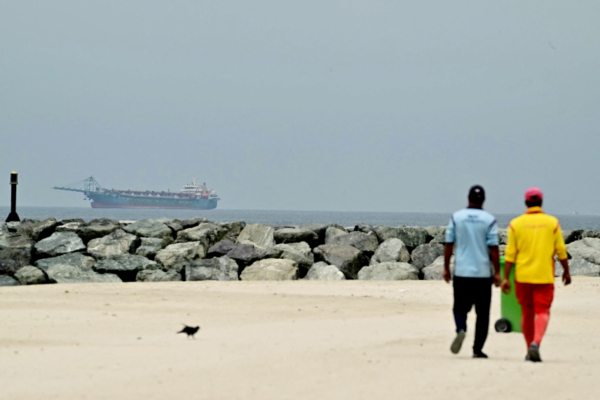
On Tuesday (April 28th), a very large crude carrier (VLCC) carrying Saudi Arabian crude oil successfully passed through the Strait of Hormuz in a vessel related to Japan. This may be the first time a Japanese oil tanker has successfully left the Persian Gulf since the outbreak of the Iran war.
According to data compiled by Bloomberg, the “Idemitsu Maru” departed from northwest Abu Dhabi towards the Strait of Hormuz late on Monday, after being anchored in Abu Dhabi for over a week. The data shows that the tanker followed the northern route approved by Tehran authorities, passing through waters near Qeshm and Larak islands before successfully passing through the strait on Tuesday.
The ship was carrying 2 million barrels of crude oil, loaded from the Juaymah terminal in Saudi Arabia in early March.
Tracking data shows that the “Idemitsu Maru” successfully crossed the Strait of Hormuz on Tuesday.
MarineTraffic, a vessel tracking website, also posted on X platform that this Japanese VLCC carrying 2 million barrels of crude oil successfully crossed the strait earlier on Tuesday.
MarineTraffic cited commodities analysis company Kpler as saying, “Japanese shipowners have always maintained a high level of caution towards regional security risks, and this voyage is a significant signal showcasing their prudent confidence.”
This super large crude carrier was built in 2007, flying the flag of Panama, and entered the Persian Gulf just a few days before the U.S. and Israel launched strikes against Iran. The registered operator of the vessel is the tanker division of Japanese energy giant Idemitsu Kosan Co., Ltd., with the current destination shown as Nagoya, Japan, expected to arrive on May 18th.
A company spokesperson stated that, for security reasons, Idemitsu Kosan would not comment on the status of individual vessels.
The passage of the “Idemitsu Maru” has drawn attention as one of the largest oil tankers attempting to cross the strait since the U.S. military blocked Iranian ports. However, U.S. Secretary of State Antony Blinken, speaking to Fox News on Monday regarding the U.S. military blockade, stated, “It’s not a blockade on shipping. It’s a blockade on Iranian shipping – because they should not be the only ones benefiting from an illegal, unfair and unreasonable toll and control system on the Strait of Hormuz.”
Some ships related to Japan have also passed through the strait during wartime, but only for transporting other goods.
According to Kpler vessel tracking data and SynMax satellite analysis, before the outbreak of the war on February 28th, there were 125 to 140 ships entering and exiting the Strait of Hormuz every day, but on the previous day (Monday) only 7 ships passed through.
Vessel tracking data shows that on Monday, a liquefied natural gas (LNG) carrier operated by the Abu Dhabi National Oil Company (ADNOC) successfully crossed the Strait of Hormuz and is currently near India. If confirmed, this would be the first fully loaded LNG tanker to cross the strait since the war broke out. It is currently unclear when the ship set sail.
Ship brokerage firm BRS stated in a report this week that even if the Strait of Hormuz were to reopen tomorrow, “we believe it will be at least until September before tankers and the oil market can recover to some degree of ‘normalcy’.”
(This article references Bloomberg and Reuters.)