
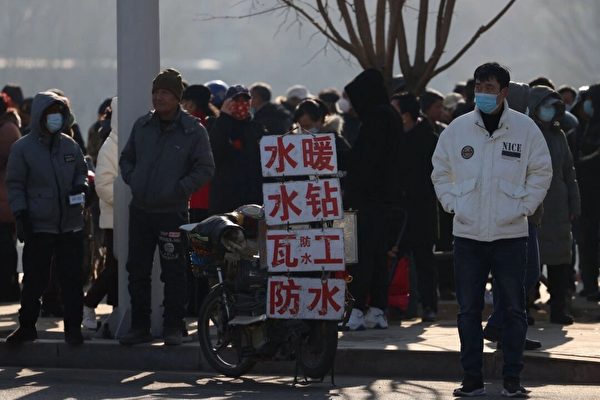
In the past few decades since the beginning of reform and opening-up in China, hundreds of millions of rural migrant workers from inland provinces have left their hometowns for developed and prosperous coastal cities in the southeast, seeking better livelihoods through labor. However, with the weakening domestic demand in China, finding urban employment has become increasingly challenging, leading more and more migrant workers to choose to stay in their hometowns for work.
According to a report by the Financial Times on April 20, a state-owned labor intermediary in Longhui County, Hunan Province, disclosed that since 2023, the number of job advertisements issued by the company has been decreasing while the number of job seekers has been steadily increasing. Almost every village now has some stranded migrant workers, which is detrimental to social order and stability.
These concerns indicate that China’s economic structure is increasingly shifting towards low-labor-intensive industries. The prolonged downturn in China’s real estate and construction sectors has raised alarms within the Chinese authorities. In November last year, the Ministry of Agriculture and Rural Affairs of the Communist Party of China held a work conference specifically to discuss the issue of unemployment, warning of the phenomenon of “mass returning to hometowns and staying there”.
The Chinese authorities have not publicly disclosed the annual data on the number of people returning to their hometowns, but analysts believe that this trend has accelerated recently. Ernan Cui, an analyst at the international research firm Gavekal Dragonomics, noted that during the pandemic, as cities were under lockdown, a large number of migrant workers returned to their hometowns and are now forced to return due to the difficulty of finding work. The urban employment market is saturated and unable to absorb more labor.
It is estimated that China has around 300 million migrant workers, but more and more of them are choosing to stay within their own provinces to seek employment, rather than traveling to other provinces as before. The attractiveness of employment in developed and prosperous provinces has declined, leading to a continuous decrease in the number of migrant workers seeking work in other provinces since 2015.
While the wages of migrant workers seeking work in slightly better-off provinces are still higher than those in inland provinces, by 2024, the wage growth in these provinces began to lag behind that of inland provinces. Chen Huiling, Associate Professor of Sociology at the Department of Applied Social Sciences at the Hong Kong Polytechnic University, mentioned that under the dual impact of industry upgrading causing skills renewal and the impact of China-US trade friction on labor-intensive manufacturing, many migrant workers, especially older ones, are at a loss and can only return home to farm or take on odd jobs to make a living.
At the end of March this year, reporters from the Financial Times visited Longhui County in Hunan Province and found that many migrant workers chose to stay in their hometowns after returning home for the Chinese New Year. A villager in his fifties named Wang revealed that many older migrant workers, especially those in their 40s, 50s, and 60s, stayed in the village weeks after the Chinese New Year.
Wang also disclosed that he used to work in construction in Guangdong, earning between 15,000 to 16,000 RMB per month during good times. However, this year, due to the suspension of construction sites, he could only take odd jobs within the province, earning much less than before. At best, he could earn seven to eight thousand RMB, and while he occasionally finds some decent work, it is not easy to make a large sum of money.
The person in charge of the state-owned labor intermediary in Longhui County revealed that a sports shoe factory in the county now only employs 200 to 300 workers, a significant decrease from nearly 3000 workers during its peak period. Due to the impact of the China-US trade war, orders for the factory have sharply declined.
A 35-year-old marble tile worker who attended a job fair in Longhui County mentioned that he had been out of work for three to four months at a job in Dongguan, and he had to return to his hometown to find work. In the hometown, he can only earn around 4000 RMB per month at most, much less than what he used to earn in Dongguan, but regardless of the pay, he is willing to take on any job.
Ernan Cui pointed out that for returning migrant workers, local economies are unable to absorb all of them, and working in big cities remains the best option. However, the labor market in big cities is becoming increasingly weak, with net recruitment in construction, manufacturing, and service industries all declining. Furthermore, new job opportunities are increasingly concentrated in industries such as artificial intelligence that are being promoted by the Chinese government, causing a structural mismatch between the needs of unemployed workers and available jobs.
A migrant worker in his sixties named Chen revealed that if he could find a job in Guangzhou with a monthly salary of 5000 RMB including meals and accommodation, he would prefer to work there. However, at his age, it is difficult to find such work, so he can only permanently return home and make a living by doing various odd jobs like construction or repairs in the village.