
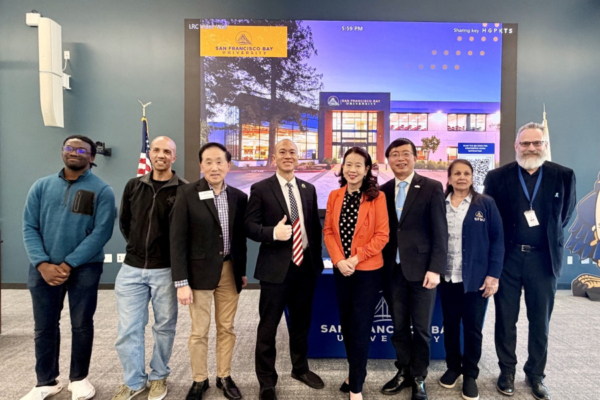
As the 2026 United States midterm elections approach, the political battles in California are heating up. In order to give the public a deeper understanding of the candidates’ platforms, the Bay Area University of California, Fremont, held a forum for the candidates for the 24th District of the California State Assembly on April 16th (last Thursday), attracting people of different ethnicities and young students to participate.
The 24th District covers areas such as Fremont, Newark, Milpitas, Sunol, and parts of San Jose, making it one of the important electoral districts in the Bay Area. Its electorate is diverse, with about 40% Democrats, 40% independent voters, and approximately 20% Republicans.
The race features three Chinese-American candidates with different backgrounds, including the incumbent Democratic Party legislator Alex Lee, independent Fremont City Councilor Yang Shao, and Republican entrepreneur Max Hsia. Although Alex Lee was invited to attend the forum, he did not participate.
Since 2020, Alex Lee has served as a state Assembly member, representing the 25th District from 2020 to 2022 and the 24th District from 2022 to 2026. At 30 years old, he became the first openly bisexual legislator in the California Assembly, currently serving as the chair of the Progressive Caucus and a member of the LGBTQ Caucus. Max Hsia, whose parents are from Taiwan, was born in South Carolina and has lived in the Bay Area for over 30 years. Yang Shao, a Harvard University Ph.D. and biotechnology expert, was elected to the Fremont Unified School District board in 2014 and has been a Fremont City Councilor since 2018.
The forum was hosted by Lily Mei, CEO of the Eclipse Project, and Benjamin Yee, Deputy CEO, with simultaneous online participation. The discussion focused on affordable housing, cost of living, public safety, artificial intelligence (AI) and employment, as well as leadership and governance. The two candidates found common ground in several areas, including increasing housing supply, reducing cost of living pressure, strengthening public safety and combating crime, regulating AI development moderately, and improving governmental efficiency and accountability, all aimed at enhancing people’s livelihoods and governance.
However, in terms of policy direction, the candidates differed. Yang Shao emphasized data-driven approaches and institutional reforms, focusing on execution and outcomes. He emphasized that current issues are non-partisan and require practical leaders who can implement policies to truly address the challenges faced by the community. Max Hsia, on the other hand, focuses on tax cuts, deregulation, and accountability enhancement, promoting change through “common-sense politics”.
Lily Mei told Epoch Times that many people are dissatisfied with current policies but are unsure how to bring about change. The purpose of holding the forum is to encourage voters and the younger generation not to rely solely on brief candidate statements but to invest time in understanding and discussing the candidates’ platforms in depth, in order to elect representatives who can best serve their interests.
Regarding their differences, Yang Shao noted his over a decade of public service experience as his advantage, advocating for data-driven approaches and accomplishments in policy-making. He stressed that the current issues are bipartisan and require practical leaders who can implement policies effectively to truly alleviate the challenges faced by the community, stating that he possesses the experience and capabilities to step forward at critical moments on behalf of all voters.
Max Hsia believes that the biggest difference between them lies in their styles and political operational methods. He emphasizes his ability to negotiate across party lines and compromise, pointing out that party support under the caucus system in Sacramento helps enhance policy implementation efficiency and highlighting this significant difference from his independent opponent.
He mentioned that the State Assembly’s system is designed to allow ordinary citizens to participate, requiring only citizenship and voter registration to run for office. He stressed his passion and action-oriented approach, expressing his willingness to speak up for the district on various issues, stating, “I am one of you”.
During the question-and-answer session, the audience actively spoke up, with topics covering oil prices and energy regulation, tax burden and government spending, voter ID systems, public safety and fraud, and youth development. A student pointed out the housing affordability and employment challenges facing California and asked the two candidates about their policy direction for the younger generation. Yang Shao emphasized education as a core, cultivating high-skilled talents to enhance employment competitiveness and income levels. Max Hsia mentioned that from the operation of the legislature, it is evident that the California government continues to increase taxes and expand spending, leading to increased burdens on the people, a situation that is unsustainable with severe population outflow and significant opportunities lost for young people. He advocates for promoting youth programs and political education, encouraging young people to participate in public affairs and become a force for change.
Interviewed voters had varying opinions. Republican supporter David Lam believes that party affiliation helps with passing legislation, hence leaning towards supporting Max Hsia, stating that if he enters Sacramento, he would be better positioned to cooperate and access resources within the party. In contrast, independent candidate Yang Shao may find it challenging to gain support from both parties.
On the other hand, Tien Mai, a Vietnamese software engineer from Milpitas, believes that the situation in California is worsening and hopes that the Republican Party will bring about change. As Yang Shao is from an independent background, making it harder to discern his stance, he supports Max Hsia based on debate performance and party affiliation, believing he can better establish connections with the community.