
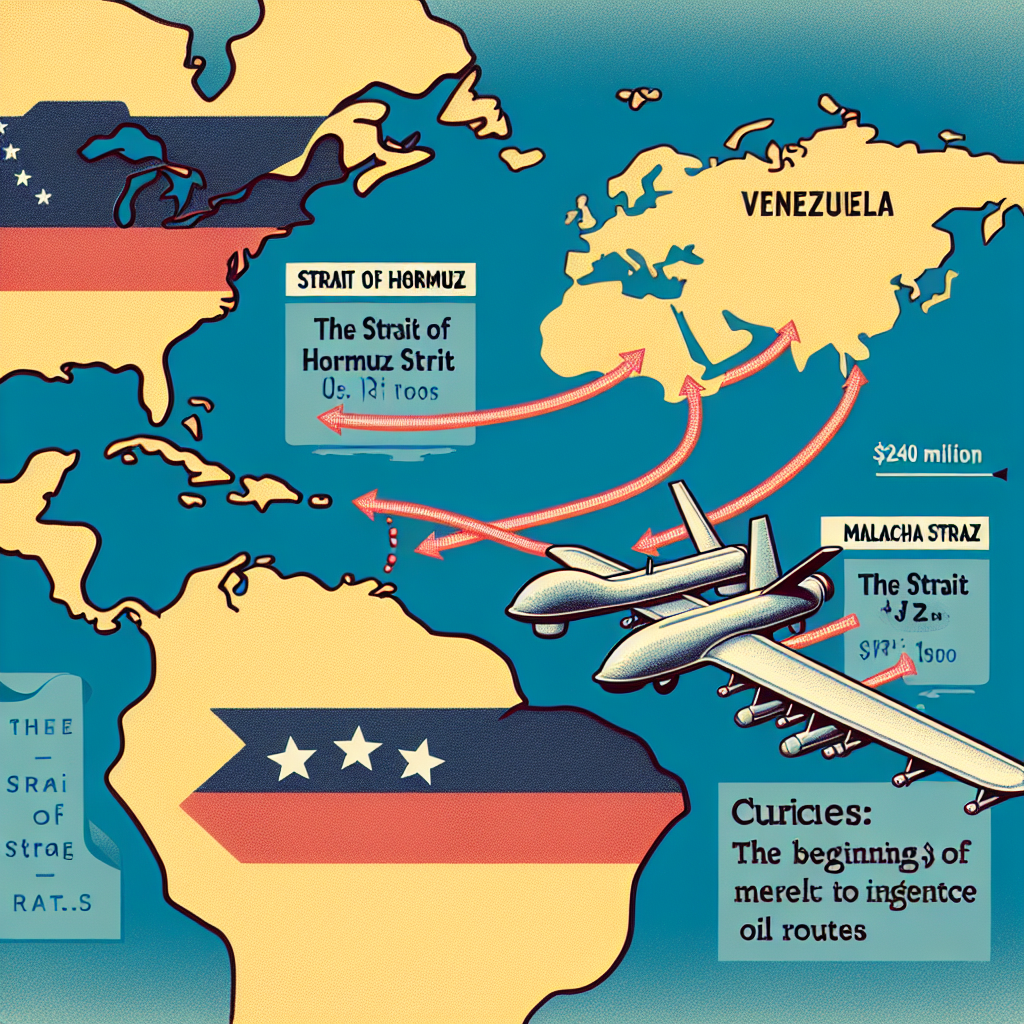
From Venezuela to the Strait of Hormuz, and now to the Malacca Strait, the United States has taken three major steps to choke off China’s oil lifeline. With a $240 million unmanned drone appearing over Cuba, it signifies the beginning of the fourth major move by the United States, as President Trump’s global strategic layout nears completion.
The U.S. Navy’s MQ-4C “Triton” surveillance drone (call sign BLKCAT6), worth $240 million, is a massive aircraft comparable in size to a Boeing 737, capable of continuous flight for over 24 hours at heights exceeding 55,000 feet, a height unreachable by civilian aircraft. This aircraft is not equipped with weapons, yet it doesn’t need any as it is a weapon itself.
According to a recent article by Chandrashekar Srinivasan, a senior editor at India’s ndtv, this drone conducted extensive reconnaissance near Cuba this week. Flight tracking data reveals that on Wednesday (April 15), it first monitored the strait between Cuba and Jamaica, a vital passage connecting the Panama Canal and the Atlantic Ocean, before hovering over the Cuban capital, Havana.
All these actions suggest that the United States has commenced the fourth move on the chessboard that links Cuba, Venezuela, Iran, the Malacca Strait, and China.
The deliberate display of the surveillance drone’s flight path on open networks is no coincidence; it is a clear message to China that the U.S. is watching everything. Moreover, the flight path of the MQ-4C indicates that it likely tracked the Windward Passage and the Yucatan Channel, major shipping lanes in the Caribbean region.
The value of these maneuvers lies not only in the quantity of oil but also in the strategic implications. Since the U.S. seized over 303 billion barrels of Venezuelan oil in January, Venezuela’s oil transportation with China has been disrupted. Following the capture of Venezuelan dictator Nicolas Maduro by U.S. special forces, Venezuela has been leaning towards Washington, forcing China to turn to Russia for assistance. From January to February this year, China’s oil imports from Russia increased by 40.9%.
The second major move by the U.S. was to block the Strait of Hormuz, cutting off 40% to 45% of China’s daily oil demand temporarily, causing China to bleed. Although the strait reopened after a cease-fire agreement between Israel and Lebanon, allowing an increase in China’s crude oil supply, U.S. military vessels in the Gulf of Oman may continue to play a gatekeeper role.
The third major move was the military alliance between the U.S. and Indonesia, upgrading to a “Major Defense Cooperation Partnership” (MDCP) in April 2026, to monitor the Malacca Strait and increase pressure on China’s eastern coastal areas. This waterway accounts for 80% of China’s maritime oil transportation, leaving China restless.
China holds one of the world’s largest oil reserves with numerous sources of oil supply and a network of oil pipelines spanning Russia, Central Asia, and Pakistan. By choking off these critical oil shipping routes, China is forced to seek alternative sources or manipulate diplomatic and economic tactics.
Following the U.S. cutting off Venezuela’s oil supply, China’s strong support for Cuba reveals its intentions. The Chinese Foreign Ministry expressed deep concern and opposition to U.S. actions in Cuba in January, followed by China sending fuel to the country.
Cuba becomes the target of the United States’ fourth move. The strategic value of the Caribbean Sea cannot be underestimated—controlling the Caribbean allows the U.S. to deter Chinese penetration, influence, and so-called “shadow oil tankers” in the region. Moreover, it extends surveillance and military coverage over the southern coastal regions of the U.S., particularly Florida, and may target Chinese electronic intelligence stations like the one in the town of Bejucal, about 30 kilometers inland from Havana.
This strategic escalation holds significant implications. While the drones provide surveillance, the bases pose military threats to all Chinese vessels within the region. The MQ-4C drone’s mission may have shifted, with a focus still on shadow oil tankers, this time clandestinely delivering fuel to Cuba.