
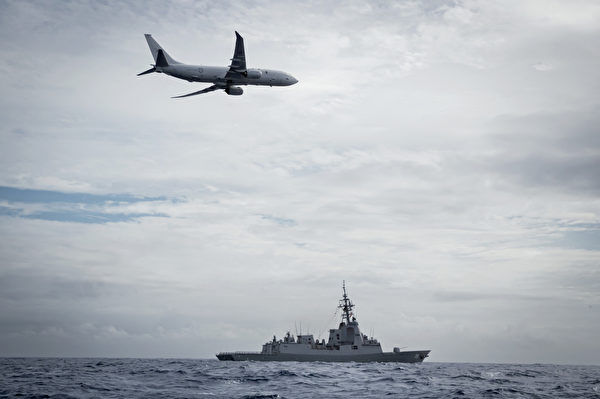
New Zealand Air Force’s P-8A “Poseidon” patrol aircraft was accused of “harassment” by the Chinese Communist Party during a sanctions enforcement operation targeting North Korea. New Zealand responded on Saturday (April 18th), emphasizing the legality and professionalism of their actions.
The New Zealand Defense Force stated in a release that this P-8A anti-submarine patrol aircraft is carrying out a long-term international mission to monitor North Korea’s evasion of sanctions in accordance with United Nations Security Council resolutions. Officials emphasized that the crew members were operating professionally and in full compliance with international law and the civil aviation procedures of the region.
In response to the Chinese Ministry of Foreign Affairs’ accusations of “close-range reconnaissance and harassment” in the Yellow Sea and East China Sea, a spokesperson for the New Zealand Defense Force clarified that “since 2018, New Zealand has been contributing to monitoring sanctions for the United Nations.”
“These activities are not aimed at China (Chinese Communist Party), but are intended to monitor ‘ship-to-ship’ transfers of refined oil and other supplies related to violations of United Nations prohibitions in the Yellow Sea and East China Sea,” the spokesperson emphasized.
The mission, known as the “Pacific Security Maritime Exchange,” is led by the U.S. State Department and involves a multinational alliance aimed at cutting off the supply chain of materials related to North Korea’s nuclear program.
This incident once again highlights the escalating tensions between New Zealand and Beijing. In 2025, Chinese naval vessels approached the Tasman Sea near New Zealand for live-fire exercises, causing strong concerns in New Zealand. Despite efforts to maintain trade relations, the military reconnaissance actions in the Asia-Pacific region demonstrate a very low level of mutual trust between the two sides.
Just two weeks before the P-8A incident, New Zealand had just settled a diplomatic dispute caused by Chinese intervention with its ally, the Cook Islands.
In February 2025, the Cook Islands signed a secret strategic agreement with China without informing New Zealand, prompting strong vigilance from New Zealand and temporarily suspending its annual funding of NZ$30 million. After a year of negotiations, New Zealand and the Cook Islands officially signed the “Declaration of Defense and Security” on April 2 this year.
For China, this agreement signifies a major strategic setback and is seen as a direct countermeasure by New Zealand towards China’s “shadow diplomacy” in Pacific island affairs.
Firstly, the Cook Islands clearly designated New Zealand as its “primary security partner,” effectively nullifying the previous secret agreement with China and preventing China from gaining a military or strategic foothold in the South Pacific through the Cook Islands.
Secondly, New Zealand reinforced its special relationship with the Cook Islands (Cook Islands residents hold New Zealand passports), ensuring that the region’s defense, law enforcement, and cybersecurity are not interfered with by Beijing.
In response, Chinese Foreign Ministry spokesperson Mao Ning stated that cooperation between China and the Cook Islands is not aimed at third parties, but New Zealand Minister Winston Peters emphasized that “the relationship between the two sides must be clear.”