
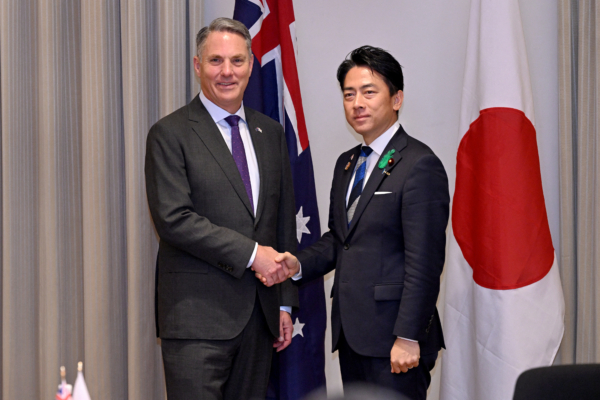
Australia and Japan announced on Saturday (April 18) the official signing of a contract for the joint development of new naval vessels for the Australian Navy. The project, with a total value of 20 billion Australian dollars (approximately 14.4 billion US dollars), will see Mitsubishi Heavy Industries constructing 11 “upgraded” “top-class” patrol vessels for Australia.
These vessels will not only be the centerpiece of the modernization of the Australian Navy but are also considered the most strategically influential defense equipment export case for Japan since it relaxed its arms export restrictions in 2014. This also indicates that in the face of escalating military threats from China, Australia is intensifying the restructuring of its military forces and establishing a broader network of security cooperation.
According to the plan, Australia will procure 11 “upgraded” “top-class” escort vessels from Mitsubishi Heavy Industries to replace Australia’s aging Anzac-class patrol vessel fleet. The first three escort vessels will be constructed by Mitsubishi Heavy Industries in Nagasaki, Japan, with delivery expected in 2029 and service entry in 2030.
The subsequent eight vessels are planned to be transferred to the Henderson shipyard in Western Australia, where Australian shipbuilding giant Austal will be responsible for local assembly, thus strengthening Australia’s domestic defense industry resilience.
On Saturday, Japanese Defense Minister Taro Kono and Australian Deputy Prime Minister and Defense Minister Richard Marles held a meeting aboard the Japanese top-class escort vessel “JS Kumano” docked in Melbourne to witness the signing of the contract.
Marles stated, “By 2029, we will welcome the first escort vessel in Australia, and in the early 2030s, the top-class multi-role escort vessel will become the backbone of Western Australia’s shipbuilding industry.”
Kono described this agreement as “historic” and emphasized that the development of Japanese-Australian security relations has “no limits.”
Kono said, “This year marks the 50th anniversary of the signing of the Japan-Australia Treaty of Friendship and Cooperation. With the introduction of Japanese vessels to the Australian Navy, the defense cooperation between the two countries has finally taken a significant step towards a higher level.”
This new type of patrol vessel boasts multi-functional combat capabilities such as anti-submarine, anti-surface ship, and air defense, aimed at safeguarding critical trade routes in the Indo-Pacific region.
In addition to Mitsubishi Heavy Industries, Japanese electronic giants like NEC, Mitsubishi Electric, Hitachi, and Fujitsu will also be involved, providing cutting-edge technologies such as stealth antennas, radar, sonar, and underwater unmanned vehicles (UUVs).
This cooperation also reflects a major shift in Japan’s defense policy.
According to reports by Kyodo News, the Japanese government plans to revise the “Three Principles on Transfer of Defense Equipment” guidelines next week to facilitate the substantial export of lethal weapons under the guise of “joint development.”
Against the backdrop of increasingly complex security situations in the Indo-Pacific region, Japan views Australia as a “quasi-ally,” and the two countries are building a tighter security framework through the high integration of military equipment.
Kono’s visit is also seen as paving the way for Japanese Prime Minister Yoshihide Suga’s upcoming visit to Australia at the end of this month, demonstrating the close cooperation between Japan and Australia in diplomacy and defense.
The Japanese Maritime Self-Defense Force has been using “top-class” escort vessels since 2022. Currently, New Zealand is also preparing to replace its aging warships, with this model being one of the two candidate options under consideration.