
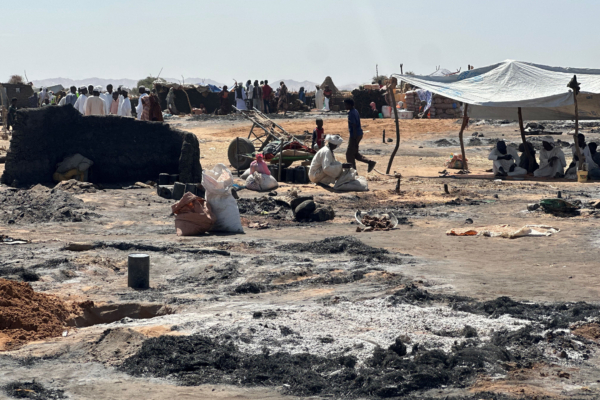
Since the outbreak of the civil war in Sudan in 2023, the number of displaced people has exceeded 13 million, making it one of the most severe humanitarian crises globally. Famine and massacres have been rampant, with the supply of basic food and resources becoming increasingly scarce.
On Wednesday, April 15, Sudan officially entered its fourth year of internal conflict. However, amidst the latest turmoil in the Middle East, this Northeast African country adjacent to the Red Sea is losing international media attention. UN officials describe this protracted civil war as an “abandoned crisis.”
Currently, the Sudanese government forces continue to clash with the armed militia group known as the Rapid Support Forces (RSF), with no sign of peace on the horizon. Most recent atrocities have been attributed to the RSF.
The RSF, formerly known as the notorious Janjaweed militia, which fought on behalf of the Sudanese government during the Darfur War in 2003, was implicated in numerous atrocities against civilians. According to human rights organizations, the unit committed crimes against humanity in Darfur.
Today, witnesses and aid groups report extensive destruction in the Darfur region. According to reports from Al Jazeera, the Humanitarian Research Lab at Yale University’s School of Public Health released a report last December stating that the RSF launched a series of organized and prolonged operations to eliminate evidence of mass killings. Their targets included civilians escaping cities and residents seeking shelter in the community of Daraja Aulla, the epicenter of the massacre.
The report further reveals that after the events, armed forces carried out systematic actions over several weeks to conceal the traces of the massacre through collective burials, burning bodies, and body transfers, actions that are likely ongoing.
Increasing evidence suggests that regional powers, including the UAE, are covertly supporting different factions. While the US and regional countries initially attempted to broker a ceasefire, these efforts have faltered amid distractions from the conflict in Iran.
Sudan, an African Arab country that saw a civil revolution overthrow a dictatorship in 2019, witnessed the shocking “Ramadan Coup” on April 15, 2023, sparking a full-scale civil war between the Sudanese military led by the interim government chairman and the RSF led by the vice chairman.
This conflict has claimed at least 59,000 lives. In October 2025, the RSF launched an offensive in the town of Fashir, Darfur, resulting in the deaths of approximately 6,000 people in just three days, displaying typical features of “ethnic cleansing,” according to experts.
Moreover, the International Red Cross reports over 11,000 missing individuals. The war has plunged some regions into famine, with estimates suggesting that severe acute malnutrition could affect up to 800,000 people, the deadliest form of malnutrition.
The UN states that approximately 34 million people across the country require humanitarian aid, affecting two out of every three individuals. The healthcare system is also on the verge of collapse, with only around 63% of medical facilities partially or fully operational. Cholera and other diseases continue to spread.
Meanwhile, due to the conflict in Iran and disruptions in shipping, fuel prices in Sudan have risen by over 24%, further driving up food prices.
Denise Brown, the top UN official in Sudan, bluntly states, “Please stop calling this a ‘forgotten crisis’; it is actually an ‘abandoned crisis’.” She criticizes the international community for failing to focus efforts on securing a ceasefire.
The conflict stems from power struggles following Sudan’s push for democratic transition in 2019. When longtime President Bashir was overthrown by the military, internal conflicts between military leader Burhan and RSF commander Dagalo erupted three years later, escalating into a civil war.
Analysts note that neither side can secure a decisive victory, with the Sudanese people gradually losing agency under external influences. Sudan has effectively split into two power structures: a military government controlling the capital Khartoum and internationally recognized, and the RSF faction that dominates the Darfur region.
The military controls the north, east, and central regions, including the Red Sea ports and oil facilities; while RSF controls Darfur and Kordofan, regions rich in oil and gold resources.
Regional powers are deeply involved in the conflict, with Egypt supporting the Sudanese military and the UAE accused of arming the RSF, though the UAE denies these allegations.
Yale University’s Humanitarian Lab suggests that the RSF may be receiving military support through bases in Ethiopia, although the organization has not responded.
During the three years of conflict, various atrocities have occurred, including large-scale massacres, sexual violence, and even collective rape.
The World Health Organization reports that hospitals, ambulances, and medical personnel have been frequent targets, resulting in over 2,000 deaths.
The International Criminal Court is currently investigating cases involving war crimes and crimes against humanity, focusing primarily on the Darfur region, which has long been infamous for genocide and war crimes.
In early 2025, following the military’s retaking of cities like Khartoum, around 4 million people could return home. However, with infrastructure severely damaged, living conditions remain challenging.
Tjada D’Oyen McKenna, the CEO of Mercy Corps, states, “This is not just returning to normal life; it is struggling to survive in a new reality.”
As international attention shifts to conflicts in the Middle East, the Sudanese civil war, now entering its fourth year, has resulted in nearly 60,000 deaths, 13 million displaced individuals, and widespread famine and humanitarian crisis, yet it receives little attention.
Concerns arise over the neglect of the situation in Sudan, the stalled progress in ceasefire efforts, and the deep external involvement due to the desire for the country’s mineral resources, which could further escalate the conflict and make it even more challenging to resolve.