
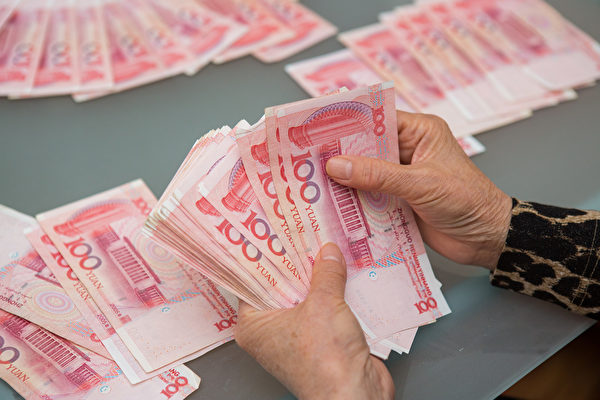
Entering 2026, signs of economic recovery are still elusive in China. The real estate market remains sluggish, and residents’ willingness to consume and invest is weak, with no visible improvement in social confidence. Despite the continuous claims by the Chinese Communist Party (CCP) officials of “economic recovery” and “stable growth”, Chinese residents have significantly increased their savings in a short period by trillions of yuan, adopting a strategy of “no consumption, no investment, just saving” in response to uncertain prospects, raising concerns among outsiders about deep structural issues and systemic financial risks in the Chinese economy.
The People’s Bank of China (PBOC) website released the financial statistics report for April 2026 on May 14th.
The report shows that in the first four months of this year, household deposits increased by 5.74 trillion yuan, while household loans decreased by 490.2 billion yuan.
This indicates that residents are “deleveraging” – unwilling to borrow money, unwilling to consume, unwilling to buy homes, but instead are inclined towards saving for risk aversion.
Observers believe that the phenomenon of people “spending less, saving more” reflects the lack of confidence in the economic outlook and income expectations in society.
Against this backdrop, recent discussions by Xu Chenggang, a former professor at the National School of Development at Peking University and now an economist in the United States, about the Chinese economic situation have been circulating on the internet, drawing attention.
Xu believes that China is not facing a typical economic cycle fluctuation, but rather a financial and fiscal crisis that has already formed. The massive stimulus measures introduced by the authorities can at best “alleviate the crisis”, but cannot truly address the deep structural issues.
Recently, the CCP authorities have continued to signal loose policies. The PBOC, in its “First Quarter 2026 Monetary Policy Implementation Report”, proposed to continue implementing a “moderately loose” monetary policy to maintain adequate liquidity.
Xu Chenggang points out that China’s most serious issues currently lie in three major areas: real estate, local government debt, and local banks. Many real estate companies are insolvent, local governments are in financial straits, and local banks are facing deteriorating balance sheets.
He noted that in a market economic system, many nonperforming enterprises and financial institutions should have gone bankrupt, but in China, due to the “too big to fail” nature of state-owned banks, local governments, and state-owned enterprises, liquidity and fiscal funds are continually injected to maintain their operation. Xu stated, “These policies may make the economy seem to be back to normal, but the problems themselves have not been resolved.”
He believes that the massive monetary injections, local debt swaps, and fiscal stimuli adopted by the CCP are essentially a form of “rescue” and “subsidy”. If short-term liquidity injections exceed 10 trillion yuan and medium-term injections exceed 20 trillion yuan, it may temporarily stabilize financial and fiscal risks, but it only delays the crisis rather than solving the problem.
Xu Chenggang points out that the real core problem of the Chinese economy is insufficient domestic demand, with the root cause of this being the low proportion of household income to GDP.
He mentioned that China has long relied on investment and exports to drive the economy, but with inadequate growth in household income, consumption capacity has weakened. Since the global financial crisis in 2009, China has faced overcapacity and deflationary pressure, but these problems have not only remained unresolved but worsened over the years, eventually triggering a real estate and local fiscal crisis.
“China is facing not just financial problems today, but a systemic crisis of the entire economic system and structure,” he said.
Xu Chenggang believes that in order to truly improve domestic demand, deep reforms involving land ownership, financial systems, and state-owned economic systems are necessary. For example, land should be state-owned, and the banking system should be state-owned, so that a large amount of resources are concentrated in governments and state-owned enterprises, leading to a low proportion of income for the household sector and thus a long-term inability to expand consumption effectively.
Regarding the recent proposals by some scholars in China to issue consumer vouchers or provide direct cash stimulus, Xu Chenggang believes that these measures can only produce short-term results and cannot fundamentally solve the problems.
Speaking of the real estate market in China, Xu bluntly stated that the national housing market is unable to return to its past glory, even in first-tier cities, as there is a lack of comprehensive foundation for a full recovery.
He believes that the recent short-term warming seen in some cities is merely an “illusion” created by market stimulus policies, rather than an improvement in fundamentals. Due to insufficient domestic demand, high unemployment rates, and an oversupply of housing that remain unresolved, the Chinese real estate market still faces long-term pressure.
Furthermore, he criticized the authorities’ attempts in recent years to boost confidence and the development of the technology industry through stimulating the stock market.
Xu Chenggang pointed out that the Chinese stock market lacks support from economic fundamentals, and artificially inflating the stock market easily leads to speculation and financial instability. He also mentioned the 2015 Chinese stock market crash, stating that the official intervention in the market and pushing up stock prices ultimately resulted in greater turmoil. “The solution to financial crises lies in financial stability, not in stock market speculation,” he said.
In recent years, the CCP has emphasized the development of technological innovation, but Xu Chenggang believes that a significant issue facing the Chinese technology industry currently is the massive retreat of private risk investment.
He noted that in the past, the rapid development of Chinese technological innovation relied heavily on private and foreign risk investment support. However, with the departure of foreign capital and a decline in private capital confidence, truly market-oriented risk investment has significantly decreased.
Xu Chenggang believes that stable financial markets and a legal environment are necessary to support technological innovation, including protecting private property and maintaining judicial independence. Without these institutional safeguards, solely relying on administrative measures to boost the stock market or inject state funds is unlikely to genuinely promote the development of innovative industries.
Finally, Xu Chenggang warned that China’s current strategy of stabilizing the economy through massive monetary issuance and debt accumulation may temporarily avoid a financial system collapse, but in the long run, it could pose even greater risks.
He pointed out that in the late 1990s, the CCP resolved a crisis by injecting capital into banks and expanding fiscal policy, but it was accompanied by extensive market-oriented reforms and rapid growth in the private economy, allowing the debt pressure to be absorbed.
However, with China’s slowing economic growth and a significant decline in confidence among private enterprises, coupled with a lack of new growth drivers, ongoing reliance on monetary expansion and increased borrowing for stimulation may sow the seeds for more severe inflation and systemic risks in the future, as Xu Chenggang stated, “It’s not a disappearance of the crisis, but a freezing and postponement of the crisis.”