
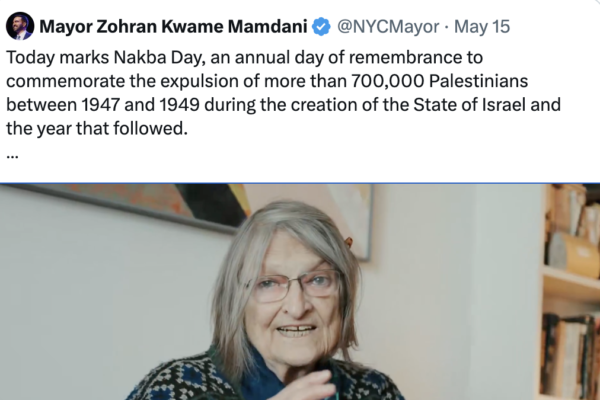
On May 14, 1948, Israel was established with the mediation of the United Nations. Israel marks this day as Independence Day, while the displaced Palestinians refer to the next day, May 15th, as “Nakba” or the Day of Catastrophe. Last week, New York Mayor Mamdani publicly screened a video of a Palestinian woman living in New York to commemorate Nakba. This move has caused unease and dissatisfaction among the Jewish community in New York.
In the video, a woman named Inea Bushnaq recalled her experience on the Day of Catastrophe in 1948 when she was just 9 years old. She was forced to flee her home with her father, leaving behind only the key they used to lock the door, unable to return.
“Inea is a New Yorker and a survivor of Nakba,” Mayor Mamdani said. “She shared her story with us—a story about home, tradition, and generational memory.”
Leaders of the New York Jewish community believe that Mamdani’s actions show open support for the Palestinian people, neglecting the stance of the Jewish community. The Mayor did not mention Israel’s Independence Day like previous mayors, and his office stated that he would not participate in the Israeli Parade at the end of May.
The UJA-Federation of New York posted on social media that the video failed to include information about the violence against Jews before and after the establishment of Israel, nor did it mention the war between Israel and several Arab countries in 1948 and the displacement of Middle Eastern Jews, who now make up half of the Jewish population in Israel.
At a press conference on Monday, Mayor Mamdani responded to public criticism of his stance.
“I firmly believe that recognizing one group’s suffering doesn’t hinder recognizing another group’s suffering,” Mamdani said. Being able to share the story of a “survivor of catastrophe” and city resident like Inea Bushnaq in the video is an “honour.”
As a result of this, leaders of mainstream Jewish groups declined to participate in the “Jewish Tradition” celebration at the Gracie Mansion hosted by the Mayor, citing his unacceptable criticism of Israel.
One of the Jewish leaders, former Brooklyn City Councilman Mark Treyger, stated on platform X that New York has the largest Jewish community outside of Israel. For the vast majority of New York Jews, their connection to Israel is not political showmanship or a social media performance but stems from ancestry, spirit, history, and deep personal emotions.
“In the rise of anti-Semitism, including terror threats against a Jewish synagogue in New York City and hate protests against Jewish families in Brooklyn, public discourse is crucial,” Treyger wrote. “Especially as the Sabbath approaches, many New York Jews already feel vulnerable and insecure.”
Treyger mentioned that only addressing a part of history without facing the full history, including the proposal after World War II by the United Nations to support two states—a plan accepted by Israel and rejected by the Palestinians—does not help promote mutual understanding.
“New Yorkers should expect leadership that seeks to deescalate tensions, unite people, and make every community (including the New York Jewish community) feel cared for, respected, and safe,” he said.