
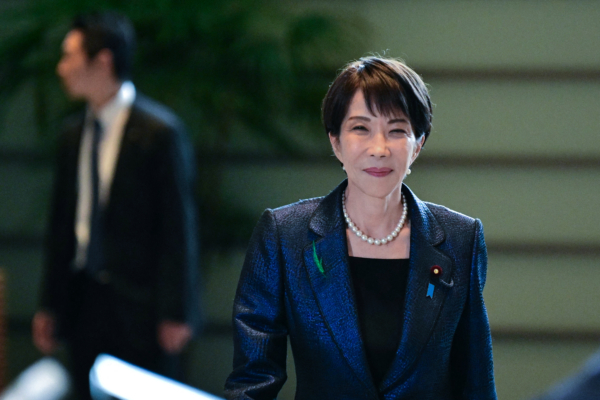
Information obtained by sources on Monday (May 18th) revealed to Japan’s Kyodo News that the Liberal Democratic Party led by Prime Minister Sanae Takaichi of Japan has drafted a proposal urging the early deployment of intercepting drones and high-energy weapons, drawing lessons from the experience of the war in Ukraine.
The insider mentioned that this proposed draft, planned to be revised by the end of this year, encompasses three key security documents in Japan, urging the government to ensure that it has the capability to conduct operations for “at least one year” in the event of long-term conflict.
To enhance Japan’s ability to counteract threats, the proposal also suggests the government research the use of a new generation of submarines with advanced propulsion systems and the capacity to carry long-range missiles.
The proposal did not address whether Japan’s “Three Non-Nuclear Principles” would be reconsidered. However, Prime Minister Sanae Takaichi, known for her hawkish stance on security policy, expressed interest in amending these principles before taking office last October. The “Three Non-Nuclear Principles” prohibit Japan from possessing, manufacturing, or allowing the introduction of nuclear weapons.
Simultaneously, the proposal emphasizes the necessity of strengthening defense of maritime routes.
It points out that the role of drones in modern warfare is escalating, and Japan needs a defense system capable of withstanding large-scale saturation attacks, “rather than relying solely on costly interception missiles.”
The proposal from the LDP also includes: introducing long-range drones for counter missions, enhancing domestic mass production capabilities, and accelerating investment in artificial intelligence technology.
To bolster Japan’s sustained operational capabilities, the proposal calls for legal measures to support an increase in weapon production in emergency situations, including options like nationalizing defense equipment factories operated by private companies.
In light of China’s large-scale military construction and export control threats, Japan has begun enhancing regional security partnerships and loosening decades-old defense export restrictions, while also strengthening cooperation with Taiwan in the field of drones.
Taiwan’s 7A drone company signed two new agreements with Japanese firms this year: one to collaborate with AlterSky in developing large-scale logistics drones, and the other to work with Autonomy HD to integrate the Taiwan-Japan drone industry supply chain and develop the next generation of autonomous drones.
Chinese Foreign Ministry spokesperson Guo Jiakun criticized Japan during a press conference on Monday, accusing Japan of “undermining the cornerstone of peace in the Asia-Pacific” and demanding that Japan halt its “remilitarization” rapid advancement.