
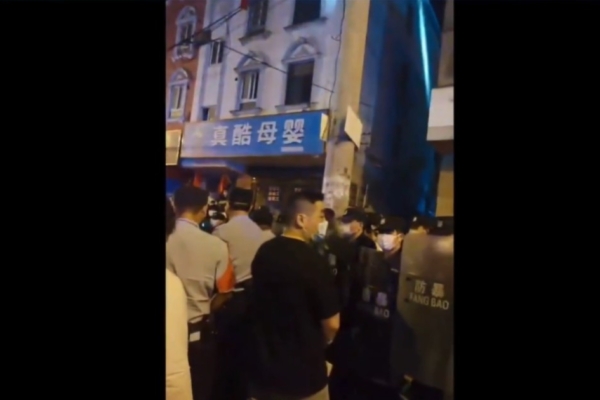
Recent reports from the Longgang Street, Yaohai District in Hefei City, Anhui Province, have brought to light a violent forced demolition incident. Local residents have informed Epoch Times that the demolition took place in the early hours of May 16th without the signing of compensation agreements or the presentation of formal compensation and resettlement documentation. The demolition team mobilized a large number of personnel late at night and forcibly demolished residents’ houses.
According to interviewed residents, these houses were mostly built between 2004 and 2005. Due to historical reasons, some houses were unable to obtain proper documentation and are now labeled as “unauthorized” or “illegally constructed.” The residents stated that they are not refusing relocation but rather demanding the presentation of official permits, planning documents, and compensation plans.
One male interviewee told Epoch Times that the forced demolition occurred in the early hours of the morning, with a large number of security personnel arriving that night. “About 400 people came last night, all security guards from outside,” he said. Before the demolition, the on-site personnel did not formally identify the entity responsible for the demolition or present any official documents. “They just said they were from a security company… and then all our houses were demolished.”
“They forcibly broke in while people were sleeping, dragged them out of the house,” he said, adding that with a large number of people present, residents were unable to resist.
Another female interviewee stated that the forced demolition occurred around 1-2 a.m., with at least seven buses and local community workers on-site. “They surrounded our entire area,” she said. “While houses with proper documentation were not demolished, residents were trapped inside. They locked both doors, preventing them from leaving or entering.”
According to the female interviewee, there were still people living in houses with incomplete documentation, but they were forcibly removed. “For houses with incomplete documentation, they forcibly evicted everyone inside. They didn’t care about some things in the house and just demolished everything.”
She also mentioned that during the demolition, there was still an elderly person in her house. Because the tenant had already moved out, the elderly person found it convenient to temporarily stay on the first floor. There was also a car parked inside the house, and items left behind by the tenant. “They used a bulldozer to forcibly move the car out, and then directly leveled the house. The refrigerator, washing machine, air conditioner, everything was buried in the ruins.”
The male interviewee also stated that some residents rely on renting out homes and stores for their livelihood. “We have no land left, no farmland, no salary income. Now we rely on houses and rentals to sustain our lives.”
The residents interviewed mentioned that the properties in question are located in the southeast corner of Longgang Street, Sun Daying, Yaohai District, along with Xin’anjiang Road and Yushan Road. Most of the houses were built around 2004 to 2005, making them over twenty years old.
One male interviewee told Epoch Times, “We obtained this land in 2003, and the houses were built in 2005. Some people bought houses from the village at that time, and some purchased them later.”
According to him, not all of these houses lack proper procedures. Some residents have obtained property certificates, land certificates, and other documents, while some have not completed full property registration due to delays in processing their paperwork.
“We didn’t build houses randomly. Some of us have obtained documents such as land certificates, property certificates, and related procedures. Currently, four households have the necessary documents, while others have incomplete documentation,” he explained.
He mentioned that some houses lacked property certificates due to a halt in the certification process at the time. “Those without certificates constructed their houses in 2005. The process was delayed, and later Hefei City suspended the procedures for property certificates, leading to the lack of documentation.”
The female interviewee stated that her family’s house was constructed starting from the second half of 2004 and completed in 2005. The procedures at that time required approval and official stamps from the village committee, followed by processing at planning and land departments step by step.
“The village committee had approved and stamped it. The next step was to handle the planning procedures,” she said. However, due to large-scale relocation in Hefei, the processing of land and planning procedures was halted, preventing them from completing the formalities.
She pointed out that their documents were stuck at a specific stage due to the inability to continue the subsequent procedures. “Because they needed to carry out the relocation at that time, how could they process certificates for us? So our documentation got stuck there, and to this day, it hasn’t been completed.”
She mentioned, “Our house has been standing for 21 years by 2026. We have been living here, using water and electricity normally.”
According to her, Sun Daying used to be a rural area where houses were built and land was purchased from the village, following the procedures of the village committee’s approval and property development. Residents believed that once the village committee approved it, processing the documentation sooner or later would be similar.
“There are about fourteen to fifteen households in this area, each having different timelines for constructing and processing documents. Some built earlier than others, nearly a year earlier, so their documentation was processed in time,” she said. “Each family situation is somewhat complicated.”
The male interviewee believed that the lack of complete documentation later on should not simply negate the historical reasons for the formation of the houses.
“These houses were built in 2005. According to the regulations in rural and urban areas at that time, we believe they should have historical legitimacy. We did not construct houses randomly,” he stated. “They claim our houses are illegally constructed, but given the economic and historical conditions at that time, even if the documentation is incomplete now, we cannot simply deny the facts from back then, let alone forcefully demolish them.”
Reports from mid-May 2026 by mainland media have indicated that there have been multiple relocation cases in Hefei recently, including areas in the Yaohai District designated for demolition. The information suggests that there are still several lands and areas in Hefei facing renovation, transformation, and relocation arrangements.
The interviewed residents mentioned that the relocation plans started around November of the previous year but have yet to present residents with official permits, planning documents, and compensation and resettlement plans.
The male interviewee informed Epoch Times, “Up to now, they have not provided a formal resettlement plan, nor have they shown any government approval, explaining what exactly this land is going to be used for, how it will be handled, compensated, and resettled. Nothing has been clarified.”
He mentioned that the local authorities only verbally mentioned the compensation differences between houses with and without proper documentation but have not provided any written documentation. “The verbal compensation plan they mentioned is vague. It includes providing resettlement based on certain proportions for houses without proper documentation and handling houses with proper documentation according to certain standards.”
He expressed dissatisfaction, stating that his family’s documented area is about 250 square meters, with an additional 100-plus square meters undocumented. However, the demolition team has not provided any official written plans for both parts.
“We definitely do not agree. How can we agree without any documents?” he said.
The female interviewee also highlighted that their total area is approximately five to six hundred square meters, but the proposed resettlement area provided is significantly lower than the actual area, and all compensation terms were just oral agreements with no written confirmation.
The relocation party had suggested compensation equivalence methods verbally, which she found clearly unreasonable. For instance, they proposed “60 square meters for 120 square meters,” which is less than half and also mentioned offering “15 square meters for over 160 square meters.”
She added that even for the designated resettlement area, she was asked to pay an additional 2680 yuan per square meter.
“The key point is that none of these were backed by any written documentation. There were no documents at all; they just said it verbally,” she stated, mentioning that when she asked for proof of unauthorized construction, the authorities failed to provide any material.
“Now that you are eyeing my land, claiming my house is unauthorized construction, you need to present official evidence from relevant departments confirming the unauthorized construction,” she added.
The interviewed residents believe that the handling of houses in the Sun Daying area may be related to land development; however, they have yet to see any official land use planning documents.
The male interviewee said, “We have asked them to clarify: if you are going to relocate us, you need to present the land planning, explaining what this land will be used for, whether it’s for a hospital, school, or commercial purposes. You need to provide official documents. Right now, they have nothing.”
“We are not refusing relocation, but it must be compensated according to policies and following legal procedures,” he stressed. “For projects managed by the government, there should be official standards, official documents, and official resettlement plans. They cannot ignore us and force us to accept unreasonable conditions.”
The residents stated that after the demolition of their houses, they will continue to demand an official explanation from the local authorities.
They mentioned that the forced demolition was not a sudden occurrence. Before that, the local authorities had previously disrupted residents and tenants’ lives through measures like blocking and cutting off power.
Recalling the past incidents, the female interviewee mentioned the first blockade that occurred around February this year. “They organized a large number of security personnel, that is security guards, in the middle of the night and forcibly blocked us off,” she said.
She explained that the ground floors of the local houses had street-facing storefronts and storage spaces, with people residing on the upper floors. After the blockade, a passage was left open for basic access. Tenants and store owners were gradually impacted, with businesses unable to operate normally and tenants being constantly persuaded to leave.
“They kept harassing our residents and tenants, all after 9 PM,” she said. The authorities informed tenants, “This area will be demolished soon, so you need to move out quickly.” Eventually, most local renters were driven away.
“After all tenants had left, they forcefully cut off our only living passage,” she said, mentioning that the excavation took place around mid-April, also in the late evening.
Residents subsequently called the police, explaining the importance of the passage to their daily lives. “This passage is crucial for our lives and the lives of our elderly and children. With the passage blocked, how can we live?” she questioned.
Eventually, with the police present, the residents dismantled the blockade, restoring basic access.
The male interviewee confirmed the above accounts, saying, “In these past two years, they have come several times.”
The female interviewee mentioned that before the forced demolition, some residents had traveled to Beijing to appeal.
She stated that after the first trip to Beijing, local officials urged them to come back, promising to address the situation upon their return. “We didn’t want to escalate the situation at the time, so we believed them and came back. However, once we returned, they immediately went back on their words, reverting to their original policy,” she recalled.
She said that residents made a second trip to Beijing thereafter, visiting petition and discipline departments to report the situation. “The national petition department indicated that the local authorities were handling it and asked us to return and wait for the response.”
“We were waiting for the local authorities to act, expecting them to resolve things around the 27th. They even promised to handle our case by this past Tuesday. However, before any resolution was reached, two nights ago, they suddenly launched a large-scale operation,” she recounted.
Public records indicate that information released on the website of the Yaohai District government at the end of December 2021 acknowledged historical issues in the real estate sector, such as the longstanding problem of “difficulty in obtaining permits.” Several projects were affected by multiple district adjustments, long time spans, and complex land ownership, including issues related to the “land ownership of Xiaohewan and Sun Daying East.”