
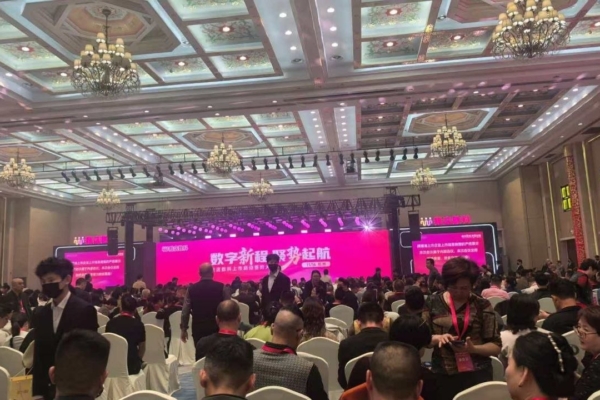
In the backdrop of China’s ailing economy and continuous decline in consumer purchasing power, the “Our Shop Digital” platform, under the guise of “profit sharing and rebate,” spun a tale involving 30 million members and a claimed wealth of billions of circulating funds. However, with the platform collapsing, issues such as frozen redemptions, headquarters relocation, and the forced conversion of user debts into shares have turned this once highly promoted and policy-supported feast into a pit of tears for countless small businesses.
Dong Qin (pseudonym), a victimized merchant from Yichun, Jiangxi, lamented in an interview with Epoch Times, stating that during difficult business times when people were anxious, this free-to-join “pseudo-innovative” platform preyed on human vulnerabilities, making people “feel as if they were seeing hope,” when in reality, it was a cruel form of exploitation.
According to reports from “Business World” magazine and related investigations, the core operation of “Our Shop Digital” lies in its “profit-sharing and rebate” mechanism where merchants can set their own profit-sharing percentages ranging from 3% to 20%. There are around 500,000 different industry merchants across the country linked through the National Cross-Industry Alliance.
Dong Qin recalled that he was introduced to the platform at the end of 2024 through a neighbor who brought him to the “service center” to learn about the platform. Despite being initially skeptical, the anxiety of struggling business convinced him to join, thinking it would attract more customers. However, this so-called “innovative” platform model turned out to be a “bloodletting machine” for merchants in reality.
The business model of “Our Shop” works like this: each time a consumer makes a purchase, the merchant offers a profit share of 3% to 20% based on the industry category (15% for dining, 20% for retail). Both consumers and merchants receive green points equivalent to the profit share amount. For example, if a consumer spends 1000 yuan and the merchant offers a profit share of 200 yuan, both parties receive 200 points each. The points are initially released at 1%, increasing by 0.1% each period.
Dong Qin, who wholesales seasoning products, with already low profit margins, found that offering a 20% profit share meant “having to put out some money.” He explained, “In reality, it’s a pit because the better your business, the more you lose. All the capital is taken away by the company.”
Giving an example of selling goods worth 10,000 yuan with a 20% profit share, Dong Qin said, “The next day I only received 8,000 yuan, and the 2,000 yuan profit share was taken by the platform.” The platform advertised that “the highest can be returned up to five times,” meaning selling out 10,000 could eventually be returned in full.
However, upon reviewing his thousands of orders, Dong Qin found the point release ratio to be extremely low, with “almost all being in single digits.” By early 2026, Dong Qin’s accumulated over 400,000 points and more than 9,000 yuan in product payments, the majority of which could not be cashed out.
Similarly, Mr. Wang from Sichuan, who joined in 2024, was promised a profit share of 10,000 yuan turning into 50,000 yuan in three years. This business logic was packaged under the national “green consumption points” policy, convincing participants that they were responding to the country’s call.
Why did thousands of merchants unquestionably believe in this model? Victims pointed to the promotion by official media and the endorsement of authorities.
Dong Qin recalled, “Why did I quickly join? At the end of 2024, there were a lot of channels on CCTV, I counted them, there were at least seven or eight channels all advertising for this platform.” These videos often featured celebrities and “politically dressed leaders,” which created a false impression of “national support” among the general public.
According to a report by “Business World” in March of this year, the founder and chairman of “Our Shop,” Xiao Hancheng, was once praised as one of the “Top 10 Innovative Figures in China’s New Economic Model of 2023,” and in 2025, he was awarded the Vice Chairman’s certificate of the Boao Global Digital Consumption Conference. Moreover, Xiao Hancheng also participated in the “2025 Shanghai China Entrepreneur Forum and Presidential Banquet” commercial event held in March of last year, which invited former German President Christian Wulff.
In September 2025, he even appeared on the CCTV program “Dialogue,” talking about “altruistic thinking” and “reshaping the physical ecology.”
More unsettling was the intervention of local officials. A victim reported that a certain Mr. Zhou from Hainan Province, who held titles such as National March 8th Red Flag Bearer and National Women’s Representative Conference delegate, stood prominently at the C Round Financing Conference in November 2025 when funds were tight for “Our Shop Digital,” claiming to have invested 100 million yuan to purchase “original shares.”
The “Business World” report revealed that before 2021, Xiao Hancheng had a nearly blank resume outside of the official promotions by “Our Shop,” hardly finding any third-party records for verification.
However, victim groups revealed that Xiao Hancheng changed his name and had been imprisoned for crimes like illegal operations, fraud, and illegal fundraising; even in his senior team, there were core members from the Guangdong “Yunlian Hui” pyramid scheme case.
Dong Qin questioned, “How did they get on CCTV for an interview? Did it not go through any verification process?”
According to a report by “Consumer Daily” at the end of January, signs of the collapse of “Our Shop Digital” began to emerge in the second half of 2025. In August, the company’s headquarters moved from Hangzhou to Danzhou, Hainan, officially for “brand enhancement,” but suspected as an attempt to evade regulation. In November, there were incidents of “voucher” funds not being credited, prompting the platform to extend the point redemption period from 3 years to 10 years.
As the investment funds became unable to be redeemed and operations faced imminent collapse, the platform dangled a bigger lure of “listing in Hong Kong.” The company held a listing advisory signing event in Hangzhou, claiming to go public in July 2026 and opening internal subscriptions for “original shares.”
Many salespersons owed commissions and merchants eager to recoup their investments were compelled to convert their funds into promised equity for the upcoming listing. Moreover, the platform was accused of threatening users with “zeroing out assets without signing an agreement,” forcing users into converting debts into shares.
Dong Qin estimated that there were “over twenty thousand reported cases of rights protection” within the first two to three months. Although public security agencies in many regions have initiated investigations on charges of illegal public fund-raising and leading pyramid schemes, Danzhou City in Hainan Province explicitly determined their violation of the “Direct Selling Regulations,” the path to justice for victims remains incredibly difficult, partly due to the legal ambiguity of “green points.”
What perplexed many was the involvement of Xiao Hancheng in drafting the “Technical Specification for Green Consumption Points” in 2024. In this standard, points were defined as exchangeable for “enterprise profit-sharing rights or capital gains rights.”
This sort of dual role of “being both umpire and player” has been viewed by legal professionals as a step towards financializing points, potentially leading to pyramid schemes akin to a Ponzi scheme.
In January 2026, the Chinese Ministry of Commerce and nine other departments jointly issued a notice strictly prohibiting the illegal conversion and tiered rebates of points, but for platforms that have already reached a substantial scale and are closely linked to local interests, the oversight evidently lagged behind.
Dong Qin reflected on his plight, stating that although he reported the case locally, he encountered repeated difficulties in filing a case because the company’s legal team had carefully crafted a “firewall” using legal loopholes to evade responsibility.
As a victim of the “Our Shop” platform, Dong Qin has been closely monitoring the company’s movements. He mentioned, “The company last year publicized that it had hundreds of billions in transactions, with payment amounts reaching several billion, and the chairman said it was around six billion in the live broadcasts.” This included parts from vouchers, recruiting shareholders from over a thousand service centers, and the “original shares” through debt-to-equity conversions.
Dong Qin suspected that the funds had long been diverted by the top executives. He explained, “The company’s excuse was that the bullets had run out, and this money had all been distributed to the market, which wasn’t true,” because “in the second half of last year, the company frequently held events and absorbed a lot of funds.”
The mysterious destination of massive funds revealed by the “Our Shop” case not only uncovers a financial scam but also reflects the public’s desire for and blind obedience to so-called “policy dividends” amidst a downturn in the economic environment. When state media and the government endorse “pseudo-innovative models” lacking substantive supervision, and this trust is maliciously exploited, the damage to societal order and public welfare becomes immeasurable.