
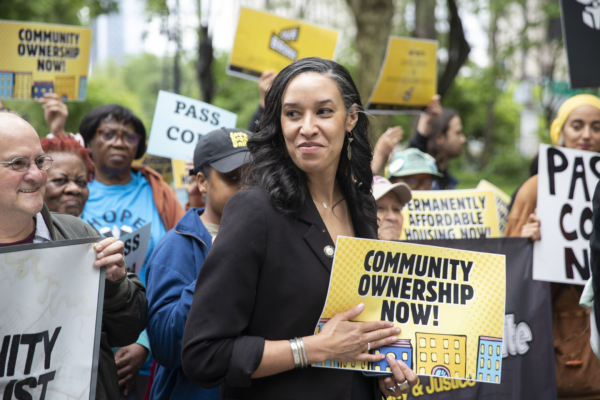
On Thursday, May 14th, progressive city council members and New York tenant organizations gathered in front of City Hall to reintroduce the “Community Opportunity to Purchase Act” (COPA) and demand that the city council push the proposal through the legislative process.
Last December, the city council passed the “Community Opportunity to Purchase Act” (COPA, Intro. 902-A) introduced by Council Member Sandy Nurse, only to be vetoed by former Mayor Adams.
The previous version of COPA proposed granting specific “community organizations” the right of first refusal on residential properties, requiring property owners to notify the city if they intend to market homes covered by the COPA proposal. The city would then notify “a small group of pre-screened eligible buyers” – these buyers are organizations selected by the city government based on applications.
If no interest is expressed, the window closes, and owners can proceed with the sale as usual. However, if community organizations express interest in purchasing, they have 175 days to complete the transaction.
To avoid potential legal challenges, the proposal only requires a delay in home sales rather than a mandatory sale. This differs from the stricter enforcement of the 79th Street Law passed twenty years ago, which was ruled unconstitutional by the courts.
The previous COPA proposal faced strong opposition from real estate groups who argued that it unfairly favored non-profit developers in home sales and would further complicate an already intricate transaction process.
The bill’s sponsor, Council Member Nurse, has made revisions to address concerns raised by the earlier version after months of negotiations with stakeholders.
Nurse stated that the bill targets a small number of residential buildings with significant maintenance issues or expired affordability terms. Allowing community organizations to bid on these properties in advance could help keep these homes as affordable housing within the community.
The new version includes a shortened timeframe for non-profit organizations to express interest and bid on buildings before they enter the broader market, as well as limiting the types of properties they can bid on in advance (for example, the new version excludes buildings with expiring 421a tax abatements).
Furthermore, once this proposal passes through the city council, it is highly likely to be signed into law by Mayor Mammadani, as he has expressed a clear stance of “empowering the people.”
However, if this bill passes, it will significantly impact the buying and selling of thousands of residential buildings in New York City.
According to the office of Speaker Manning, she will schedule a hearing for the new version of COPA at some point in the future.