
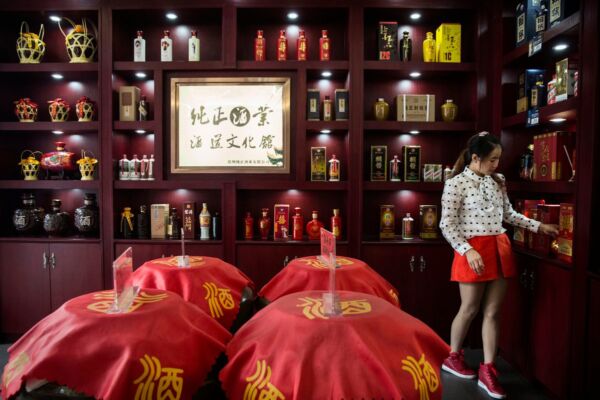
In the first quarter of this year, 261 Maotai distributors have exited the market. The main reason behind this is the sluggish market environment. Guizhou Maotai has changed its business strategy, leading to a compression of profits for the Maotai distributors, with an average revenue decrease of 1.01 million yuan.
According to a report by Jiemian News on May 12th, the operational data disclosed by Guizhou Maotai shows that in the first quarter of this year, the average revenue per Maotai distributor was around 10.973 million yuan. In comparison, during the same period last year, the average quarterly revenue per distributor was about 11.9842 million yuan. This reflects a year-on-year decrease in Maotai distributor income of 1.012 million yuan, representing an 8.44% decline.
The reduction in distributor income can be attributed to Maotai’s price adjustment of its Feitian Maotai (53% alcohol content, 500ml) in late March. Public data reveals that Guizhou Maotai raised the factory price per bottle by 100 yuan to 1,269 yuan, while the retail price guidance was only increased by 40 yuan to 1,539 yuan. This “asymmetric adjustment” of a higher increase in factory price compared to retail price directly impacted the profit margins of distributors.
Prior to this adjustment, distributors purchased the Maotai at 1,169 yuan per bottle and sold it in the market at the guidance retail price of 1,499 yuan or even higher, resulting in a minimum bottle price difference of 330 yuan. Following the price adjustment in March, the price difference between purchase and retail guidance reduced to 270 yuan per bottle, a decrease of 60 yuan, resulting in at least an 18% profit squeeze. Additionally, with the weakening market demand for Feitian Maotai, distributors were hesitant to raise prices even after the manufacturer’s increase.
According to the International Finance News, after the manufacturer raised the retail price of Feitian Maotai by 40 yuan, many tobacco and alcohol store owners did not maintain a corresponding price increase. Some stores raised prices by 10-30 yuan, while others chose not to increase prices, citing concerns that raising prices too much would impact sales negatively.
Furthermore, some views suggest that Guizhou Maotai’s change in business approach has also adversely affected the distributors. In the past, Maotai sales heavily relied on distributors who would purchase the products and sell them in the market, reducing the financial burden on Guizhou Maotai. However, since distributors could determine the retail price of Maotai, retail prices varied among different distributors. This distribution model worked well when the Maotai market was booming. However, as the market declined, distributors were forced to offer discounts for cash flow, resulting in instances where the retail price of Maotai was lower than the wholesale price.
In response to this, Guizhou Maotai introduced Maotai direct sales on its official platform. In 2025, Maotai’s direct sales channel surpassed wholesale agents for the first time, with a revenue gap between the two channels of 300 million yuan, evenly split at a 5:5 ratio. In the first quarter of this year, Guizhou Maotai’s direct sales channel generated revenue of 29.5 billion yuan, accounting for nearly 54%, significantly higher than the 24.382 billion yuan from the wholesale channel.
With declining profits and reduced income, Chinese Maotai distributors have been withdrawing. According to Guizhou Maotai’s “2026 First Quarter Main Business Data Announcement,” in the first quarter of this year, the number of distributors decreased by 261, with only 6 new additions.
The reports suggest that such a massive exodus of distributors has never been seen in the past few years. At a time when the product still lacks competitiveness in the market, the large-scale departure of distributors further exacerbates the unstable situation in Maotai’s distribution channels.