
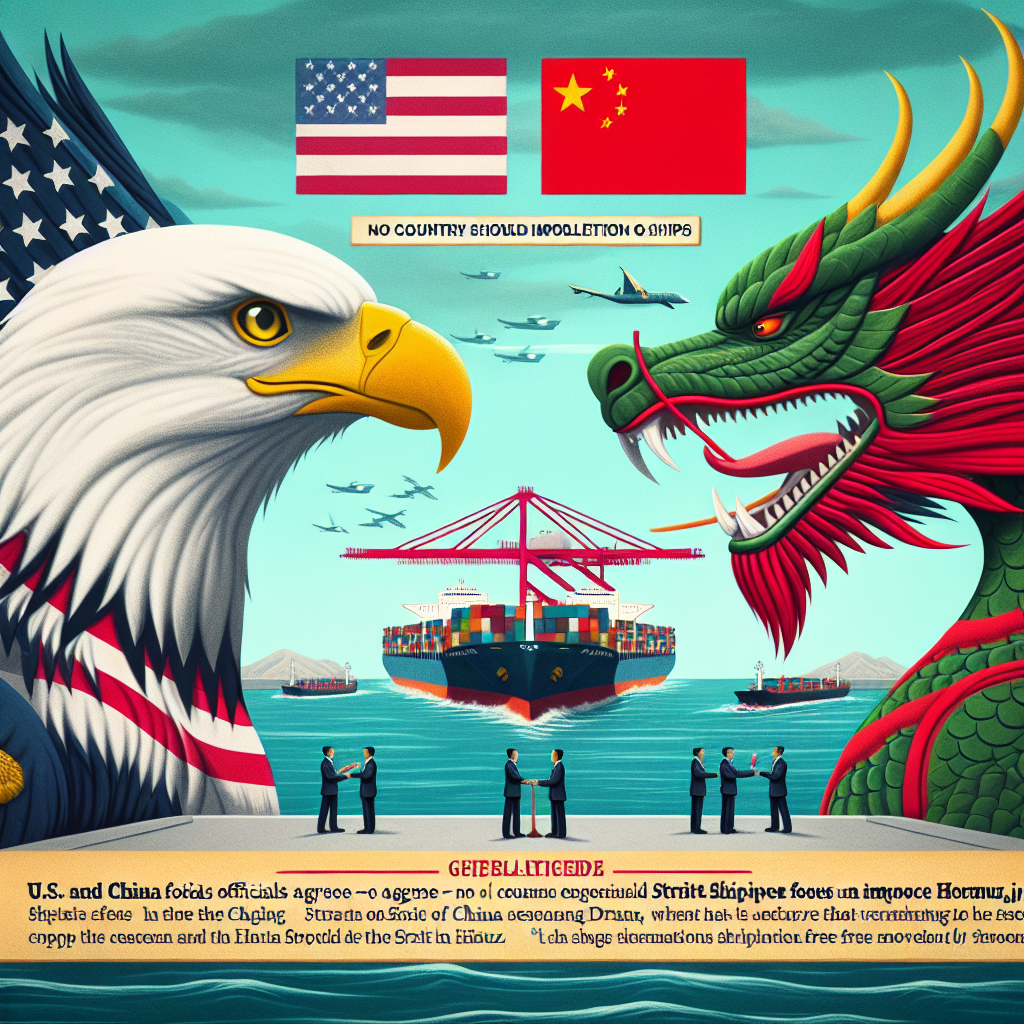
On May 13, 2026, the U.S. Department of State informed Reuters on Tuesday that senior officials from the United States and China unanimously agree that no country should be allowed to impose shipping fees in the Strait of Hormuz.
This statement from the Department of State comes as President Trump departed for China on the same day for a state visit, preparing to meet with the leader of the Chinese Communist Party. At that time, Iran’s disturbance and blockade of the strait will be one of the core agenda items.
Since the joint airstrikes by the U.S. and Israel on Iran on February 28, Iran has almost completely closed this major trade artery, triggering repeated fluctuations in the global energy market.
The U.S. and Israel launched a military operation codenamed “Operation Epic Fury” with the aim of completely destroying Iran’s nuclear facilities and drone production bases, and dismantling its military capabilities supporting terrorist activities in the region, in order to eliminate the long-term threats to the stability of the Middle East and global energy security.
The Department of State stated that Chinese Foreign Minister Wang Yi and U.S. Secretary of State Marco Rubio discussed this issue in a call in April.
“They unanimously agreed that no country or organization should impose tolls on international waterways such as the Strait of Hormuz,” Department of State spokesperson Tommy Pigott told Reuters.
The Chinese Embassy in the U.S. did not refute the U.S.’s account of the discussion, expressing a desire to restore normal navigation in the strait. This strategic waterway carried one-fifth of global oil and natural gas supplies before the war. After the outbreak of the war, Iran used it as a bargaining chip, demanding the right to impose “shipping tolls” as a precondition for ending the war.
Currently, the U.S. has imposed a maritime blockade on Iran. The White House emphasized that Trump hopes to see the Strait of Hormuz fully open without any restrictions. So far, Chinese officials have avoided directly addressing the issue of Iran levying tolls while condemning the U.S. blockade.
Two sources who were briefed on the conversation between Wang Yi and Rubio revealed that Rubio mentioned the possibility of Chinese ships paying tolls. The move is apparently aimed at urging Beijing to exert more pressure on the Iranian regime to quickly end the conflict.
Beijing has close relations with the Iranian regime and remains a major buyer of Iranian oil exports. In a subsequent meeting with the Iranian Foreign Minister, Wang Yi emphasized that the international community has a common concern for “restoring normal and safe passage through the strait,” while reaffirming China’s support for Iran in “maintaining national sovereignty and security.”
Last month, China vetoed a U.N. resolution supported by the U.S. aimed at encouraging cooperation among countries to protect commercial navigation in the Strait of Hormuz, citing bias against Iran. This led U.S. Ambassador to the U.N., Mike Waltz, to accuse Beijing of allowing Iran to threaten the global economy.
The U.S. has now collaborated with Bahrain to draft another U.N. resolution calling on Iran to stop attacking passing ships and laying mines in the strait. However, diplomats indicate that if voted on, the resolution is likely to be vetoed again by China and Russia. The resolution also urges an end to attempts to “impose illegal tolls on passage through the strait.”
Furthermore, Beijing has instructed domestic companies not to comply with U.S. sanctions on Chinese refineries buying Iranian oil. These U.S. sanctions aim to further isolate and pressure the Iranian regime.