
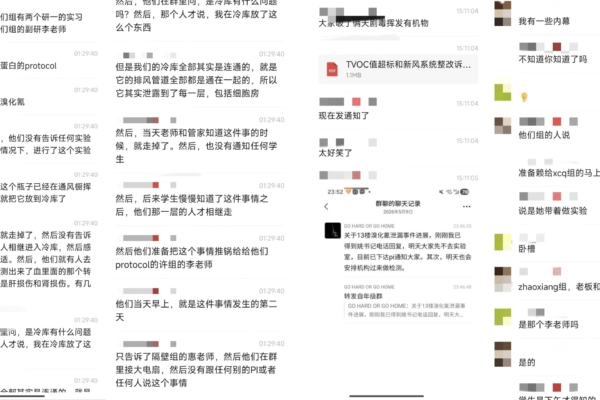
Shanghai university laboratory was reported to have a suspected chemical leakage incident recently. Several WeChat group chat screenshots revealed that two students conducted an experiment involving cyanogen bromide without reporting it, and placed related items into the connecting cold storage. Subsequently, many people experienced physical discomfort, with some individuals reportedly showing abnormal liver and kidney test results. The authorities have not yet made any public announcement regarding this suspected cyanogen bromide leakage incident.
Netizens uploaded around 10 pages of chat records, indicating that the incident took place in a university laboratory building in Shanghai. Multiple group members mentioned the “cyanogen bromide leakage incident on the 13th floor,” and stated that two “first-year graduate interns” requested an experiment protocol from an assistant researcher in a specific research group, then proceeded to conduct a “protein cleavage” experiment. The chat content showed that cyanogen bromide was used during the experiment.
According to the chat records, the two students did not inform the relevant laboratory personnel, completed the experiment on their own, mistakenly believed that the chemicals had completely evaporated in the fume hood, and then placed the related containers into the cold storage. Several chat participants mentioned that the cold storage was connected to the multi-layer laboratory ventilation system, and “the leak actually reached every floor, including the cell rooms.”
Zhejiang chemistry teacher Qin Xiumei, interviewed by a reporter from Dajiyuan, stated that cyanogen bromide is a highly toxic chemical, usually strictly regulated in laboratory management. Qin said, “If indeed students operated individually without complete reporting, it is no longer a simple operational mistake but a problem with laboratory management.”
One of the screenshots also displayed a PDF titled “TVOC Over Limit and New Air System Improvements.” Another chat record indicated that someone forwarded a notification saying, “Everyone should not go to the laboratory tomorrow,” and mentioned that arrangements would be made for an organization to conduct testing.
TVOC refers to Total Volatile Organic Compounds, commonly used to measure the level of chemical volatile pollution in the air.
In laboratories, chemical workshops, and enclosed spaces, high TVOC values usually signify the presence of high concentrations of volatile chemicals in the air. Short-term inhalation of high concentrations of volatile gases may lead to symptoms such as dizziness, nausea, chest tightness, and difficulty breathing; prolonged exposure in such an environment could potentially damage the liver, kidneys, and nervous system.
Qin Xiumei remarked, “Once cyanides enter the body, they interfere with the normal cellular oxygen utilization, potentially causing abnormalities in the respiratory and circulatory systems. If ventilation in the laboratory environment is inadequate, or if there is diffusion in enclosed spaces, the risks become higher.”
She added that cyanides are classified as highly toxic dangerous chemicals. According to the “Regulations on the Management of Hazardous Chemicals,” when incidents involving relevant substances leakage or personnel poisoning occur, the relevant units must promptly initiate emergency response measures and report to the supervisory authorities. She said, “In the event of such incidents, they should be reported immediately.”
In one chat record, a student mentioned that after some personnel entered the cold storage, they experienced physical discomfort, with some being sent for medical examination. Group members also noted, “The transaminase was detected to have issues, which indicates liver and kidney damage.”
The chat records revealed that no immediate public notification was made within the laboratory building after the incident occurred. Some group members expressed that, “When the teachers and superiors knew about it that day, they left.” Others said, “No students were informed.” Additional chat records indicated that the implicated laboratory was preparing to blame the teacher who provided the protocol.
In various parts of China, incidents involving cyanides in chemical plants and laboratories have occurred, leading to personnel poisoning and casualties. Due to cyanides being highly toxic hazardous chemicals, the Chinese Communist Party regulatory authorities mandate that relevant units establish specialized management, ventilation, and emergency reporting mechanisms. However, limited follow-up investigations and information disclosure have been seen after some incidents, with external notifications citing “toxic gases” or “abnormal chemicals” as reasons for the incidents.
Senior media figure from Henan, Mr. Yin, informed the reporter that authorities often prioritize social impacts over information disclosure and personnel safety in the event of major incidents or public safety accidents.
He stated, “I’ve encountered incidents of pesticide-contaminated water sources, batteries factories discharging wastewater into farmland, and the common people’s complaints being useless. I’ve been to places where farmland has been contaminated by heavy metal wastewater for a long time, and local farmers dare not consume the crops they grow, but have to sell them in town. Think about it, what would be the consequences when these things eventually enter ordinary households?”
Mr. Yin criticized that whenever sudden events occur, especially those related to public safety and can easily attract public attention, the authorities often prioritize “stability maintenance.”
He stated, “I strongly detest the term ‘stability maintenance,’ as it disregards life and treats ordinary people as mere tools. During the early stages of the 2003 SARS epidemic, the CCP concealed the epidemic; at the beginning of the COVID-19 epidemic, they initially suppressed and blocked information, and detained journalists. Whenever something happens, the CCP’s first reaction is not openness, but fear of disrupting stability. Why do many people now call COVID-19 the ‘CCP virus’? It’s because of their concealment.”
As of the time of writing, the organizations involved have not publicly explained the location of the aforementioned cyanogen bromide leakage incident, the chemicals involved, the number of affected individuals, or the test results. Information circulating on the internet primarily stems from internal chat screenshots, with the school authorities and regulatory departments withholding public responses regarding the situation.