
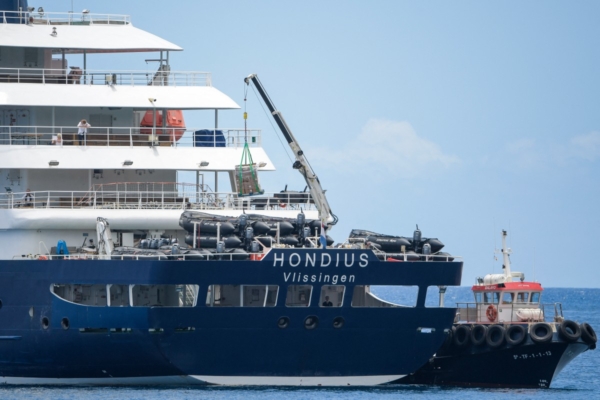
As the luxurious cruise ship MV Hondius, flying the Dutch flag, experienced an outbreak of the Hantan virus, countries around the world are urgently repatriating passengers. On Monday, May 11th, a French woman and an American tested positive for the virus, sparking high levels of international concern.
The MV Hondius recently docked at the port of Tenerife in the Canary Islands, Spain. Starting on Sunday, all passengers were escorted ashore by staff wearing full protective gear and respirators. The passengers, wearing blue medical uniforms, were then shuttled to the Tenerife South Airport by Spanish military buses to board repatriation flights arranged by various governments.
Maria Van Kerkhove, the head of outbreak response at the World Health Organization (WHO), stated that this is the first time an outbreak of the Hantan virus has occurred on a cruise ship. So far, three passengers have died. The WHO recommends countries to isolate and conduct “active follow-up” of evacuees for 42 days, including daily monitoring for symptoms such as fever.
Captain Jan Dobrogowski of the cruise ship praised both the crew and passengers for their resilience in a video message, saying, “I witnessed the care, unity, and calm strength displayed by everyone on board. In the toughest moments, the crew showed selfless determination.”
On the French front, Health Minister Stéphanie Rist confirmed on Monday that a French woman tested positive and her condition deteriorated overnight. She is currently receiving treatment in a specialized infectious disease ward in Paris. Authorities in France are closely monitoring 22 citizens who may have come into contact with the virus.
In the United States, among the 18 passengers who arrived in Omaha, Nebraska on a chartered flight, one tested positive without symptoms, while another exhibited mild symptoms.
The repatriation efforts are nearing completion. Spain has coordinated the evacuation of over 90 passengers, assuring that the repatriation process poses no risks to the local population.
Around 20 passengers have returned to the UK and are currently isolated at Arrowe Park Hospital in Merseyside.
Flights carrying Dutch and other nationalities have landed at Eindhoven Airport. Dutch passengers will undergo 6 weeks of home quarantine.
Canada has mandated 21 days of quarantine for 4 returning citizens, with the possibility of extending it to 42 days based on circumstances.
Mónica García, the Spanish Minister of Health, noted that due to scheduling issues with Australian flights, the remaining passengers will be evacuated via a Dutch flight. Currently, there are only around 50 people left on board, with 26 crew members returning to the Netherlands with the ship.
The Hantan virus is typically transmitted through rodent feces. The strain detected in this outbreak is the Andes virus, a rare type capable of human-to-human transmission. WHO Director-General Tedros Adhanom Ghebreyesus emphasized, “This is not another COVID-19. The public risk is extremely low, and there is no need for panic.”
The MV Hondius set sail from Ushuaia, Argentina on April 1st. It wasn’t until early May, when the cruise reached the waters near Cape Verde, that the outbreak was confirmed by the WHO, following the death of a Dutch passenger on April 11th. International efforts are now focused on preventing secondary transmission within countries.
(Some information in this article was referenced from the Associated Press.)