
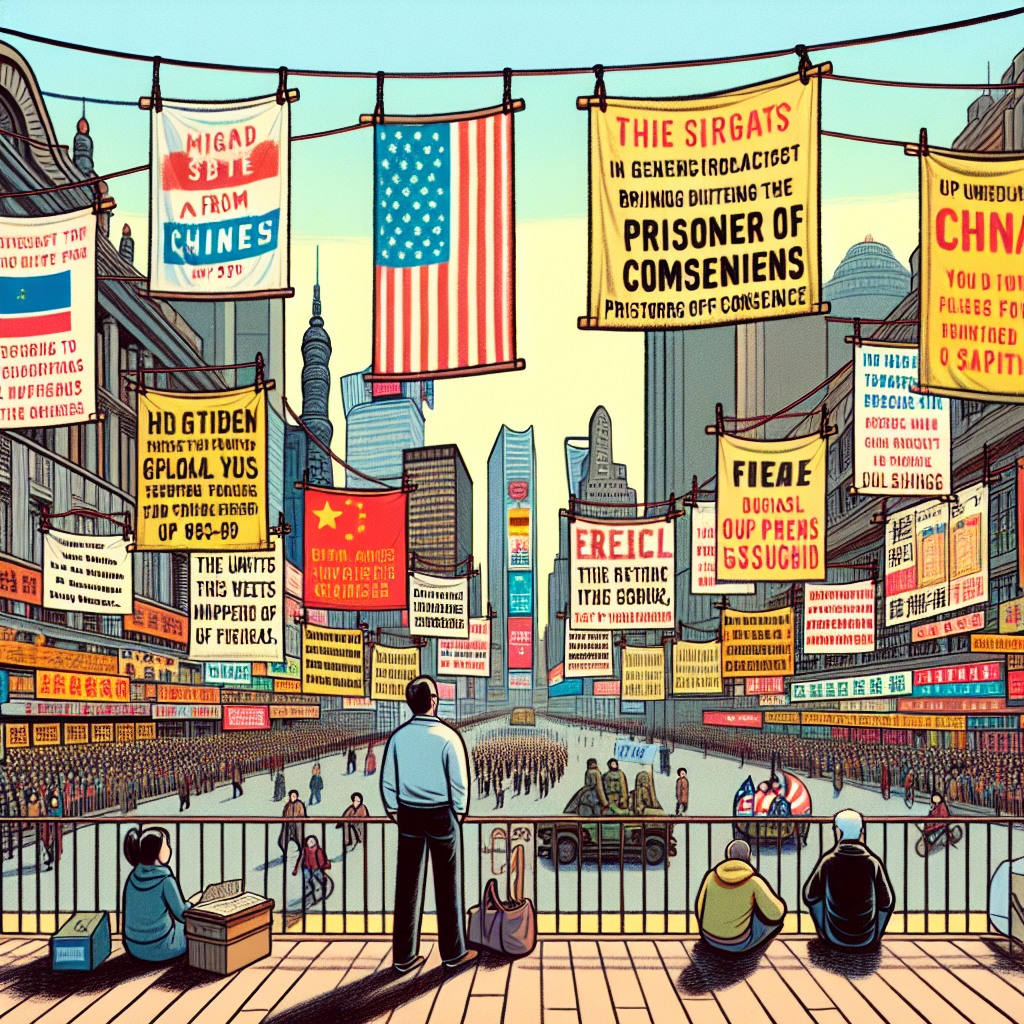
The United States President Trump is expected to visit China this week and meet with the Chinese Communist Party leader Xi Jinping. On May 9th, Shanghai residents hung banners urging Trump to pay attention to China’s poor human rights conditions and issues concerning prisoners of conscience during his visit.
Among those participating in hanging the banners were Shanghai residents Gu Guoping, Liu Dongbao, Song Jiahong, Chen Zhongmin, and Huang Zhengquan.
The United Nations General Assembly passed a resolution in 2019 designating April 5th as the “International Day of Conscience,” an important commemoration day for promoting global peace and sustainable development.
Song Jiahong told a reporter from Dajiyuan, “The so-called ‘prisoners of conscience’ are simply those who are punished for their words, which contradicts the United Nations declaration that ‘all human beings are born free.'”
He said, “Currently in Shanghai, the Chinese government can do whatever they want, without scrutiny from the people. Anyone who speaks up will be suppressed! Even those who travel to Beijing to express legitimate demands may end up in black jails or face criminal detention.”
He gave the example of Wu Fenghua, a petitioner from Pudong, who criticized the unjust actions of the Beijing Fangshan District Public Security Bureau online and offended certain individuals (officials). The Fangshan police directly came to Shanghai, arrested Wu Fenghua, and detained her for 58 days. “The oppression has reached a point where no one dares to speak out!”
He further stated, “We are all rights defenders with common aspirations. During President Trump’s visit to China, we want to raise our collective voice: ‘Focus on Chinese prisoners of conscience!’ This suppression of prisoners of conscience under the leadership of the Chinese Communist Party is inevitable. We have no other way out, so Trump’s visit gives us an opportunity to speak out, and we are thankful to President Trump!”
Having long been concerned about the Shanghai black jail incidents, Song Jiahong also sent a “human rights letter” to the U.S. Embassy in China, intended for President Trump, along with a list of verified Shanghai black jail cases. He hopes that Trump will pay attention to the dire human rights situation in Shanghai and even across the nation.
Gu Guoping told the reporter from Dajiyuan, “Prisoners of conscience are also referred to as political prisoners. Hong Kong’s Jimmy Lai is also a political prisoner of conscience. During Trump’s visit to China, he should address the issue of Jimmy Lai and demand that the Chinese authorities release him. We also urge Trump and the U.S. government to pay attention to the worsening human rights situation in our country, such as the crackdown on petitioners, black jails, criminal detentions, and even sentencing.”
Gu Guoping shared his 25-year-long experience as a rights defender, proving that Chinese petitioners have no human rights.
He said, “For example, in my case where I was forcefully evicted without proper housing, my parents were forced to death in nursing homes as a result. For 25 years, my rights protection efforts have not resolved the issue but subjected me to a series of persecutions, including being sent to black jails, criminal detentions, and sentencing.”
He added, “The recent incidents of retaliating against society in Beijing, Chongqing, Chengdu, Jiangxi, Guangdong, Guangxi, and other places demonstrate that the dire human rights situation imposed by the Chinese Communist Party is what leads to these unfortunate events. In addition to requesting Trump’s attention on China’s poor human rights conditions, we also urge him to specifically focus on the appalling human rights situation concerning prisoners of conscience, political prisoners, and rights defenders like us. Therefore, we hope that major overseas media outlets will pay attention and respond to our call!”