
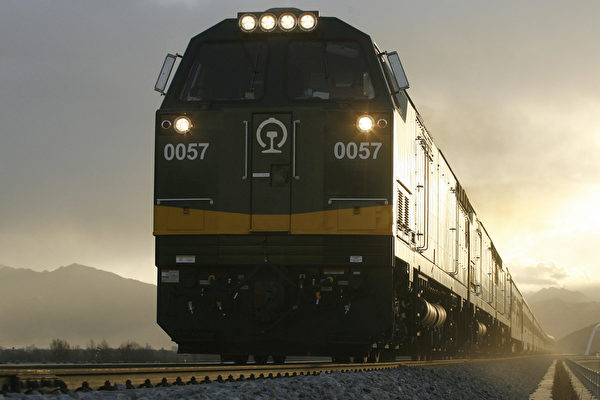
The United States has implemented a naval blockade on Iranian ports while Iran has begun accelerating the use of a land route railway leading to China, in an attempt to use it as a “back door” to evade sanctions. However, analysts point out that this route, which is part of Beijing’s “Belt and Road Initiative,” has extremely limited effectiveness in offsetting the losses from the blockade.
Amid the turmoil in the Strait of Hormuz caused by Iran, the U.S. Navy began the blockade operation about three weeks ago, aiming to cut off most of Tehran’s oil exports and block its crucial food imports. Iran’s economy has shown signs of collapse, with the currency Rial falling to a historic low.
Since the intensification of U.S. sanctions in mid-April, the freight train from Xi’an to Tehran has increased from a weekly service to one every three to four days. Driven by demand, the standard 40-foot container freight rate has surged to around $7,490, an increase of 40%. Altan Dursun, the General Manager of the Turkish Silkroad-Avrasya logistics company, told Bloomberg, “All slots for May are fully booked.”
This railway artery, approximately 10,400 kilometers long, starts from cities such as Xi’an and Yiwu in China, crosses Kazakhstan and Turkmenistan, and ends at Iran’s Aprin Land Port. The line has been operational since 2014, with significant upgrades completed in 2025. Currently, freight transport only takes 15 days, more than twice as fast as sea transport which takes 30 to 40 days.
Kambiz Etemadi, an official of the Iran National Shipping Association, optimistically estimates that Iran can redirect 40% of its maritime trade to the land route.
Despite Tehran’s optimistic outlook, data shows that the railway cannot support the lifeline of energy exports.
A Very Large Crude Carrier (VLCC) can carry between 1.9 to 2.2 million barrels of crude oil in one trip. In contrast, a professional oil tank railcar with 110 compartments can only carry about 70,000 barrels.
Energy News Beat, a professional analysis agency, points out that to match the capacity of one oil tanker, Iran would need 25 to 35 complete trains. Currently, the main cargo on this route is containers and high-value goods, with extremely limited bulk crude oil facilities.
Steve H. Hanke, a professor of economics at Johns Hopkins University, has poured cold water on the “land route substitution” theory. He believes that the railway currently only holds “political symbolic” significance. Due to the much higher freight costs compared to sea transport, it can only serve as a niche hedge for a daily scale of tens of thousands of barrels.
Analysts point out that Iran is adopting a multi-pronged evasion strategy, but each route has clear limitations, including land routes through Pakistan and Turkey.
Comparatively, road transport via Pakistan or Turkey appears to be more constrained: with cumbersome border procedures, outdated infrastructure, regional security risks, and a small scale, road transport can only handle small-scale essential goods like food and medicine, providing no assistance to Iran’s core energy exports.
These routes lack unified strategic coordination and centralized facilities. Faced with comprehensive U.S. sanctions, they can only play a sporadic infiltration role and cannot form a resilient logistics network.
Furthermore, Iran has invested billions of dollars to connect with Russia, aiming to open up routes between Europe and the Indian Ocean, but is currently hampered by the Russia-Ukraine conflict and incomplete infrastructure, making it less stable compared to the Chinese route.
Although the railway may not rescue the economy, it could potentially become a military lifeline. The bidirectional nature of freight trains allows products like electronic components from China, dual-use machinery, and even weapon systems to flow west into Iran, making it difficult for the U.S. military to intercept. The U.S. intelligence agencies have monitored potential transfers of drone parts and missile components via this covert channel.
Michael Sobolik, a researcher at the Hudson Institute, points out that Sino-Iranian relations are not unbreakable. Beijing has not fully implemented the agreement signed in 2021 to invest $400 billion in Iran over 25 years, primarily due to concerns about secondary U.S. sanctions.
Sobolik analyzes that Beijing’s trade and investment in Saudi Arabia and the UAE far exceed those in Iran. Beijing will not risk losing out on billions of dollars of cooperation with Arab countries in fields like AI and green energy to support a “strategic liability.”
The high cost and low capacity of the China-Iran railway determine that it “does not solve the core problem”; while other land routes are fragmented and inefficient, they do not even qualify as alternative solutions. After losing the main axis of maritime transport, these land attempts only serve to delay the suffocation of Iran’s economy.